Category Archives: fourfolds

John Buridan’s Octagon of Opposition

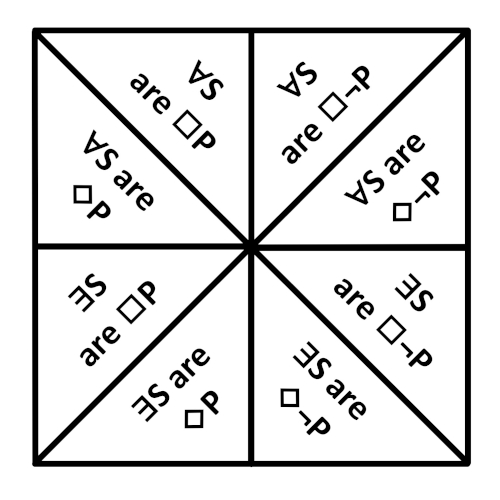
Medieval logician John (or Jean) Buridan was a scholar of Aristotle, and wrote many works of commentary and elaboration on Aristotelian philosophy. Several items in logic and philosophy are tied to Buridan (such as Buridan’s Bridge and Buridan’s Ass) but he may now be more widely known for his Octagon which combines Aristotle’s Square of Opposition with a Square of Modality.

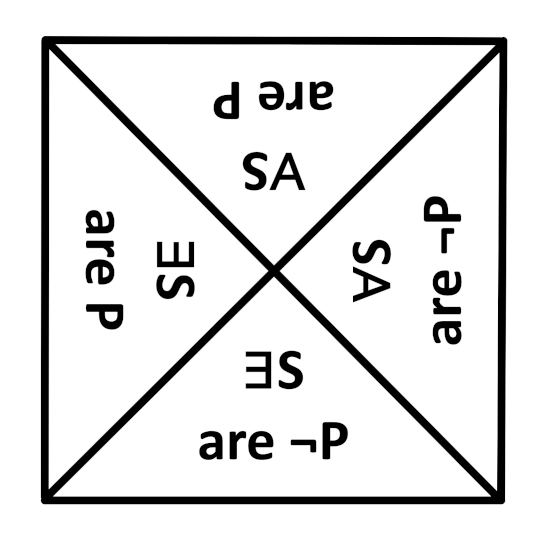
Below and to the right is a fourfold diagram of Aristotle’s Square of Opposition. The modern universal and existential (or particular) qualifiers are ∀ (meaning All) and ∃ (meaning Some), respectively. Also in these diagrams, ¬ means logical Not.

  • ∀ S are P
  • ∃ S are P
  • ∀ S are ¬ P
  • ∃ S are ¬ P

Next I show a fourfold of modal operators and their equivalents. The modern modal symbols are (meaning Necessarily) and or ◊ (meaning Possibly).

  • P ≡ ¬ ◊ ¬ P
  • ◊ P ≡ ¬ ¬ P
  • ¬ P ≡ ◊ ¬ P
  • ¬ ◊ P ≡ ¬ P


Further Reading:

https://en.wikipedia.org/wiki/Jean_Buridan

https://plato.stanford.edu/entries/buridan/

https://plato.stanford.edu/entries/medieval-syllogism/#JohnBuri

The Art of the Syllogism

Possibility and Necessity: An Introduction to Modality

https://en.wikipedia.org/wiki/Modal_logic

https://plato.stanford.edu/entries/logic-modal/

https://plato.stanford.edu/entries/modality-varieties/

https://lirias.kuleuven.be/retrieve/517366

Click to access Demey_DWMC2015_Buridan_Avicenna_slides.pdf

Click to access Buridan_Octagon.pdf

Click to access hughes-buridan.pdf

https://en.wikipedia.org/wiki/Buridan%27s_ass

https://en.wikipedia.org/wiki/Buridan%27s_bridge

https://en.wikipedia.org/wiki/Buridan_formula

[*12.144]

<>


What am I?

I am the Beginning of Everything,
I am the End of Time and Space,
I am the Beginning of Every End,
and the End of Every Place.

What am I? (Hint: the answer isn’t Four!)

Further Reading:

Other images of this riddle are here.

Such riddles remind me of the Song of Amergin.

https://en.wikipedia.org/wiki/Amergin_Gl%C3%BAingel

https://en.wikipedia.org/wiki/The_Dark_Is_Rising_Sequence

https://minbarigirl.livejournal.com/32873.html

[*12.146]

<>


The Square of Epictetus

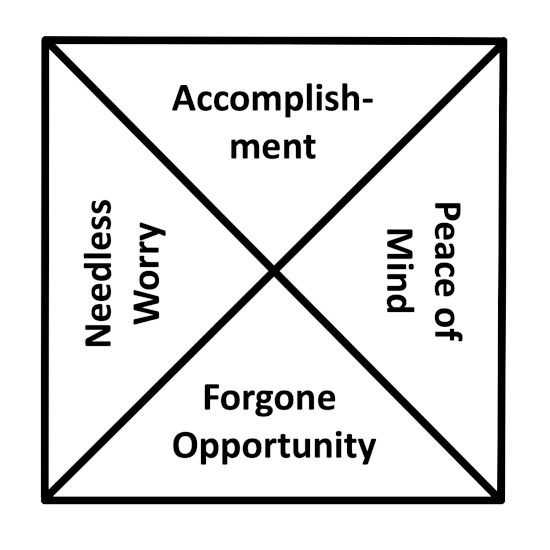
Here is a nice two-by-two matrix by engineer David E. Goldberg derived from the stoic philosophy of Epictetus. For each and every concern, it’s the cross product of one’s Activity (control vs. no control) and State of Mind (concerned vs. not concerned). And so we have the four combinations:

  • Concerned with Control: Accomplishment
  • Unconcerned with Control: Forgone Opportunity
  • Concerned but No Control: Needless Worry
  • Unconcerned and No Control: Peace of Mind

Of course the key is to dwell within the positive Accomplishment and Peace of Mind regions, and not to inhabit the negative ones of Needless Worry and Forgone Opportunity.

Further Reading:

http://entrepreneurialengineer.blogspot.com/2006/11/square-of-epictetus.html

https://www.linkedin.com/pulse/20141007110433-722904-worry-less-accomplish-more/

More Accomplishment, Less Worry: Follow the Epictetus Square

https://plato.stanford.edu/entries/epictetus/

Epictetus

<>


The Four Worlds of the Kabbalah

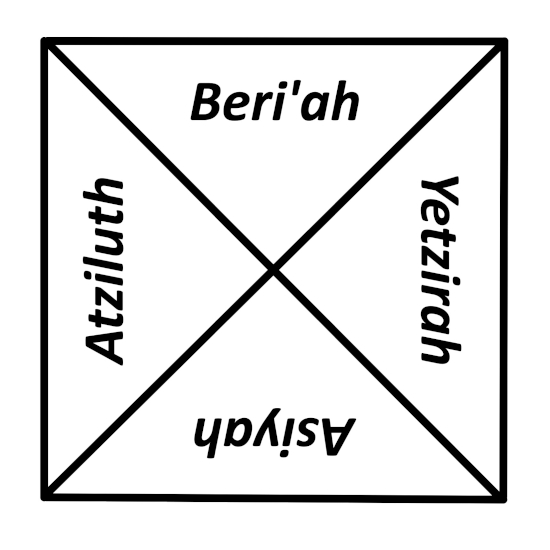
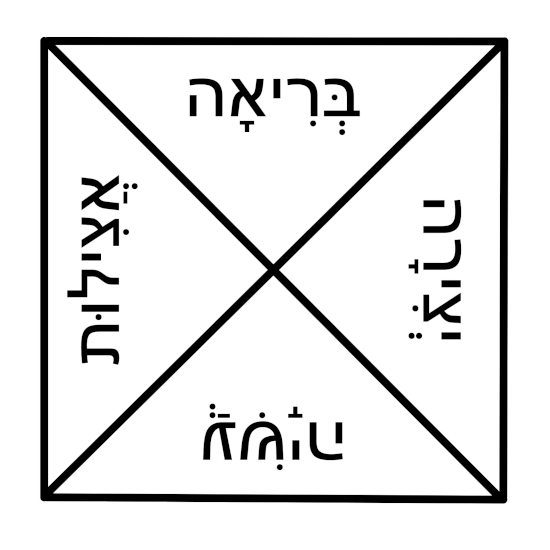
The Kabbalah (correspondence) is a traditional and esoteric school of thought in Jewish mysticism. The ten Sephirot (emanations) of the Kabbalah in the Tree of Life diagram can be divided into Four Worlds as follows, and correspond with the Four Suits of the Tarot and the Four Elements:

  • Atziluth (אֲצִילוּת): World of Emanation (Wands, Fire, Spirit)
  • Beri’ah (בְּרִיאָה): World of Creation (Swords, Air, Intellect)
  • Yetzirah (יְצִירָה): World of Formation (Cups, Water, Emotion)
  • Asiyah (עֲשִׂיָה): World of Manifestion (Disks, Earth, Action)


Further Reading:

https://en.wikipedia.org/wiki/Four_Worlds

https://en.wikipedia.org/wiki/Kabbalah

https://en.wikipedia.org/wiki/Tree_of_life_(Kabbalah)

And:

The Four Worlds

Four Worlds Judaism

http://www.yashanet.com/studies/revstudy/rev6.htm

Alan Bain’s Thirty Two Paths of Wisdom

Also:

https://en.wikipedia.org/wiki/Promethea

<>

The Art of Memory

Memory is the treasury and guardian of all things.

— Cicero

Before the internet and before even writing, memory served as the treasury and the guardian of the past, as the imagination served as the vanguard and the promise of the future. Today, our memory is weakened by the onslaught of the new and the now, leaving us open to attack from forgetfulness and apathy. Well-documented techniques of the past exercised our “artificial” memory, over and above that of our “natural” memory. One such method was the use of a “memory palace,” a spatial geography or edifice that enabled a visualization and recall of structural sequence, ornamented by real or imaginary decoration to link things or words into this order.

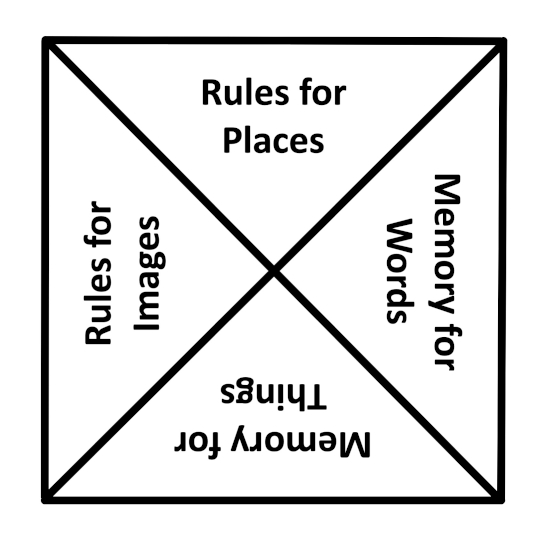
The art listed four main constituents: the rules for the places (or loci), the rules for the images, and (rules for) the memories of the things or the words to be remembered. As the art originated in antiquity, the records of its use and evolution come to us only in written or printed form. Perhaps this is like trying to reconstruct a living, breathing life-form from the bits and pieces of its fossilized body. And so, perhaps this arcane art was nothing like what we imagine it is today, but something else, rich and strange, that enabled techniques and skills beyond mere recall.

  • Rules for Places
  • Rules for Images
  • Memory for Things
  • Memory for Words

And so as Plato recounts Socrates’ dialog with Phaedrus, wherein Thamus says to Thoth, inventor of the written word:

This discovery of yours will create forgetfulness in the learners’ souls, because they will not use their memories; they will trust to the external written characters and not remember of themselves. The specific which you have discovered is an aid not to memory, but to reminiscence, and you give your disciples not truth, but only the semblance of truth; they will be hearers of many things and will have learned nothing; they will appear to be omniscient and will generally know nothing; they will be tiresome company, having the show of wisdom without the reality.

Further Reading:

https://en.wikipedia.org/wiki/Art_of_memory

https://en.wikipedia.org/wiki/The_Art_of_Memory

https://artofmemory.com/wiki/Main_Page

Frances Yates / The Art of Memory

https://plato.stanford.edu/archives/spr2018/entries/mental-imagery/

Daniel J. Boorstin / The Lost Arts of Memory
The Wilson Quarterly, Vol. 8, No. 2 (Spring, 1984), pp. 104-113
https://www.jstor.org/stable/40256753

https://en.wikipedia.org/wiki/Giordano_Bruno

event-state2

<>
The Quaternion Poetry of Anne Bradstreet

The former four now ending their discourse,
Ceasing to vaunt their good, or threat their force.
Lo other four step up, crave leave to show
The native qualityes that from them flow:
But first they wisely shew’d their high descent,
Each eldest daughter to each Element.

— From The Four Humours in Man’s Constitution, by Anne Bradstreet

As a young puritan poet, Anne Bradstreet (1612-1672) wrote several poems in fourfold arrangements, dealing with fourfold topics, she called Quaternions.

    • Four Elements
    • Four Seasons
    • Four Humours
    • Four Life Ages

She later added another to her oeuvre, writing one dealing with Monarchies or Empires.

Further Reading:

https://en.wikipedia.org/wiki/Anne_Bradstreet

https://en.wikipedia.org/wiki/Quaternion_(poetry)

https://www.poetryfoundation.org/poets/anne-bradstreet

https://reslater.blogspot.com/2013/02/anne-bradstreet-four-humours-in-mans.html

Anne Hildebrand / Anne Bradstreet’s Quaternions and “Contemplations”, Early American Literature, Vol. 8, No. 2 (Fall, 1973), pp. 117-125 (9 pages)
https://www.jstor.org/stable/25070614

Jane Donahue Eberwein / The “Unrefined Ore” of Anne Bradstreet’s Quaternions, Early American Literature, Vol. 9, No. 1 (Spring, 1974), pp. 19-26 (8 pages)
https://www.jstor.org/stable/25070645

Jane D. Eberwein / Civil War and Bradstreet’s “Monarchies”, Early American Literature, Vol. 26, No. 2 (1991), pp. 119-144 (26 pages)
https://www.jstor.org/stable/25056854

https://web.archive.org/web/20110708061310/http://quaternionpoetry.blogspot.com/

<>

How to Solve It

“How to Solve It” (first published in 1945) is a small volume by mathematician George Pólya describing methods of problem solving.  The book suggests the following steps when solving a mathematical problem:

1. Understand the problem.
2. Devise a plan to solve it.
3. Carry out the plan.
4. Revise and extend: look back on your work.

Further Reading:

https://en.wikipedia.org/wiki/How_to_Solve_It

https://en.wikipedia.org/wiki/Heuristic

<>


Yonkoma

From Wikipedia:

Yonkoma manga (4コマ漫画, “four cell manga” or 4-koma for short), a comic strip format, generally consists of gag comic strips within four panels of equal size ordered from top to bottom.

And also:

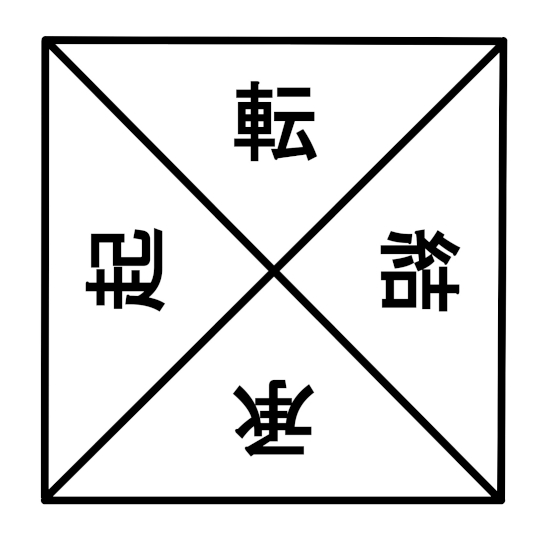
Traditionally, yonkoma follow a structure known as kishōtenketsu. This word is a compound formed from the following Japanese kanji characters:

    • Ki (起): The first panel forms the basis of the story; it sets the scene.
    • Shō (承): The second panel develops upon the foundation of the story laid down in the first panel.
    • Ten (転): The third panel is the climax, in which an unforeseen development occurs.
    • Ketsu (結): The fourth panel is the conclusion, in which the effects of the third panel are seen.

Further Reading:

https://en.wikipedia.org/wiki/Yonkoma

https://en.wikipedia.org/wiki/Kish%C5%8Dtenketsu

[*12.3]

<>

The Golden Ratio

Here are shown various ways to write the Golden Ratio, a favorite theme of mathematical recreation and investigation:

  • The equality of two ratios of simple algebraic quantities in two unknowns
  • The infinite limit of the ratio of successive Fibonacci numbers
  • In an infinite continued fraction representation
  • As a specific irrational number involving the square root of five (but cross multiply and 4 = 4 is explicit)

These instances remind me a bit of the Four Causes in their representations:

  • Relative and relational, but indefinite (Efficient)
  • Idealized as an infinite sequence and infinite completion (Formal)
  • Infinitely nested and recursively reductive (Material)
  • Definite but with embedded irrationality (Final)

Further Reading:

https://en.wikipedia.org/wiki/Golden_ratio

https://en.wikipedia.org/wiki/Fibonacci_number

https://en.wikipedia.org/wiki/Irrational_number

[*12.92]

<>

Four Dimensions of Knowledge

What is the best way to educate, to teach and learn? Ideally, students shouldn’t merely memorize facts and recall them on demand, although retaining well accepted knowledge is important. Certainly, students need mental structures to organize these facts, so that they form associated groups of categories and classification. Additionally, methods are needed for accepting and rejecting facts, and procedures for organizing facts, although facts may often be revisited for truth, or to reorganize them, and so on.

Benjamin Bloom et al. developed a taxonomy for educators of six mental aspects for the acquisition of knowledge, which was revised later into six cognitive actions or processes by L. Anderson, B. S. Krathwohl and others. These six actions form a sort of food pyramid for knowledge, so that lower actions form a broader base for higher ones. Both taxonomies sort a dimensional hierarchy of knowledge operated by these aspects or actions from concrete to abstract: Factual, Conceptual, Procedural, and Metacognitive (the last added when revised).

In the revised taxonomy, “Remember” is the lowest cognitive action, described by “remember facts and basic concepts,” which deals with the Factual and Conceptual. Above it is “Understand,” described by “explain ideas or concepts,” and I imagine an idea can be a fact. Next is a procedural action “Apply: use information in new situations,” and in fact all six actions are procedural by being actions. At the top of the pyramid is “Analyze,” “Evaluate,” and “Create”. The Metacognitive dimension (“thinking about thinking”) is for thinking about these six actions and these four dimensions, as to how they are related and differ.

These taxonomies are well considered and there are many resources to investigate.

Further Reading:

http://edtheory.blogspot.com/2016/03/knowledge-dimensions-factual-conceptual.html

Bloom’s Taxonomy

https://www.celt.iastate.edu/teaching/effective-teaching-practices/revised-blooms-taxonomy/

Bloom’s Taxonomy Revised

https://www.goconqr.com/en/mindmap/12973371/four-types-of-knowledge

Pedagogy of book and chapter organization

Click to access krathwohl.pdf

Anderson, L., Bloom, B. S., Krathwohl, D., & Airasian, P. (2000). Taxonomy for learning, teaching and assessing: A revision of Bloom’s Taxonomy of Educational Objectives (2nd ed.). New York: Allyn & Bacon, Inc.

Anderson, L. W., Krathwohl, D. R., Airasian, P. W., Cruikshank, K. A., Mayer, R. E., Pin- trich, P. R., … & Wittrock, M. C. (2001). A taxonomy for learning, teaching, and assessing: A revision of Bloom’s taxonomy of educational objectives, abridged edition. White Plains, NY: Longman.

https://en.wikipedia.org/wiki/Metacognition

https://en.wikipedia.org/wiki/Concept

https://plato.stanford.edu/entries/concepts/

https://iep.utm.edu/th-th-co/


https://en.wikipedia.org/wiki/Cognition

https://plato.stanford.edu/entries/innateness-cognition/

[*12.84]

<>