Category Archives: alchemy

Graham Harman’s Quadruple Object, V2

The world is made up of a basic set of polarities – four of them, it turns out. They cannot be derived from a single radical root, but neither do they exist as incorruptible elements untransmutable into one another in the manner of the Empedoclean air, earth, fire and water.

— From Prince of Networks by Graham Harman

sq_harman

Objects exist as autonous units, but they also exist in conjunction with their qualities, accidents, relations, and moments without being reducible to these. To show how these terms can convert into one another is the alchemical mission of the object-oriented thinker.

— From Prince of Networks by Graham Harman

sq_harman2

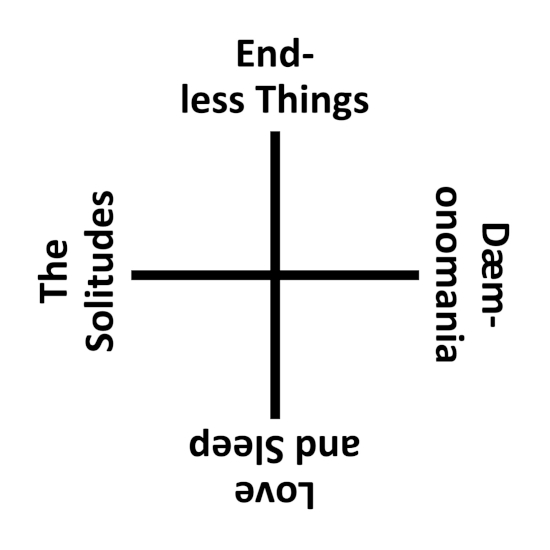
I have made an attempt at orienting Graham Harman’s fourfold of real object, sensual object, real qualities, and sensual qualities with respect to the other fourfolds presented here. The fourfold object emerges from Harman’s analysis of Heidegger’s das Geviert.

References:

Graham Harman / Guerrilla Metaphysics: phenomenology and the carpentry of things

Graham Harman / Prince of Networks: Bruno Latour and metaphysics

Graham Harman / The Quadruple Object

[*6.46, *6.48, *6.62, *7.40, *7.132, *7.133]

<>

Ægypt Tetralogy

AEgypt is a literary work by John Crowley consisting of four novels published over a period of twenty years. Each of the four books is divided into three parts, and the twelve parts are named after the astrological houses.

Many occult, alchemical, and esoteric themes run through the novels, and one might describe the work as being “magical realism”. Many of the magical elements are told as “a book within the book” about British occultist Doctor John Dee and Italian heretic Giordano Bruno. Even though some of the magical events occurring in the past and described within the novels seem to be actually magical, by the time the novels end the age of magic is now over, and the last magical event seemed to erase the fact that magic ever was.

The ending of the last book makes several references to Shakespeare’s “The Tempest”.

Further Reading:

http://en.wikipedia.org/wiki/%C3%86gypt

Some very useful reviews of the first three books can be found below.

http://watershade.net/wmcclain/jc-index.html

http://en.wikipedia.org/wiki/House_%28astrology%29

http://www.latimes.com/features/la-bkw-park7oct07,0,4224148.story#axzz2lmoAGKzp

http://www.latimes.com/features/la-bkw-park4nov04,0,6059163.story#axzz2lmoAGKzp

<>

The Medicine Wheel

The Native American Medicine Wheel is a symbol system that associates several fourfolds together, such as the Four Seasons, the Four Cardinal Directions, the Four Elements, etc. Another fourfold that does this is the Four Temperaments.

There should be a good word for this amalgamation of fourfolds into one hyper- or mega- or uber- fourfold. What about quadriphilia? No, that’s just love of fours, but it is in the Urban Dictionary. Quadrasyncretism? I like the neologism tetrasyncretism, from tetra meaning four, and syncretism, meaning combining different (or many) beliefs into one.

The aspect of the Medicine Wheel illustrated above is similar to the Four Temperaments.

The colors Red, White, Black, and Yellow are important for the Medicine Wheel. The colors often occur in a certain order within quadrants of the circle of the wheel. The colors also correspond to the Four Seasons: Black for Autumn, White for Winter, Yellow for Spring, and Red for Summer, although there can be other mappings.

These same four colors are also important in alchemy and represent stages of the Magnus Opus or Great Work, where Red is Rubedo or Iosis, White is Albedo or Leukosis, Black is Nigredo or Melanosis, and Yellow is Citrinitas or Xanthosis. The order is usually Black, White, Yellow, and then Red, through beginning to ending stages of the work.

In addition, the current anime RWBY has characters with these main costume colors. Apparently it is a story with some magic and much fighting with large weapons by four young women.

Further Reading:

http://en.wikipedia.org/wiki/Medicine_wheel

http://en.wikipedia.org/wiki/Magnum_opus_%28alchemy%29

http://en.wikipedia.org/wiki/Cardinal_direction

http://en.wikipedia.org/wiki/RWBY

Angeles Arrien / The Four-Fold Way: Walking the Paths of the Warrior, Teacher, Healer, and Visionary

Google search for images of the Medicine Wheel.

Google search for images of the Four Cardinal Directions.

[*7.194, *8.12]

<>


The Tempest and Forbidden Planet

To work mine end upon their senses that
This airy charm is for, I’ll break my staff,
Bury it certain fathoms in the earth,
And deeper than did ever plummet sound
I’ll drown my book.

Prospero from The Tempest

In times long past, this planet was the home of a mighty, noble race of beings who called themselves the Krell. Ethically and technologically they were a million years ahead of humankind, for in unlocking the mysteries of nature they had conquered even their baser selves, and when in the course of eons they had abolished sickness and insanity, crime and all injustice, they turned, still in high benevolence, upwards towards space. Then, having reached the heights, this all-but-divine race perished in a single night, and nothing was preserved above ground.

Dr. Morbius from Forbidden Planet


Further Reading:

http://en.wikipedia.org/wiki/The_Tempest

http://en.wikipedia.org/wiki/Forbidden_Planet

http://en.wikipedia.org/wiki/Return_to_the_Forbidden_Planet

https://grg.org/charter/Krell2.htm

[*7.154, *8.11]

<>

The Four Temperaments

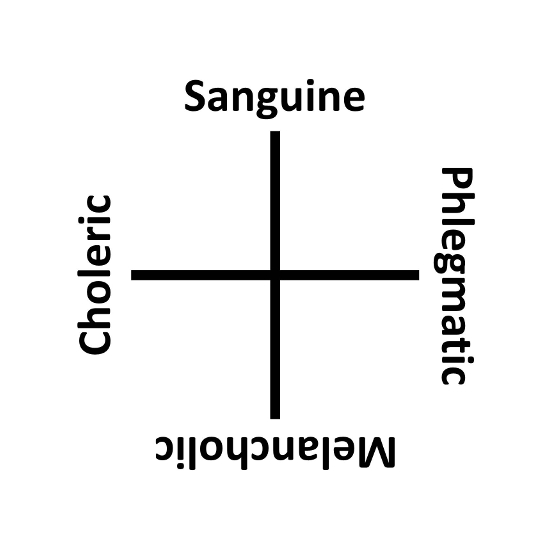
What would a list of fourfolds be without mentioning the Four Temperaments: Sanguine, Choleric, Melancholic, and Phlegmatic?

Indeed, these personality types from ancient medicine and philosophy are still a source of classification and inspiration for modern psychology, even though the reasons for the differences (the four humors) has been discredited. The four humors were blood, yellow bile, black bile (they were big on bile), and phlegm, and were also related to the Four Seasons and the Four Elements.

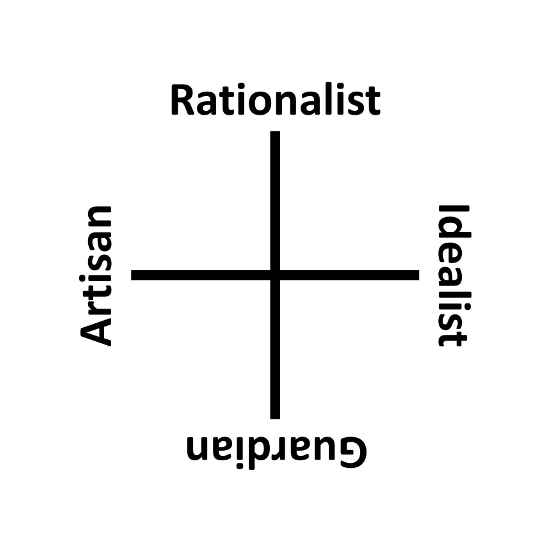
Below is psychologist David Keirsey’s modernization of the four temperaments, consisting of Idealist, Artisan, Guardian, and Rationalist.

References:

http://en.wikipedia.org/wiki/Four_temperaments

http://en.wikipedia.org/wiki/Humorism

http://en.wikipedia.org/wiki/Myers-Briggs_Type_Indicator

http://en.wikipedia.org/wiki/David_Keirsey

http://en.wikipedia.org/wiki/Keirsey_Temperament_Sorter

https://en.wikipedia.org/wiki/The_Four_Temperaments_(ballet)

Images of the Four Temperaments.

[*6.122, *6.123, *7.194, *8.14, *8.94, *8.139]

<>


A Vision by W. B. Yeats: The Four Faculties

A Vision by W. B. Yeats is the focus of a large amount of scholarship for a book on the occult. It looks interesting as a source of metaphor and symbolism, and I hope to return to it at another time. There is an excellent website devoted to Yeat’s Vision, the link of which is below.

Above I show the fourfold of the Faculties: Will, Body of Fate, Mask, and Creative Mind. It is not arranged as recommended by the four elements, but by my whim.

I saw a preview of the recent movie “Kill Your Darlings” which mentioned A Vision and showed the woodcut of the Cosmic Wheel.

Further Reading:

http://en.wikipedia.org/wiki/A_Vision

http://www.yeatsvision.com/

Neil Mann, Matthew Gibson, and Claire Nally, eds. / Yeats’s “A Vision”: Explications and Contexts

https://academic.oup.com/liverpool-scholarship-online/book/43466#login-purchase

[*7.200]

<>


Equivalent Exchange

There is an old riddle that asks, what is the value of a human body? It goes on to enumerate the quantities of the various chemicals that constitute an average body, and then price those chemicals to come up with a total material value. This might come as a shock to the one who tried to answer the riddle, because the value is so low.

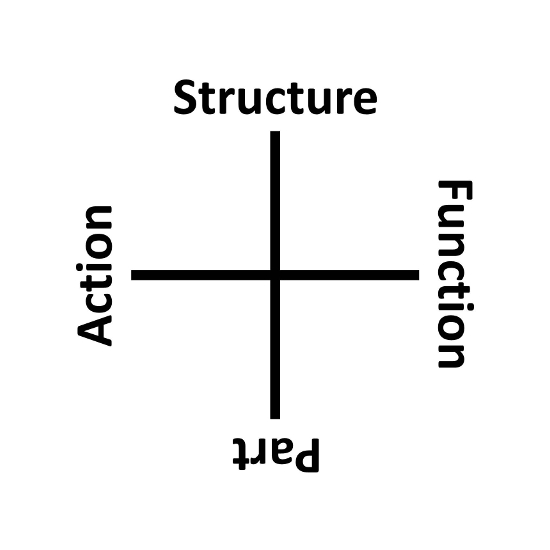
Of course that analysis ignores the real value of the body because it ignores the spatial arrangement of those chemicals in the various tissues and organs of the body. It ignores the form of the body as an hierarchical arrangement of structured parts. These parts are very valuable for someone needing an organ donation, for example.

This static analysis is lacking as well because it neglects the dynamic actions that a body can perform. Taken as a set of discrete individual acts, this is like considering the individual chemicals that constitute a body. One can enumerate the acts too, as in counting the number of breaths or the number of heart beats over a lifetime.

But we are still not finished, because this enumeration of actions also overlooks the functions that a body can perform, as arrangements of actions in time. These functions are the most important value of a body because they include but are not limited to being alive, thinking, and feeling.

So it seems to me that there is a heirarchy here, that goes from parts to structure to actions to function, with parts being at the lowest level and function being at the highest. Each level of the hierarchy is dependent on the level below, but the nature of a level is fundamentally different from the level below it, as well as the level above it. Please see my previous post Structure-Function.

The term “equivalent exchange” comes from an alchemy-centric anime, where through a process called “human transmutation” it is attempted to recreate a body starting from a pile of the basic chemicals that constitute it. Even with some high-powered magic, the attempt fails due to the fact that much more is required to fashion a body or even a living, breathing person.

Further Reading:

http://chemistry.about.com/b/2011/02/06/how-much-are-the-elements-in-your-body-worth.htm

http://www.datagenetics.com/blog/april12011/index.html

https://briankoberlein.com/post/four-elements/

<>

Fourfolds and Double Duals, Part 2

In addition to the symbolic fourfold presented in the previous entry Fourfolds and Double Duals, which includes the alchemical symbols for the four elements, here is another generic representation. This fourfold reminds me of the fourfolds Bright-Light-Dim-Dark shown in the early entry with the Four Elements, as well as the newer fourfold of The One and the Many.

If one considers the outer ring and the inner circle to be “outer-as-inner”, then this fourfold is related to the One and the Many by letting One be white and Many be black.

Additionally, the symbols can be seen to map to the fourfold Bright-Light-Dim-Dark by noting that White-as-White is Bright, White-as-Black is Light, Black-as-White is Dim, and Black-as-Black is Dark.

For fun, this figure can be tweaked to reveal a deconstructed yin yang. It reminds me of John Dee’s Hieroglyphic Monad. Or someone holding a Vulcan Lirpa from Star Trek’s Amok Time.

References:

http://en.wikipedia.org/wiki/Monas_Hieroglyphica

Notes:

Amusingly, I’m starting to think of the lower figure as a crossed fork and spoon: a fork to separate and a spoon to combine. Note the handles of the utensils (the circles) appear to be switched, but that is just the way it is.

Also: a c & t’s mouth and c t’s eye; a d g’s nose and d g’s eye. These are the binary operators of Linear Logic!

<>

Fourfolds and Double Duals

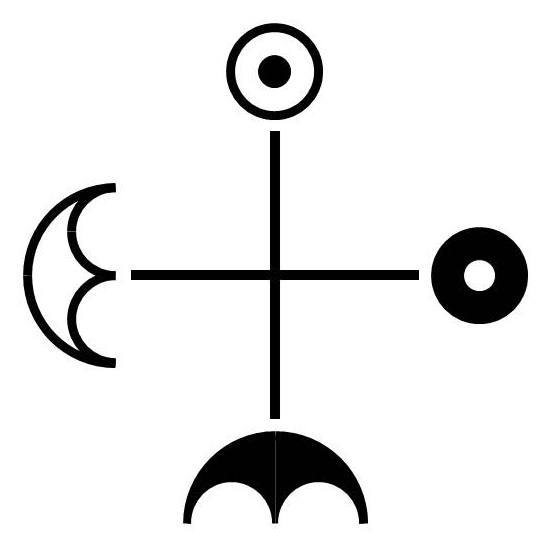
For every aspect of the world that someone has thought to analyze into its components, it probably has been suggested to divide it into four parts. I suggest that many of the things that have a fourfold form, are a fourfold in the same way. Not in the trivial cardinal sense, but in a deeper structural sense. They are a combination of two dualities, a double dual if you will, such that one dual operates as interior and exterior, or true and false, a duality of opposites, and another (dual) dual operates as one and many, or unity and multiplicity, or discreteness and continuity, a duality of numeracy.

I have been gathering fourfolds for a time, and have written about some more than others. Some have been around a long time, and others I’ve been inspired to fashion. I have tried to orient them all in the same way to accentuate their common deep structure. For example, everything in the left position in the diagrams have a commonality across fourfolds, as does everything in the lower, upper, and right positions. The four ancient symbols shown in the diagram above represent the four elements of alchemy: fire, earth, air, and water.

Because of these relations between the fourths and the halves of these fourfolds, I have choosen the name “Equivalent Exchange”. In addition, the fourfolds themselves might be “equivalently exchangable” with each other because of their common deep structure. For many reasons, I believe that the best exemplar for these fourfolds is the recent logical system known as Linear Logic, which has two combining binary operators and two dividing binary operators.

Others before me have reached similar hypotheses about fourfolds in general, and I am grateful for their scholarship. I hope others will follow, and I’m sure they will present their findings more eloquently and convincingly than I have.

References:

http://en.wikipedia.org/wiki/4_%28number%29

http://www.samuel-beckett.net/Penelope/four_symbolism.html

http://www.unterzuber.com/4our.html

<>

Bending the Elements

You and your forefathers have devastated the balance of this world. And now, you shall pay the ultimate price!

— From Avatar: the Last Airbender

I recently finished watching the animated series “Avatar: the Last Airbender”. I know I’m a bit late with my praise, but I thought this was an excellent series. It had fascinating world-building, well thought-out plotting, and believable characterization. It had humor, drama, fantasy, even teen romance. Something for all ages!

It could be because I’ve been thinking alot about the Four Elements and how I view them as analogies for the four relations I’ve been discussing for some time on this blog. In Avatar, they are literally the four elements of the world: fire, earth, water, and air. But in addition, these elements correspond to the four peoples of this world. The people of the Fire Nation are willful, the people of the Earth Kingdom are resolute, the people of the Water Tribe are empathic, and the people of the Air Nomads are reflective. Some individuals are able to “bend” the element that is associated with the people they are born into, so that for example a member of the Fire Nation might be able to produce and control fire with thought and gesture. Not everyone has this ability, however.

The Avatar is a continuously reincarnated individual that embodies the spirit of the world. He or she is born into each of the four peoples in a repeating cycle, but the Avatar is also the only individual that can learn to bend all four elements, and even all at the same time. Because of his or her unique powers, the Avatar is known to be able to bring and restore balance to the world, and to tie the real world to another, spiritual world. Avatar: the Last Airbender is the story of Aang, a descendent of the Air Nomads, but the last of his people due to genocide. He has been in a state of suspended animation for the last 100 years and awakes to a troubled world of war and turmoil. Can Aang save his world?

Hopefully I’m not spoiling anything in saying that he does. Indeed a sequel is currently being produced called “The Legend of Korra” that is planned to run 52 episodes. This sequel takes place a number of years after the end of Avatar, and the next Avatar after Aang is Korra from the Southern Water Tribe. The world is now somewhat more advanced technologically than it was during Aang’s time, and although not at war because it is still enjoying the peace that Aang initiated, there is still some strife and unrest for Korra to eventually bring the Avatar’s balance to. I am enjoying it also!

http://en.wikipedia.org/wiki/Avatar:_The_Last_Airbender

http://en.wikipedia.org/wiki/The_Legend_of_Korra

Note:

It is interesting to note that fire is the only element that can be generated by the will ex nihilo. With enough skill, water can be extracted from living matter and the air. Of course, air is ever present and earth is seldom far away.

<>