
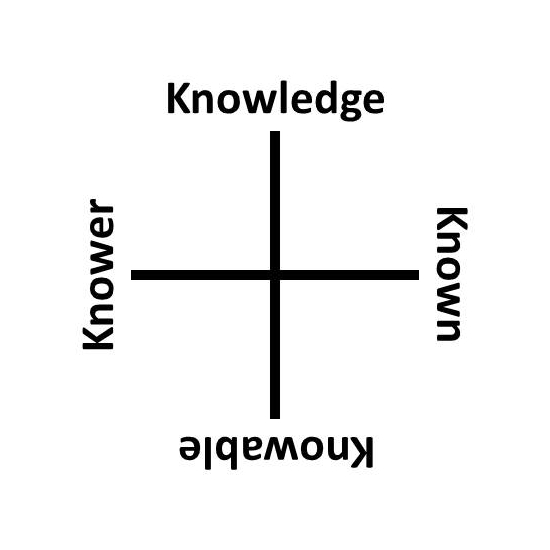
 Richard McKeon’s system of Philosophical Semantics arises from the sixteen pairwise and ordered relations between his four aspects of knowing or cognates: knower, knowledge, the known, and the knowable. These sixteen relations can be sorted in four groups of four elements each: methods, interpretations, principles, and selections.
Between knower and knowledge, and between the knowable and the known, arise the four methods of two each: the universal and the particular.
- From knower to knowledge, the operational method.
- From knowledge to knower, the dialectical method.
- From the knowable to the known, the logistic method.
- From the known to the knowable, the problematic method.
Between knower and the known, and between the knowable and knowledge, arise the four interpretations of two each: the phenomenal and the ontic.
- From knower to the known, the existential interpretation.
- From the known to knower, the essential interpretation.
- From the knowable to knowledge, the entitative interpretation.
- From knowledge to the knowable, the ontological interpretation.
Between knower and the knowable, and between knowledge and the known, arise the four principles of two each: the meroscopic and the holoscopic.
- From knower to the knowable, the actional principle.
- From the knowable to knower, the simple principle.
- From knowledge to the known, the comprehensive principle.
- From the known to knowledge, the reflexive principle.
Between each of the aspects of knowing with itself, arise the four selections.
- From knower to itself, the perspectival selection.
- From knowledge to itself, the transcendental selection.
- From the knowable to itself, the reductive selection.
- From the known to itself, the functional selection.
Each method can be associated with a discursive process: operational with debate, dialectical with dialogue, logistic with proof, and problematic with inquiry. Each method is also associated with a mode of thought which in turn has two moments and one dependency or assumption: the operational method is debate by discrimination and postulation dependent on chosen theses, the dialectical method is dialogue by assimilation and exemplification dependent on changeless models, the logistic method is proof by construction and decomposition dependent on indivisible constituents, and the problematic method is inquiry by resolution and question dependent on discoverable causes.
References:
Richard McKeon / On Knowing–The Natural Sciences
Richard McKeon / Freedom and History and Other Essays: an introduction to the thought of Richard McKeon
Sadly, the following pages are no longer available:
http://net-prophet.net/mckeon/mckeon.htm
http://forums.abrahadabra.com/showthread.php?2331-Unifying-Astrology-and-I-Ching
[*4.47, *5.184-*5.187, *6.20, *6.106]
<>


 Equivalent Exchange