All posts by Martin K. Jones

Kant’s Analytic-Synthetic Distinction

One of the oldest and most problematic philosophical questions is the comparison of the a prioria posteriori distinction with that of the analyticsynthetic distinction. Both are used in epistemology to divide knowledge, or true statements, between the innate and the learned, or the immediate and the earned, so they might even be considered the same. A priori and a posteriori statements are before “experience” and after it, respectively. Analytic statements are true only by their “meaning”, whereas synthetic statements are true only when facts about the world are combined consistently with that meaning.

It seems we have complicated the issue because now we must define and understand “experience” and “meaning”. However, these concepts are not independent because we must experience meaning, and meaning in turn conditions experience. In addition, even the a priori or the analytic are not innate or immediately obvious because deductions and the rules of logic require effort just like inductions do. Otherwise we would have Fitch’s Paradox: all truths are in fact known. What a muddle! So both experience and meaning are necessarily locked into a cooperative spiral dance to improve each other.

Even so, these two distinctions can be distinguished and combined into a fourfold.

The web site of Stephen R. Palmquist has a great wealth of material on fourfolds in relation to Kant’s as well as his own philosophy. From my own initial reading of his extensive material I have tried to choose a canonical Kantian fourfold which has the most relevance to my project.

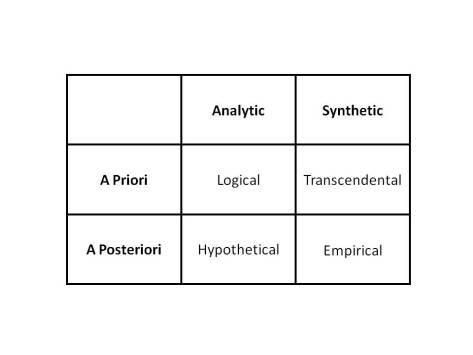
The fourfold shown to the right Dr. Palmquist calls Kant’s “reflective perspectives on experience”. Consisting of the logical, the empirical, the transcendental, and the hypothetical, these facets bear a close analogical likeness to many of the fourfolds presented here.

Logical: Analytic a priori
Transcendental: Synthetic a priori
Hypothetical: Analytic a posteriori
Empirical: Synthetic a posteriorikant_table
Dr. Palmquist also has many of his own books available on his web site for the interested reader. I will certainly be returning to his web site in the future for much enjoyable study.

Links:

http://en.wikipedia.org/wiki/Analytic-synthetic_distinction

http://en.wikipedia.org/wiki/A_priori_and_a_posteriori

http://plato.stanford.edu/entries/analytic-synthetic/

A Priori and A Posteriori

http://plato.stanford.edu/entries/fitch-paradox/

http://www.philosophypages.com/hy/5f.htm

http://www.hkbu.edu.hk/~ppp/

http://www.hkbu.edu.hk/~ppp/ksp2/KCR3.htm

[*8.126]

<>
 

Off to See the Wizard

sq_wizard_ozIf the Wizard is a Wizard who will serve.
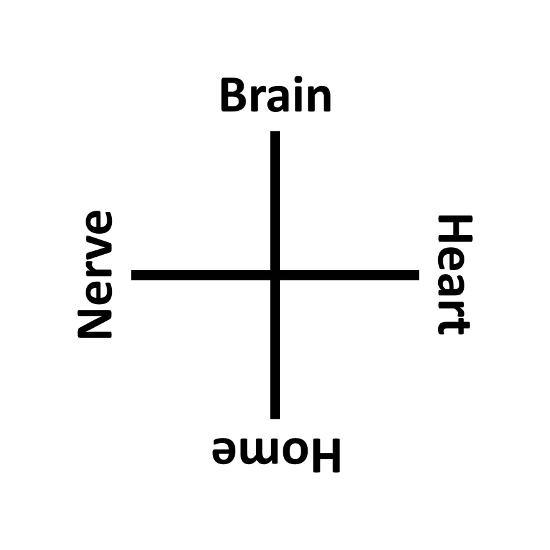
Then I’m sure to get a brain; a heart; a home; the nerve!

From the film The Wizard of Oz

Links:

http://en.wikipedia.org/wiki/If_I_Only_Had_a_Brain

Brains, heart, courage and home: Principles to live by

[*8.124]

<>

The 4-H Club Pledge

sq_four_h_clubI pledge my head to clearer thinking,
My heart to greater loyalty,
My hands to larger service,
and my health to better living,
for my club, my community, my country, and my world.

— From the 4-H Pledge

Links:

http://en.wikipedia.org/wiki/4-H

Further reading:

Also see Metropolis: “The Mediator between the head and hands must be the heart!”

[*7.14, *7.22]

<>

The Fantastic Four

Fire, Aire, Earth, Water, all the Opposites
That strove in Chaos, powrefull Love unites;
And from their Discord drew this Harmonie,
Which smiles in Nature.

– From Sandy’s translation of Ovid’s Metamorphoses (1632)

sq_fantastic_fourAll fours are fantastic, but especially this superhero team! I hear that a reboot of the movie franchise is on the way.

Nsq_elementsote they are close to being elementals, after the Four Elements. Paracelsus associated different spirits with each element.

Gnome: spirit of earth (industrious)
Undine: spirit of water (inspired)
Sylph: spirit of air (curious)
Salamander: spirit of fire (changeable)

Notes:

Her name is now the Invisible Woman, instead of the Invisible Girl.

Links:

http://en.wikipedia.org/wiki/Fantastic_Four

http://en.wikipedia.org/wiki/Elemental

http://en.wikipedia.org/wiki/Classical_elements_in_popular_culture

http://ovid.lib.virginia.edu/sandys/contents.htm

[*7.12, *8.96]

<>

Wave-Particle Duality

sq_wave_particle_dualityIs the fundamental nature of light and matter more like a wave or is it more like a particle? After hundreds of years of scientific research the answer is … Yes! Light and matter have aspects of both: sometimes one and sometimes the other. Kind of like that duck-rabbit illusion where the drawing flips back and forth between a duck or a rabbit.

Now that we have the irreconcilable duality of wave and particle, can we add to the confusion and enlarge it into a four-fold? Two additional aspects (from physics) come to mind: motions, as in the motions of particles, and fields, as in electric and magnetic fields.

We immediately can see this four-fold as a play of dimensions: (idealized) particles have 0 dimensions, motions have 1 (along a path), waves have 2 (or more), fields have 3 (or more).

sq_lucretiusWe can also see this four-fold in a weak analogy with the Four Elements: particles for earth, waves for water, motions for fire, and fields for air (or space). Also compare to the four-fold for Lucretius!

Should fields above be replaced with wave-functions? I guess a wave-function is a kind of field of probabilities of existence over space and time, so perhaps it makes no difference!

Links:

http://en.wikipedia.org/wiki/Wave%E2%80%93particle_duality

http://en.wikipedia.org/wiki/Field_%28physics%29

http://en.wikipedia.org/wiki/Rabbit%E2%80%93duck_illusion

http://dl.acm.org/citation.cfm?id=2811288&picked=formats

Charis Anastopoulos / Particle or Wave: The Evolution of the Concept of Matter in Modern Physics

Notes:

I like Forces or Speeds better than Motions. Atoms better than Particles at top?

[*7.152, *8.32]

<>


Reasons Things Happen

sq_reasons

What kind of reasons do we give for things happening? In physics, we call the reasons causes and the things that happen are called effects. One way that these causes can be divided into two is by distinguishing between chances and necessities: causes that can happen and those that must happen. In contrast, in describing reasons why we as agents do things, we merely call the reasons reasons, or reasons for actions. One way these reasons can be divided into two is by distinguishing between choices and plans: the reasons for making a choice and the explanations for planning a goal.

If we cannot understand the reasons that something happened, we might claim that it was just random or it was just fate. We might come to believe that there is an agent we know that is responsible for the thing happening by either a choice they have made or a goal they have planned. Or we might even think that there is an agent or institution hidden from our knowledge that might be responsible, with hidden choices and plans. This is not the same as the world operating by chance and necessity.

If we cannot understand the reasons why an agent does what they do, their behavior appears random or even insane. If we can understand the reasons for their actions, their behavior may be justified to us, but it can still be considered good or bad. Of course, our good actions may be ineffectual against the world’s chances and necessities, in which case we are not responsible for outcomes. Even so, our bad actions and our plans and goals may still be scrutinized in a normative way. If an agent’s actions or plans appear to be contrary to our goals or society’s goals, that agent is at odds with us or society.

Ordinarily what is called free will consists of the freedom to make choices and plans and to attempt to carry them out. What is free will free from? Is it free from physical laws, or the energy and matter of our brains and bodies? That doesn’t make much sense to me. Is it the same as chance? That isn’t a freedom worth wanting, as Daniel Dennett says. If we do something that doesn’t make sense to us, various experiments have determined that we then construct reasons for ourselves that we can understand and believe that explain our actions. Are they the real reasons or have we just lied to ourselves?

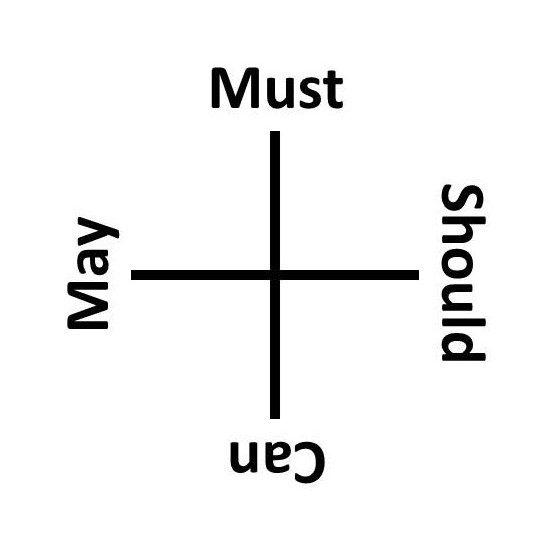
Regardless whether free will exists, the explanations given by choices and plans are required for our understanding of each other’s actions and goals. sq_modal_verbsHowever, these must not be confused with the chances and necessities of the world when and where they apply.

Notes:

This four-fold consisting of Choice, Chance, Fate, and Plan is inspired by the Modal Verbs: May, Can, Must, and Should. One might consider it as the double duality of internal or external and possibility or necessity.

Also consider changing “chance” to “luck”, and “choice” to “pick”.

Links:

http://en.wikipedia.org/wiki/Causality_(physics)

http://people.wku.edu/jan.garrett/302/4persona.htm

[*8.116]

<>


Grid-group Cultural Theory

sq_grid_group

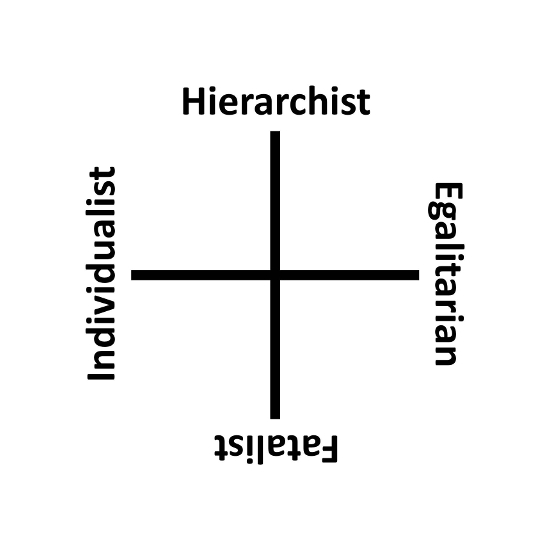
Looking over some old notes, I ran across something about the Grid-Group Cultural Theory. Also known as the Cultural Theory of Risk, it originated from the studies of anthropologist Mary Douglas and political scientist Aaron Wildavsky. Two dimensions of sociality are described, each with a low and high value (or a continuum): grid measures the differentiation between people, and group measures the cohesion or social bonds between people.

Individualist: Low group and low grid
Fatalist: Low group and high grid
Hierarchist: High group and high grid
Egalitarian: High group and low gridsq_archic_philosophers

Notes:

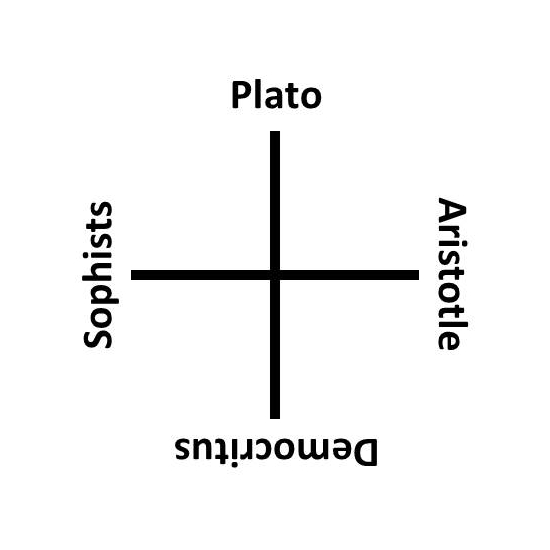
In the representation shown above, this arrangement reminds me significantly of the Archic Philosophers.

Sophists for Individualist
Democritus for Fatalist
Plato for Hierarchist
Aristotle for Egalitarian

Links:

http://en.wikipedia.org/wiki/Cultural_Theory_of_risk

http://changingminds.org/explanations/culture/grid-group_culture.htm

[*4.86, *8.112]

<>


The DISC Theory

sq_disc_theoryWilliam Moulton Marston, the creator of the DISC personality theory, has been in the media lately. The book “The Secret History of Wonder Woman” by Jill Lepore was released recently, and interestly enough, Marston created this super-hero as well as the psychological theory from which the DISC assessment was based. His life was indeed quite fascinating.

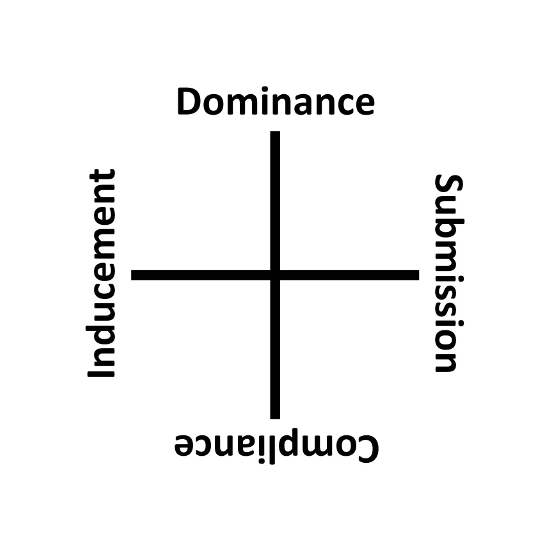
The basic four-fold of the DISC theory deals with an agent’s perception of her ability to act in relation to her enviroment. For the agent, she sees herself either more powerful or less powerful than the environment. For the environment, it is seen to be either favorable for her actions or unfavorable. Thus there are four combinations.

Inducement: More powerful than a favorable environment.
Dominance: More powerful than an unfavorable environment.
Submission: Less powerful than a favorable environment.
Compliance: Less powerful than an unfavorable environment.

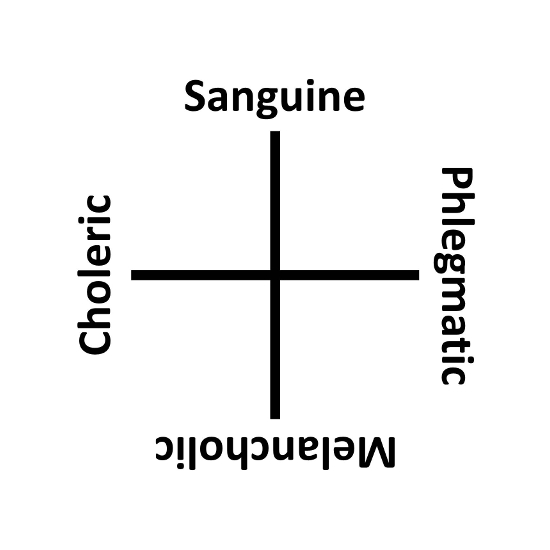
sq_four_temperamentsIt is fascinating that many brain function, behavioral, personality, and psychological schemas are based on a four-fold distinction. I have already briefly mentioned the Four Temperaments, but I hope to look at several more in the near future.

.

.

Links:

http://en.wikipedia.org/wiki/DISC_assessment

http://en.wikipedia.org/wiki/William_Moulton_Marston

Images of DISC theory.

[*8.90]

<>

Relative Time

sq_relative_time For what more terrifying revelation can there be than that it is the present moment? That we survive the shock at all is only possible because the past shelters us on one side and the future on another.

— From Orlando, by Virgina Woolf

As we can see on the previous four-folds of space and time, all have a degree of conditioning to the location and orientation of an observer. In other words, there are no absolute frameworks of space or time. That does not mean that they are not useful conventional and conceptual tools.

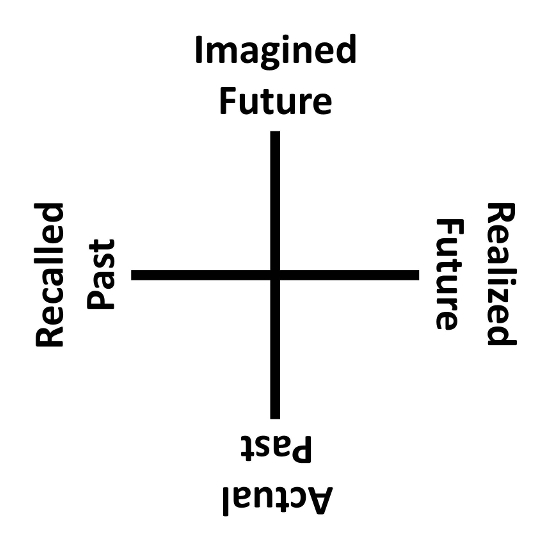
What would a four-fold of Relative Time be like? Because time seems to be linear instead of two dimensional, relative time would be very different than relative directions. What if we contrast our understanding of what happened in time with what actually occurred? What if we compare our thoughts of an imagined future with what becomes realized?

One could contrast an individual’s notions of past and future with a group or society’s notions of past and future. Or one could contrast an individual’s or society’s recalled past and imagined future with the actual past and the realized future. Some might argue that there is no actual past, but only the past we think or recall that it is. Similarly, those or others might argue that there is no realized future, because once the future becomes the present it has already slipped into the past that we can now only recall.

As the future becomes realized, the imagined future is discarded or blended into it to become our recalled past. As we understand more about the real past, our recalled past may be discarded or blended into it to become our new recalled past. Or one can refuse that knowledge and believe whatever suits them.

[*8.99, *9.60]

<>

The Diurnal Cycle

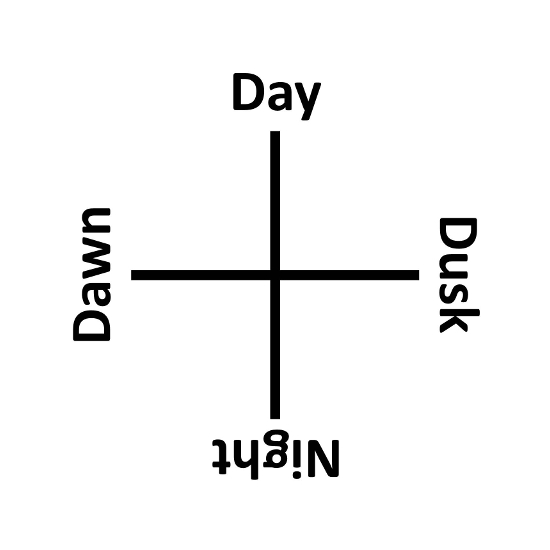
sq_diurnal_cycleA four-fold of Time.

Links:

http://en.wikipedia.org/wiki/Diurnal_cycle

[*8.98]

<>