All posts by Martin K. Jones

On the Psychology of Cognition

sq_jardine_relations

Searching for “four primary relations” led me to the work of Rev. Robert Jardine (1840-1924, Canada). His most notable (and perhaps only major) work is “The Elements of the Psychology of Cognition”.

His first fourfold consists of the “four primary relations” of consciousness: difference, resemblance, simultaneity, and succession. Each of these are relations of perception that can be informed and conditioned by other members of these four relations, or at least that is what I think he’s saying. Note that difference and resemblance have to do with information (or space), and simultaneity and succession have to do with time.

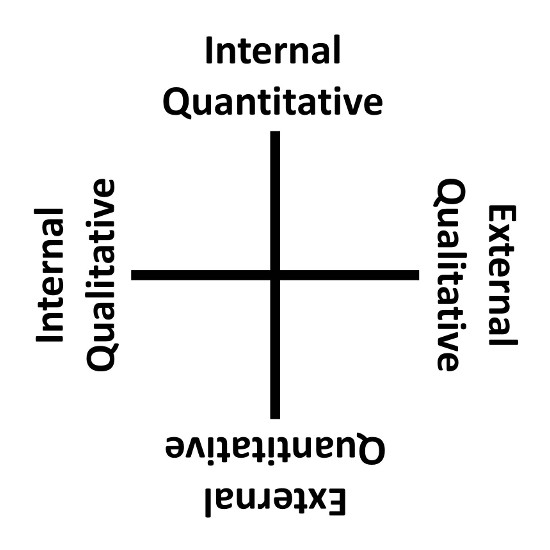
His second fourfold consists of the double dual of Internal-External and Quantitative-Qualitative, and are the relations between objects in our thought. Thus these are:

  • Internal Quantitative:
    Relations of figure, size, shape, motion, number, and so on, of the constituent parts or elements of objects, classes or systems. These relations may be any of the four primary relations or any combination of them.
  • Internal Qualitative:
    Relations between the qualities of objects of our knowledge, or classes of objects, these qualities being made known to us by the sensations or ideas which they produce in our minds.
  • External Quantitative:
    Relations of any of the four primary kinds or any combinations of them between the figure, size, shape, motion, duration, number, and so on, of objects, classes or systems which are external to one another.
  • External Qualitative:
    Relations between external objects or systems with reference to qualities made known by sense, moral or aesthetical qualities, characters, habits, conditions and any other characteristics of objects of knowledge which may be appropriately called qualitative.

Quantities he relates to Forms, and Qualities to Sensations.

Some of the material seems interesting, but before running to read, consider the beginning of the review (of the 1st edition) from Nature, by Douglas A. Spalding:

MR. JARDINE has seemingly had some personal reason for writing this treatise; for in the preface he asks the critic to bear in mind “that the book has been written with considerable haste, in order to secure its publication within a certain limited time.” It would have been wiser to ignore the critic: for this unsympathetic personage is only too certain to meet this innocent confidence with the unfeeling remark that perhaps the interests of science would not have suffered had the author taken a little more time over his work.

I could well adopt the last phrase as a tagline for my own blog! The review concludes with:

Another general criticism that must be made is, that there is not a sufficient wealth of concrete illustration, and that, though the writer has “endeavoured to express himself in as clear and simple language as possible,” his words are, nevertheless, often dark and difficult enough. What will readers “beginning their philosophical studies” make of such a sentence as this?—“It must be borne in mind that it is in their character as modes of the non-ego that objectified sensations are localised. The localising is, therefore, not so much an act of consciousness as a precept of consciousness and a form of the non-ego.”

Eh?

References and Links:

Robert Jardine / The Logical Doctrine of the Proposition. The Calcutta Review, Vol 62, No 124 (1876), 307-323.

Rev. Robert Jardine / The Elements of the Psychology of Cognition, MacMillan & Co. (2nd edition 1885)

Review of 1st edition in The Calcutta Review, Vol 60, No 120 (1875), 280-322.

Review of 1st edition from Nature 11, 422-423 (01 April 1875) | doi:10.1038/011422a0

Book available online:

https://archive.org/details/cu31924031232600

[*9.10]

<>

Four Primary Relations

sq_four_ances

I’ve written previously about my fourfold Structure-Function (consisting of Structures, Functions, Actions, and Parts) and its association with four Modal Verbs (Must, Should, May, and Can). This resulted in the combined fourfold of Modal Things.

Here I present the next step: what it is that Structures Must do, what it is that Functions Should do, what it is that Actions May do, and what it is that Parts Can do.

Structures Must Maintain => Maintenance
Functions Should Perform => Performance
Actions May Occur => Occurrence
Parts Can Vary => Variance

The first column lists the four aspects of Structure-Function. They are loosely based on Aristotle’s Four Causes. Structures correspond to the formal cause. Functions correspond to the final cause. Actions correspond to the efficient cause. Parts correspond to the material cause.

The second column lists the Modal Verbs, the “modes” of each aspect. They are similar to deontic logic, two being more or less necessary and two being more or less contingent.

The third column lists the Actional Verbs, what it is that each aspect does in its modal way. One could also say these as mottos: “Structures must be maintained”, “Functions should be performed”, “Actions may have occurred”, and “Parts can be varied”.

The fifth column lists the four primary relations that correspond to each of the four aspects.

These four relations could inform a metaphysics, consisting of relations all the way down, all the way up, all the way back, and all the way forward.

Links:

http://plato.stanford.edu/entries/logic-deontic/

[*7.192, *8.40, *8.136]

<>

The Sackur-Tetrode Equation

sq_sackur_tetrode

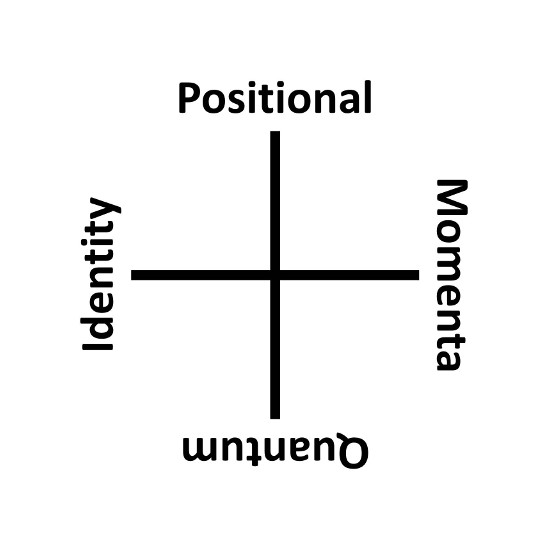
The Sackur-Tetrode Equation expresses the entropy of a monatomic classical ideal gas. Including quantum aspects of the system gives this formula a more detailed description than it would have otherwise. Above I’ve tried to represent the four uncertainties that constitute the equation in its information theoretic version: positional, momenta, quantum, and identity.

From Wikipedia:

In addition to using the thermodynamic perspective of entropy the tools of information theory can be used to provide an information perspective of entropy. The physical chemist Arieh Ben-Naim rederived the Sackur–Tetrode equation for entropy in terms of information theory, and in doing so he tied in well known concepts from modern physics. He showed the equation to consist of the sum of four entropies (missing information) due to positional uncertainty, momenta uncertainty, the quantum mechanical uncertainty principle and the indistinguishability of the particles.

http://en.wikipedia.org/wiki/Sackur%E2%80%93Tetrode_equation

http://en.wikipedia.org/wiki/Entropy_%28information_theory%29

[*9.4]

<>

Four Philosophies

sq_four_philosophies3

If one could divide all philosophies into four groups, what would those groups be? There doesn’t seem to be a strong consensus on how to do this although several have tried.

My first inclination is to start with the Archic Philosophers, discussed by Robert McKeon and his students Walter Watson and David Dilworth. These would be the Sophists, Plato, Democritus, and Aristotle. Philosophies aren’t usally divided in this way, but pros of doing this is that all four groups emerge from classical Greek thought. One of the main cons is that many would not agree that all philosophies are decendents of these four philosophers, or even combinations of aspects from each.

Another student of McKeon, Robert S. Brumbaugh, thought the process philosophies starting from those of Heraclitus and Anaxagoras (both pre-Socratic) and ranging through Whitehead should be represented instead of the Sophists. Otherwise he choose the same three as McKeon, giving Anaxagorean, Platonic, Democritean, and Aristotelian philosophies. By doing this he can form the double dual of Materialist-Formalist (direction) and Holoscopic-Meroscopic (method).

  • Anaxagoras: Materialist, Holoscopic
  • Platonic: Formalist, Holoscopic
  • Democritean: Materialist, Meroscopic
  • Aristotelian: Formalist, Meroscopic

Two works older than Brumbaugh’s that divide philosophy into the same four groups are those of Ralph Barton Perry and James Donald Butler. Their division is Naturalism, Idealism, Pragmatism, and Realism. I believe that the Realism in these books means Platonic Realism, instead of the more recent Scientific Realism thought of today. Of course Realism has many shadings as seen below.

It might be advantageous to consider Naturalism as a group instead of Realism, since the very concept of the real has so much disagreement. Naturalism does too, but not the extent that Realism does.

Several web sites divide four philosophies of eduction into Idealism, Realism, Pragmatism, and Existentialism. To me, Existentialism is similar to the Relativism of the Sophists. But what about Phenomenalism? Is that more like Relativism or Idealism?

There is also the monumental work “The Sociology of Philosophies” by Randall Collins but I haven’t examined it yet. I suspect they are not condensed or simplified into four groups.

So for now I’ve settled on Relativism, Idealism, Pragmatism, and Naturalism.

http://en.wikipedia.org/wiki/List_of_philosophies

http://en.wikipedia.org/wiki/Idealism
http://en.wikipedia.org/wiki/Relativism
http://en.wikipedia.org/wiki/Pragmatism
http://en.wikipedia.org/wiki/Philosophical_realism
http://en.wikipedia.org/wiki/Naturalism_%28philosophy%29
http://en.wikipedia.org/wiki/Aesthetic_Realism
http://en.wikipedia.org/wiki/Karen_Barad#Agential_Realism
http://en.wikipedia.org/wiki/Anti-realism
http://en.wikipedia.org/wiki/Critical_realism_%28philosophy_of_perception%29
http://en.wikipedia.org/wiki/Irrealism_%28philosophy%29
http://en.wikipedia.org/wiki/Moral_realism
http://en.wikipedia.org/wiki/Na%C3%AFve_realism
http://en.wikipedia.org/wiki/New_realism_%28philosophy%29
http://en.wikipedia.org/wiki/Platonic_realism
http://en.wikipedia.org/wiki/Surrealism
http://en.wikipedia.org/wiki/Actual_idealism
http://en.wikipedia.org/wiki/Absolute_idealism
http://en.wikipedia.org/wiki/German_idealism
http://en.wikipedia.org/wiki/Objective_idealism
http://en.wikipedia.org/wiki/Subjective_idealism
http://en.wikipedia.org/wiki/Transcendental_idealism
http://en.wikipedia.org/wiki/Metaphysical_naturalism
http://en.wikipedia.org/wiki/Spiritual_naturalism
http://en.wikipedia.org/wiki/Process_philosophy
http://en.wikipedia.org/wiki/Heraclitus
http://en.wikipedia.org/wiki/Anaxagoras
http://en.wikipedia.org/wiki/Pluralism_%28philosophy%29
http://edu402mariasblog.blogspot.com/2008/10/four-philosophies-of-education.html

Walter Watson / The Architectonics of Meaning: Foundations of the New Pluralism

David Dilworth / Philosophy in World Perspective: A Comparative Hermeneutic of the Major Theories

Robert S. Brumbaugh / Western Philosophic Systems and Their Cyclic Transformations

Ralph Barton Perry /Present Philosophical Tendencies: a critical survey of naturalism, idealism, pragmatism, and realism together with a synopsis of the philosophy of William James

James Donald Butler /Four Philosophies and Their Practice in Education and Religion

Randall Collins / The Sociology of Philosophies: a global theory of intellectual change

[*8.138, *8.151, *8.152]

<>


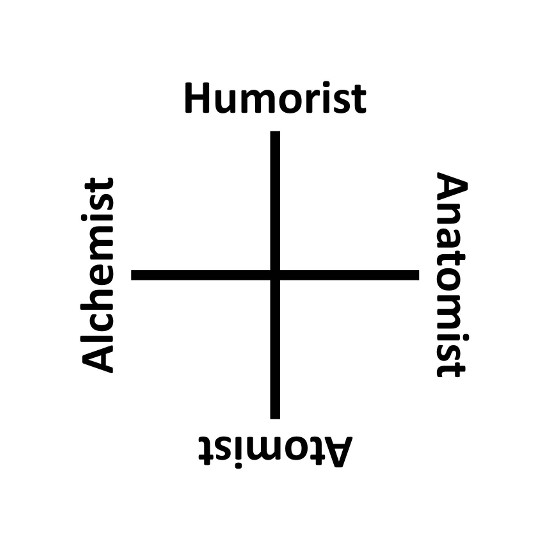
The Fourfold Democritus

sq_fourfold_democritusOld Democritus under a tree,
Sittes on a stone with booke on knee;
About him hang there many features,
Of Cattes Dogges, and such-like creatures,
Of which he makes Anatomy,
The seat of black choler to see.
Over his head appears the skye,
And Saturne Lord of Melancholy.

— From Robert Burton’s Anatomy of Melancholy

Truth lies at the bottom of a well.

— Democritus

References:

Christoph Luthy / The Fourfold Democritus on the Stage of Early Modern Science
Isis, Vol. 91, No. 3 (Sep., 2000), pp. 443-479
The University of Chicago Press on behalf of The History of Science Society
http://www.jstor.org/stable/237904

http://www.gutenberg.org/files/10800/10800-h/10800-h.htm

Who Was Democritus?

[*9.3]

<>

Into the Woods

sq_halfway

How far can you walk into the woods?

Halfway! Because then you start walking back out!

[*8.140]

<>

The Religion of the Future

sq_four_flawsIf religion remade itself for the present and for the future, what should it be like? Robert Mangabeira Unger thinks religion is an important aspect of human existence but doesn’t serve our own needs and those to each other or to the world that we find ourselves in and are so dependent on. In “The Religion of the Future”, he continues the program that he introduced in his previous book “The Self Awakened”.

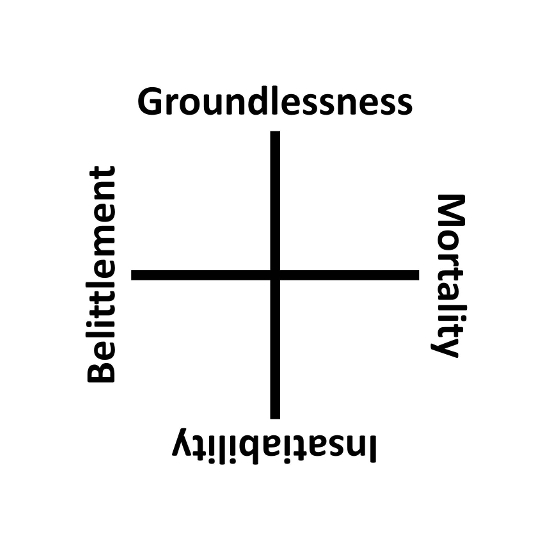
There are four major existential flaws of human existence: mortality, insatiability, groundlessness, and belittlement. Our mortality is the inevitable end of our struggle within life, although some scientists think it may be overcome someday. Our insatiability does seem to be part of human nature, a yearning for more of life and even life itself, but perhaps it could be quelled with training and resolve. Our groundlessness is due to the incompleteness of our knowledge as to the reasons of our existence and the future that we should pursue.

Unger considers belittlement to be a repairable flaw, unlike the other three. Belittlement may be different because we could learn to not reduce each others dreams and goals, but it may also be part of human nature to raise ourselves up by belittling others. We are social beings, but we are also confrontational and competitive. Even if we can learn, what is to stop the world itself from belittling us by placing physical limits on our actions and resources, or constraints on our abilities and plans?

These four flaws make us craven, clueless, needy, and terrified. sq_four_failingsCould a revolution of religion make us face up to our flaws in a mature and dignified way? Unger seems to think so and lays out his ideas. Four important principles that this religion must serve are apostasy, higher cooperation, plurality, and deep freedom. Four needful virtues that this religion must promote are self-transformation, connection, purification, and divinization.

The major religions of the past have the themes of overcoming the world, struggling with the world, and humanizing the world. What would the theme of the religion of the future be? Accepting the world? Embracing the world? Loving the world? Many religions avoid or even despise the world because it is only a means to an end, instead of an end in itself. We are indeed part of the world and must learn to accept, embrace, and love it as well as ourselves.

From the book description:

How can we live in such a way that we die only once? How can we organize a society that gives us a better chance to be fully alive? How can we reinvent religion so that it liberates us instead of consoling us?

These questions stand at the center of Roberto Mangabeira Unger’s The Religion of the Future. Both a book about religion and a religious work in its own right, it proposes the content of a religion that can survive faith in a transcendent God and in life after death. According to this religion–the religion of the future–human beings can be more human by becoming more godlike, not just later, in another life or another time, but right now, on Earth and in their own lives.

Unger begins by facing the irreparable flaws in the human condition: our mortality, groundlessness, and insatiability. He goes on to discuss the conflicting approaches to existence that have dominated the last 2,500 years of the history of religion. Turning next to the religious revolution that we now require, he explores the political ideal of this revolution, an idea of deep freedom. And he develops its moral vision, focused on a refusal to squander life.

The Religion of the Future advances Unger’s philosophical program: a philosophy for which history is open, the new can happen, and belittlement need not be our fate.

References:

Roberto Unger / The Religion of the Future

Click to access religion.pdf

Other links of interest:

http://bigthink.com/think-tank/the-shortcomings-of-religion-and-the-coming-revolution-with-roberto-unger-2

https://ndpr.nd.edu/news/49986-the-religion-of-the-future/

[*8.75, *8.102]

<>

The Four Qualities

sq_four_qualities2

By convention sweet and by convention bitter,
By convention hot, by convention cold,
By convention color; but in reality atoms and void.

— Democritus

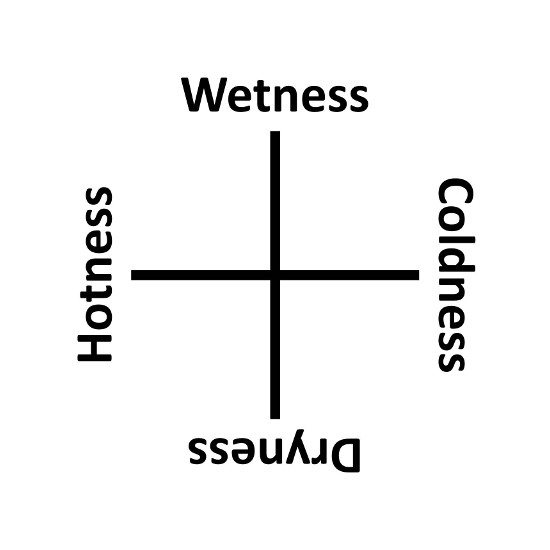
The ancient and archaic system of medicine called Humorism still has associations with modern psychological investigations via analogies with the Four Temperaments. Mentioned more for completeness, the four qualities of Humorism (Hotness, Coldness, Dryness, Wetness) may be considered linked to other fourfolds presented here such as the Four Seasons, the Four Elements, and as I mentioned the Four Temperaments.

These are called the four qualities because four relations between the Four Elements generate them, out of the six possible. Dryness is the relationship between Fire and Earth, Hotness is between Air and Fire, Wetness is between Water and Air, and Coldness is between Earth and Water. Alternatively, one can say Air has the qualities of being Hot and Wet, Fire is Hot and Dry, sq_elementsWater is Cold and Wet, and Earth is Cold and Dry.

As such these relations can be considered lying between the poles of the Four Elements. Along with the elements they may form a double square star, or two squares within a regular octagon. I’m not sure if this figure has a special name: in the anime “Inuyasha: the Final Act”, “Kagome” was this double square figure as well as the name of a major character. However “Kagome” actually seems to mean a different symbol: a star formed by two triangles within a regular hexagon. We don’t talk much about triads here.

There is also a children’s game called “Kagome Kagome”, where one child is centered within a ring of others, circling and chanting a song. The central child is only released if she can guess who is behind her when the chant stops. No peeking! Perhaps this position is reserved for reality or metaphysics in our representations.

These two axes can also be thought to encircle typical earth-type organisms within their habitable zones of humidity and temperature: neither too cold nor too hot, neither too dry nor too wet. This is known as a “Goldilocks effect”, after “Goldilocks and the Three Bears”. Also, the desirable middle between extremes is often called the “Golden Mean”, or the “Happy Medium”.

If humidity is considered to be a Cosine wave, and temperature is considered a Sine wave, then the Four Seasons can be located where x = 0 (Spring), π/2 (Summer), π (Fall), and 3π/2 (Winter). Q.E.D.!

References:

http://en.wikipedia.org/wiki/Humorism

http://en.wikipedia.org/wiki/Goldilocks_principle

http://en.wikipedia.org/wiki/Golden_mean_%28philosophy%29

http://en.wikipedia.org/wiki/Kagome_crest

http://en.wikipedia.org/wiki/Kagome_Kagome

[*8.36, *8.107, *9.6]

<>

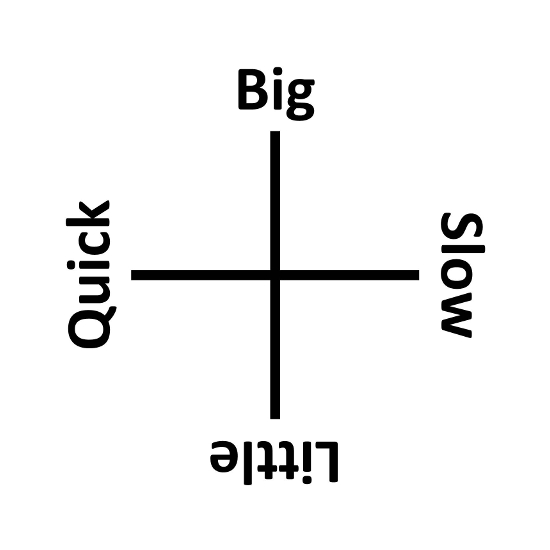
Little, Big

sq_little_big

Ask not the elves for advice, because they will tell you both ‘yes’ and ‘no’.

— J. R. R. Tolkien

Another riddle, perhaps?

http://en.wikipedia.org/wiki/Little,_Big

https://en.wikipedia.org/wiki/Sic_et_Non

https://en.wikipedia.org/wiki/Peter_Abelard

[*8.43, *8.130]

<>

The Fundamental Four of Sandeep Gautam

sq_millon

I was excited to recently find the long running blogs of Sandeep Gautam. The one I’ve looked at so far (“The Mouse Trap”) is mainly about psychology and neurology, but he seems to have a penchant for fourfolds, and some of the entries in “The Mouse Trap” talk about the same topics as my blog. He has also developed many interesting models of psychological and mental organization.

Guatam is a software developer and psychology enthusiast, from his short bio on his Psychology Today blog “The Fundamental Four”. He also has a multitude of other blogs (where does he find the time?), gives TED talks, and is just about everywhere on social media. Entries on “The Mouse Trap” are appearing less frequently these days, but it has been going since 2006.

Above is a diagram of the four fundamental evolutionary problems of humans as per psychologist Theodore Millon (and each also associated with a duality): survival or existence (pain/pleasure), adaptation (passive/active), replication (self/other), and abstraction (broad/narrow). Gautam’s Fundamental Four are the four basic drives to overcome these problems, a “lens” through which he sees psychology: food/foe (survival), flourishing/fun (adaptation), family/friends (replication), and focus/frame (abstraction). (I hope he doesn’t mind if I added “frame” to “focus”.)

I was not familiar with either Millon’s or Gautam’s work until now. I was thinking about updating my article on Aristotle’s Four Causes, and I chanced upon Gautam’s post on the subject because of images from it. I was soon very intrigued, because I see similarities in many of his formulations and mine! Also please compare these fourfolds to the Relational Models Theory.

Some of the more interesting blog entries of “The Mouse Trap”:

http://the-mouse-trap.com/2011/11/19/the-four-mechanisms-of-evolution/
(See my Theory of Evolution)

The Four Fundamental Causes

2 factor theories of personality

http://the-mouse-trap.com/2011/01/07/i-could-have-avoided-writing-this-blogpost-but-i-was-fated-to-be-a-blogger/
(See my Reasons Things Happen)

Six world hypotheses or how we explain eyerything and anything

The ABCD of Psychology and Happiness

Emotions and personailty : take 3

Links:

http://the-mouse-trap.com

http://www.psychologytoday.com/blog/the-fundamental-four

http://www.psychologytoday.com/blog/the-fundamental-four/201112/your-fundamental-four-journey

[*8.146, *8.147]

<>