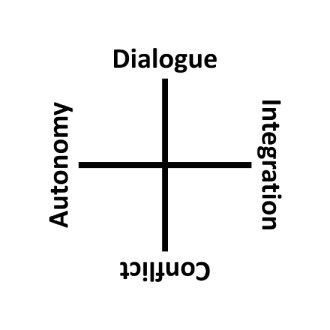
 What is the relationship between religion and science? Instead of one answer, Templeton Prize winner Ian Barbour presents us with four possibilities: independence (or autonomy), conflict, dialogue, and integration.
These four relationships described by Barbour can be useful to consider, as they describe what may exist between the two entities in the mind of an individual or the social discourse of a culture. For religion and science, what is their stance towards one another? Would you say they are independent of one another like Stephen Jay Gould’s non-overlapping magisteria, or in constant conflict as they appear to be in the media? Or are they in helpful dialogue with one another or even harmoniously integrated with one another? Or are they one thing some times, and then another thing at other times?
It seems that these four relationships are not restricted to just religion and science, as any two distinct institutions could have one or more of these interactions between them. For example there is religion and government, science and business, or public education and certain political organizations, to name just a few. Also, any two different religious institutions or any two different scientific fields could be in any of these relationships. For example there is the Catholic Church and all Protestant Churches, Sunni Islam and Shia Islam, and even Christianity and Buddhism. For science, consider physics and biology, chemistry and sociology, etc.
So why pick on religion and science? Is it because there seems to be so much conflict between them in our own minds? Are they frequently at odds with one another in the public and private spheres? And is that a good thing or a bad thing?
What is religion, anyway? Is it the sum total of all religious institutions and cultural behaviors? Is it the sum total of all religious beliefs held by individuals? Or is it the total of both of those things, plus more? And what is science? Is it the sum total of all scientific facts and literature, or the actual institutional structures and methodologies for all scientific practitioners? Is it the sum total of all scientific knowledge along with all the evidence for all that knowledge that are in the current minds of scientists and even non-scientists?
Without people, all you would have left of religion are the buildings, the texts, and the relics. Without people, all you would have left of science are the buildings, the writings, the instruments, and the facts. Both obviously have very large individual and social components that are sustained through teaching and learning. If post-humans or alien visitors found only the material residue of human religion, they could possibly understand it to some extent with enough anthropological work. If visitors found only the material residue of human science, I think they would be able to follow the chain of reasoning and the body of evidence to support the factual conclusions. Some facts and theories might be incorrect, certainly, but not most. Thus science contains an objective component not found in religion.
The first sentence about each from Wikipedia:
“A religion is an organized collection of beliefs, cultural systems, and world views that relate humanity to an order of existence.”
“Science is a systematic enterprise that builds and organizes knowledge in the form of testable explanations and predictions about the universe”.
The definition of science is pretty clear, but the one for religion is a little vague. I’m not sure what an “order of existence” is supposed to be, and it’s not defined there on Wikipedia. Is it an ordering of things that exist, so humanity is assigned to fit in a certain place in a hierarchy, say between gods and animals, i.e. a “great chain of being”? Is that the same as a “world view”? It seems that a world view could contain an order of existence, but not necessarily the other way around. So one could have a world view without an order of existence.
Only you can decide for yourself which relationship exists between religion and science, and unless you have public writings on the matter, no one can investigate and draw their own conclusions of what you think. And anyone can produce a claim for the ultimate stance between religion and science, but of course such claims must be substantiated by reason and evidence. Scholars can produce informed discussions on the matter, to greater or lesser acceptance.
References:
https://en.wikipedia.org/wiki/Ian_Barbour
https://en.wikipedia.org/wiki/Relationship_between_religion_and_science#Perspectives
Science and Religion: Barbour’s 4 models
https://en.wikipedia.org/wiki/Religion
https://en.wikipedia.org/wiki/Science
Also please see the previous post:
https://equivalentexchange.wordpress.com/2011/07/27/the-four-conic-sections/
[*9.42]
<>

 “I am leaving soon, and you will forgive me if I speak bluntly. The universe grows smaller every day, and the threat of aggression by any group, anywhere, can no longer be tolerated. There must be security for all, or no one is secure. Now, this does not mean giving up any freedom, except the freedom to act irresponsibly. Your ancestors knew this when they made laws to govern themselves and hired policemen to enforce them. We, of the other planets, have long accepted this principle. We have an organization for the mutual protection of all planets and for the complete elimination of aggression. The test of any such higher authority is, of course, the police force that supports it. For our policemen, we created a race of robots. Their function is to patrol the planets in spaceships like this one and preserve the peace. In matters of aggression, we have given them absolute power over us. This power cannot be revoked. At the first sign of violence, they act automatically against the aggressor. The penalty for provoking their action is too terrible to risk. The result is, we live in peace, without arms or armies, secure in the knowledge that we are free from aggression and war. Free to pursue more… profitable enterprises. Now, we do not pretend to have achieved perfection, but we do have a system, and it works. I came here to give you these facts. It is no concern of ours how you run your own planet, but if you threaten to extend your violence, this Earth of yours will be reduced to a burned-out cinder. Your choice is simple: join us and live in peace, or pursue your present course and face obliteration. We shall be waiting for your answer. The decision rests with you.”





 Equivalent Exchange