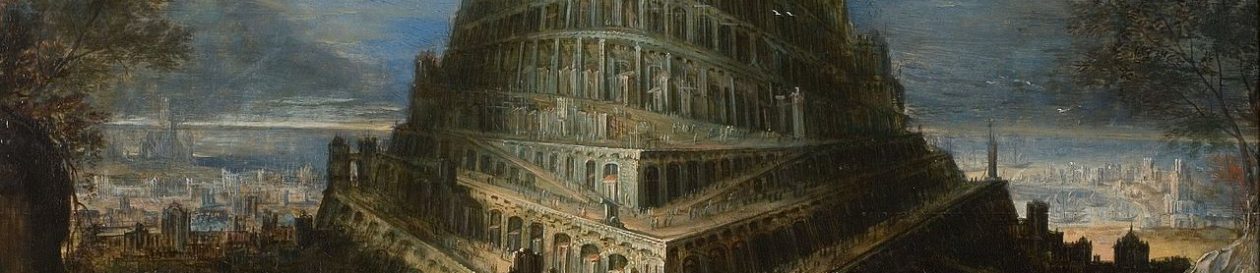
 Some classify labyrinths as unicursal and mazes as multicursal, but I don’t think this is standard terminology, and often the terms are used interchangeably for each other. Four elements may be common to both: doors or gates to enter and leave, turns to the left or right, forks in the path going two or more ways, and dead ends or stops. Unicursal labyrinths only have doors and turns, whereas multicursal mazes have all four.
A maze or labyrinth can be a metaphor for our experience of time. A block universe, where time is determined from its very beginning, can be modelled by a unicursal labyrinth that winds back and forth but leads ultimately to its final end. An open universe where time divides endlessly depending upon actions and choices can be modelled by a multicursal maze full of forks, dead ends and maybe loops, but may also have many paths to its many ends.
Multicursal designs may also have loops, where one can return to a location without turning around and going back. But a loop is part of the global pattern, and not discernable from any local inspection. There is a strategy for maze navigation called the right-hand-rule, which perhaps works for multicursal designs without loops. Any fork in a multicursal maze must be considered as a decision to make.
An interesting myth that I ran across is Hercules at the Crossroads. A crossroads is an intersection of two roads, and so allows the traveler to turn to the left, the right, or perhaps continue straight. One cannot divide oneself to go two or three ways at once and so must choose. Perhaps the myth should have been called Hercules at the Fork in the Road, but that’s not as catchy.
Some labyrinths have no walls, but are just laid out as a design on the floor of a cathedral or other building. I think these are mostly unicursal, but I’m not sure. A person may enjoy the experience of walking through the design, taking the twists and turns as they come, and being lost in the middle for a while, but then finally emerging at last. Success!
Other mazes may be constructed by hedges or in corn fields, and so are outside and open to the elements. Another style of outdoor maze is the turf maze, which only has short turf greenery for its walls that can be stepped over. Many formal gardens of large estates had hedge or turf mazes in them. Also, many of the so-called crop circles were also maze-like in their layout.
The classic text adventure game Colossal Cave, besides being a maze of sorts, contains two mazes inside of it, one that describes each room by saying “You are in a maze of twisty little passages, all alike” and one that changes each room description sightly. One must use paper and pencil to map them out unless one has a very good memory.
Some of the very first computer games with graphics also took place in a maze, like Castle Wolfenstein. These were usually first-person shooter type games. It was easiest to draw the simple perspective and hidden lines of a receding corridor with turns and doors than some elaborate building interior. Plus, monsters or enemies that could suddenly jump out and threaten you were easily programmed.
There’s more that can complicate a maze or labyrinth. The lighting can be poor, or nonexistent. There can be hidden doors or traps. Monsters or enemies could emerge suddenly. A maze or labyrinth can be three dimensional, with stairs or ramps or holes. There may be requirements to be able to proceed to unexplored parts. Found hints or clues may also benefit the maze goer.
Further Reading:
https://en.wikipedia.org/wiki/Hedge_maze
https://en.wikipedia.org/wiki/Corn_maze
https://en.wikipedia.org/wiki/Turf_maze
https://publicdomainreview.org/collection/mazes-and-labyrinths-1922/
https://en.wikipedia.org/wiki/Colossal_Cave_Adventure
https://en.wikipedia.org/wiki/Castle_Wolfenstein
<>
 Equivalent Exchange
i just used a screen grab of this pyramid design because yesterday i was hypothesizing the new discovery at Khafre pyramid not the great one but the son of khufu.. happens to have 8pillars or channels/wells seemingly with pathways leading to 4 building like structures that the OGDOAD mix to then move to the 5th structure before ascension to the heavens if they do? Amun did to become Amun Ra im kind of hatching this as i go but it seems like the likely rationale.. not that it was some gigantic alien laser 🤣i hope i live to see an excavation
LikeLike
this leads me to hypothesize the 8 cylinder structures are for the ogdoad leading 4 from each of the duality or cube structures then to arrive at the 5 layered temple like structures to mix in this world before ascension .. i borrowed a screengrab because your pyramid shape brought it together about the eight Ogdoads and it will be hard to convince me otherwise
LikeLike
Hi, your image link isn’t working, so could you find some other way to share it? Thanks.
LikeLike
so had issues posting yesterday look up Khafre pyramid if you havent seen the news article about the SAR scans theres 8 cylinders or wells/channels 4 each above two cube shaped structures. Egyptians believed in the duality so 4 female and 4 male channels out of each structure. Ive heard filippo biondi and others are doing a more detailed presentation on the 25th. People trying to debunk but i found a paper last night from similar work the did on Khufu pyramid in 2022.
LikeLike