
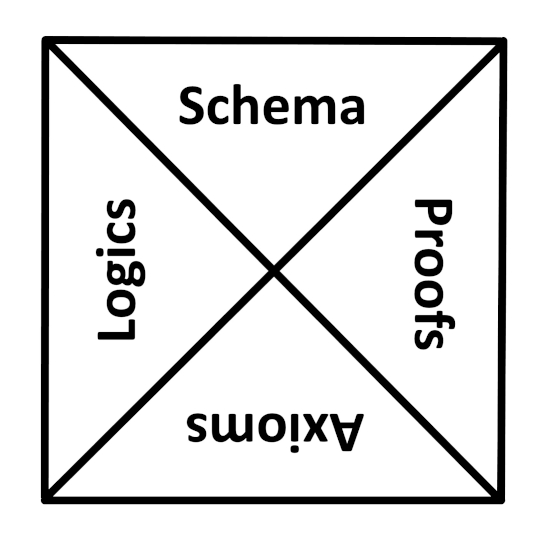
 Me: I’m trying to come up with a model for a deductive system. It should contain four parts: axioms, a logic or rules of inference, a proof methodology, and an overall schema or system. What can you add to my thoughts?
ChatGPT: Certainly! Developing a deductive system involves careful consideration of axioms, rules of inference, proof methodology, and an overall system or schema. Here’s a breakdown of each component:
-
- Axioms:
- Define the fundamental, self-evident truths or statements that serve as the starting point for the deductive system.
- Axioms should be clear, consistent, and independent, forming the foundation upon which logical reasoning will be built.
- Ensure that the axioms are relevant to the specific domain or problem you are addressing.
- Logic or Rules of Inference:
- Establish a set of rules that dictate how conclusions can be drawn from the given axioms.
- Common rules of inference include modus ponens, modus tollens, hypothetical syllogism, and more.
- Choose rules that align with the nature of your deductive system and support valid logical reasoning.
- Proof Methodology:
- Specify how proofs will be constructed within your deductive system.
- Determine the structure and format of a valid proof, including the sequence of logical steps that lead from the axioms to the desired conclusion.
- Consider the principle of mathematical induction, direct proof, proof by contradiction, or other proof techniques depending on the context.
- Overall Schema or System:
- Develop a coherent and systematic framework that integrates the axioms, rules of inference, and proof methodology.
- Clarify the relationships between different components and how they interact within the deductive system.
- Consider whether your system aligns with classical logic, modal logic, propositional logic, or some other logical framework.
- Axioms:
Here’s a more detailed breakdown:
-
- Introduction:
- Present the purpose and scope of your deductive system.
- Define the terms and symbols used in the system.
- Axioms:
- List and explain each axiom.
- Ensure clarity and completeness.
- Rules of Inference:
- Enumerate the rules of inference.
- Provide examples to illustrate how the rules are applied.
- Proof Methodology:
- Specify the steps involved in constructing a proof.
- Define the criteria for a valid proof.
- Examples and Applications:
- Demonstrate the application of your deductive system with specific examples or problem instances.
- Show how the axioms and rules lead to valid conclusions.
- Analysis:
- Evaluate the strengths and limitations of your deductive system.
- Discuss any assumptions or constraints.
- Conclusion:
- Summarize the key components of your deductive system.
- Reflect on the effectiveness of the system in addressing the intended purpose.
- Introduction:
Remember to iterate and refine your deductive system based on feedback and further analysis. It’s also important to be explicit and precise in your definitions and statements to ensure the soundness of your deductive reasoning.
Me: Thanks! I guess I was trying to decide if any model for a deductive system would have these four parts. What do you think?
ChatGPT: Yes, typically, deductive systems do encompass these four fundamental parts: axioms, rules of inference, proof methodology, and an overall schema or system. These components work together to create a coherent and systematic framework for logical reasoning. Let’s briefly revisit each part:
-
- Axioms: Axioms serve as the foundation of a deductive system, providing self-evident truths or statements from which logical reasoning begins.
- Rules of Inference: These rules dictate how conclusions can be drawn from the axioms, enabling the systematic derivation of new statements or theorems.
- Proof Methodology: The proof methodology outlines how to construct valid proofs within the deductive system, specifying the logical steps to move from the axioms to a desired conclusion.
- Overall Schema or System: This component ties everything together, providing a structured framework that defines the relationships and interactions between axioms, rules of inference, and proof methodology.
Together, these parts create a robust deductive system that allows for rigorous and valid logical reasoning. The specific details and nature of these components may vary depending on the type of logic or the problem domain you are addressing. However, having these four elements ensures a systematic and well-defined approach to deductive reasoning.
Further Reading:
https://en.wikipedia.org/wiki/Formal_system
https://en.wikipedia.org/wiki/Formalism_(philosophy_of_mathematics)
https://www.sciencedirect.com/topics/computer-science/deductive-system
https://ncatlab.org/nlab/show/deductive+system
[*11.167]
 Equivalent Exchange
I am positing an inductive system where larger ethical systems are culturally based along the lines that Mary Douglas and Aaron Wildavsky suggest (grid v group or social roles v social relations), with a cross check based on dominant Jungian cognitive functions (sensory v intuitive and reasons v values (thinking v feeling). Hierarchists, Egalitarians, Individualists and Realists. Realists and Individualists have low group and are generally more sensory while Hierarchic and Egalitarians are high group and more intuitive. Hierarchists and Realists believe in reason and set roles while Individualists and Egalitarians are value based and a lack of rules. Hierarchists favor formal systems, including the deductive system you propose. Egalitarians favor Durkheim’s Collective Consciousness. Individualist ethics are negotiated. Realists comply with rules they are taught or individual conscience.
Each way of life believes that everyone has their ethical system, which is not the case
LikeLike
Ma proposition est simple, quoi qu’elle m’ai demandé d’innombrables efforts : axiome/principe/paradigme/système. Les causes d’Aristote parlent comme souvent.
Je ne suis pas encore certain du 4, puisqu’il m’apparait aussi comme vous en tant que le tout de ce quaternaire. Ceci dit votre association à la déduction semble approuver ma stabilisation actuelle, puisque je met comme d’habitude mes quaternaires en analogie avec les inférences intuition/abduction/induction/déduction.
Le terme “logique” est dysémique, il faut s’en méfier. De base, c’est “déduire quelque chose à partir de faits avérés”. C’est l’inférence de clôture, agissant sur des faits des 4 types, d’intuitif à déductif.
En tant que formalisme académique : la logique pure n’autorise d’inférences que sur des faits logiques, le premier d’entre tous étant vide de sens, la tautologie A=A. La logique pure peut sembler ontologiquement aberrante, mais elle est puissante à l’extrême en pratique, comme chacun sait.
La notion de preuve est sans doute l’une des façons d’avérer un fait. Il y en a d’autres, comme le témoignage, l’expérimentation active, etc. Je n’ai pas encore fait cette recherche.
Schema est intéressant, il vient de m’apparaître dans “sémantique : concept/relation/catégorie/schème”; c’est l’IA qui ma me l’a trouvé. Je ne le maîtrise pas encore, mais il semble assez solide.
LikeLike
You write: My proposal is simple, although it has required countless efforts: axiom/principle/paradigm/system. Aristotle’s causes speak as often.
I am not yet certain of the 4, since it also appears to me as you as the whole of this quaternary. That said, your association with deduction seems to approve my current stabilization, since I usually put my quaternaries in analogy with the inferences intuition/abduction/induction/deduction.
The term “logic” is dysemic, one must be wary of it. Basically, it is “to deduce something from proven facts”. It is the inference of closure, acting on facts of the 4 types, from intuitive to deductive.
As an academic formalism: pure logic only authorizes inferences on logical facts, the first of all being meaningless, the tautology A=A. Pure logic may seem ontologically aberrant, but it is extremely powerful in practice, as everyone knows.
The notion of proof is probably one of the ways to prove a fact. There are others, such as testimony, active experimentation, etc. I have not yet done this research.
Schema is interesting, it just appeared to me in “semantics: concept/relation/category/scheme”; it was AI that found it for me. I have not mastered it yet, but it seems quite solid.
LikeLike
I was thinking along the lines of an Axiomatic System when I developed this entry, even though I didn’t reference it. And when I used the word schema, I meant the overall milieu for the deductive system, that enables the axioms and logics to produce proofs. I didn’t want a recursive definition, where system is the whole and also a part. What is the entity’s name made up of axiom/principle/paradigm/system?
I had in mind the Genzten-style presentation of modern logics, so sequent calculus-style or natural deduction style could be considered “schemas”. Logic needn’t work only with facts, as it can also work with assumptions or hypotheticals or “conditional tautologies”. I know you’re not fond of “linear logic”, but it is informative to consider the diagram of the logical rules for it. See for example:
There’s also the Hilbert-style, where you do work with logical facts. You could also say that is a “schema”. But my terminology may not be very acceptable to logicians.
https://en.wikipedia.org/wiki/Axiomatic_system
https://en.wikipedia.org/wiki/Sequent_calculus
Your two quaternaries seem a bit difficult for me at present, I will need to think about them more. I did find some Google AI text on the concept/relation/category/scheme quad which was interesting, in what I call a fourfold “chain”. In the same way that your intuition/abduction/induction/deduction is a chain, going from weaker to stronger reasoning.
LikeLike