
 I’ve heard that learning English isn’t easy, but I don’t really remember my own experience of doing so. Learning the difference between these four indefinite pronouns is just one of the many things to know, and seems to be a common grade school poster to hang up in the classroom.
- Anything
- Something
- Everything
- Nothing

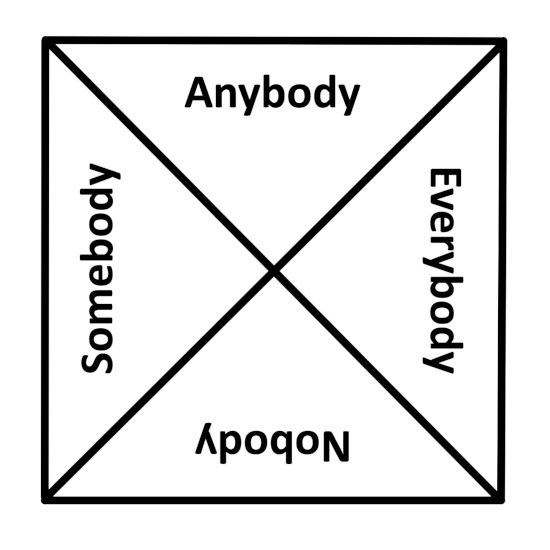
Some use these four words together in a clever sentence or epigram, but today I’ve got nothing except this sad little diagram. I hope it is of some use to someone.
I also see this is done with anybody, somebody, everybody, and nobody, and there are some cute little stories out there too! Plus here’s another diagram.
Further Reading:
https://www.google.com/search?q=something+everything+anything+nothing&tbm=isch
https://www.google.com/search?q=somebody+everybody+anybody+nobody&tbm=isch
[*11.140]
<>

 Equivalent Exchange