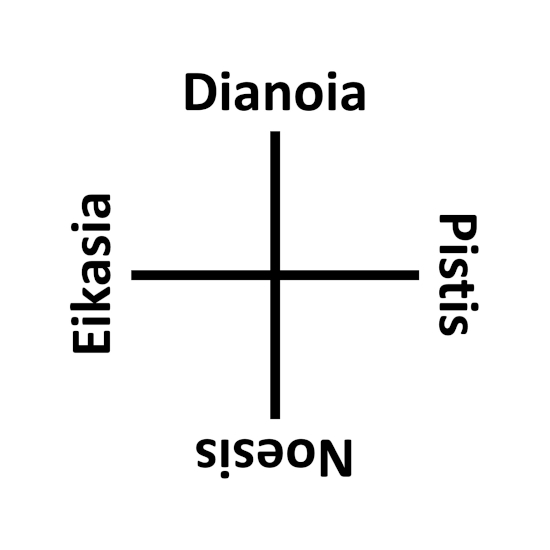
 How to display Plato’s Divided Line? Instead of a continuous line going from low to high as it is usually shown, I’ve shown it as two continuous crossed lines, a fourfold or double dual. Eikasia (imagining) and Pistis (belief) together are Doxa, the phenomenal. Dianoia (understanding) and Noesis (knowledge) together are Episteme, the intelligible. Doxa should indeed be horizontal, corresponding to the phenomenal of Richard McKeon’s Aspects of Knowing, and the subjective or content of other double duals. I believe Eikasia should come before Pistis, as the substance and form of content in Hjelmslev’s Net. Considering the vertical axis, Episteme as Dianoia and Noesis should surely be there for Plato, corresponding to McKeon’s ontic. But how do Dianoia and Noesis relate?
By the measure of the Aspects of Knowing or the Archic Matrix, Dianoia could be considered the method/knowledge and Noesis the reality/knowable of Plato’s Divided Line. Thus Dianoia should be above Noesis, as method/knowledge is above reality/knowable. Yet by other measures, that of the Here and Now or Hjelmslev’s Net, Noesis should be above and Dianoia below. Noesis is the form to the substance of Dianoia. Dianoia can also be thought of as meroscopic, reducing all to number and quantity, and Noesis can be thought of as holoscopic, combining all thing into the hierarchy of forms that culminate in that ultimate form, “The Good”.
The difficulty may be because the lower position, here Noesis, serves both as the position of the real in some fourfolds, as well as the position of earth and matter in others. This is a bias that I would like to avoid, but a resolution will need to come later.
References:
http://en.wikipedia.org/wiki/Analogy_of_the_Divided_Line
Images of Plato’s Divided Line:
https://www.google.com/search?udm=2&q=plato%27s+divided+line&sa=X
[*6.158-*6.165, *6.186]
<>
 Equivalent Exchange
Comme on se retrouve ! Je cherche “dianoia” et me voilà ici : votre image apparaît en référence ! J’avais déjà lu ce billet et étudié “la ligne” sans trop de succès, mais voilà qu’il tombe à la fin de longues discussions avec l’IA, comme un pavé dans la mare !
J’ai maintenant beaucoup plus de cartes en main pour décortiquer tout ceci, à commencer par un absent remarquable : gnôsis, comme exact et fameux complément dialectique à épistémè.
Je reviendrai peut-être vous montrer mes cogitations “anti-agnosticisme”. Je ne sais encore si je saurais “signer” ce quaternaire, mais nous ne serons sans doute pas d’accord ! Au plaisir en tous cas.
LikeLike
Welcome back! I admit I had to Google translate your comment, as my French is pretty minimal, but it wasn’t much effort and certainly worth it. I have had difficulty resuming my work here, after a lengthy pause. But I’m not dead yet, unless I’m an AI ghost of myself at this point.
Indeed, I’ve wormed my way into many corners of the web through my dogged longevity and my breadth of scope. But my worming is starting to taper off with my creator’s block. I wish I could say I’ll return soon with fresh new theories, but alas. Just the same old, if anything.
Gnosis and episteme, an intriguing pair: private and public knowledge? And anti-agnosis returns us to gnosis through a double negative. Your comments as always are fascinating, even if I don’t have the energy to reply. But show me more consternation, c’est vous plais.
LikeLike
Pardon my translation: How we meet again! I search for “dianoia” and here I am: your image appears as a reference! I had already read this post and studied “the line” without much success, but here it falls at the end of long discussions with the AI, like a stone in the pond!
I now have many more cards in hand to dissect all this, starting with a notable absence: gnosis, as the exact and famous dialectical complement to episteme.
I may come back to show you my “anti-agnosticism” cogitations. I don’t know yet if I would be able to “sign” this quaternary, but we will probably not agree! In any case, it would be a pleasure.
LikeLike