Tag Archives: Plato

Plato’s Fourfold Vision in the Phaedrus

In Plato’s Phaedrus, this “fourfold vision” refers to four distinct types of divine madness or inspiration; and being of divine origination are associated with various Greek gods. These are: prophecy from Apollon (later, Roman Apollo), mystic rites (telestic madness) from Dionysus (Bacchus), poetry and arts from the Muses (Camenæ), and love from Aphrodite and Eros (Venus and Cupid). These different forms of divine madness are seen as beneficial blessings and essential for a fulfilling life, crucial for living well and having a deeper connection to truth and beauty.

Also in the Phaedrus is Plato’s theory of the soul, most famously utilizing the metaphor of a chariot driven by two horses. The four types of divine madness represent different ways the soul can be uplifted. They are powers that can help guide the charioteer, steering the soul towards its higher purpose. If the soul follows the divine, the charioteer can ascend to the “plain of truth” (i.e. the realm of Plato’s Forms.) If not, the soul falls to earth in human form. The better the soul has seen truth, the higher will be its place in its “next” life.

It’s kind of odd that the charioteer is supposed to embody Reason, in order to steer the chariot’s horses properly, and yet there is no divine madness specifically associated with reason. Where is Athena (Roman Minerva), to aid the soul in its journey, as a guide for Reason? Perhaps Plato thought that Apollon could serve double duty, as he was thought to also symbolize reason as well as prophecy. Or perhaps the very notion of “divine madness” should not be associated with reasoning and logic. I disagree.

The writings of Benjamin Labatut come to mind as showcases of the “divine madness” of reason and logic. Various persons of science and mathematics are written about in a pseudo-bibliographical way: the mathematician Alexander Grothendieck, the computer scientist John von Neumann, and others. Other writers have also written about those that live in the highest realms of logic and mathematics: Kurt Godel, Grigory Perelman, etc. Their intellect may put them close to a form of madness.

Note:

I’ve chosen the Roman names for these Greek gods for the sole reason that they fit better in my diagram. I hope it’s not too confusing.

Further Reading:

https://en.wikipedia.org/wiki/Phaedrus_(dialogue)

PLATO’S PHAEDRUS: FOUR TYPES OF DIVINE MADNESS

View at Medium.com

View at Medium.com

https://en.wikipedia.org/wiki/Muses

https://en.wikipedia.org/wiki/Benjam%C3%ADn_Labatut

https://en.wikipedia.org/wiki/Alexander_Grothendieck

https://en.wikipedia.org/wiki/John_von_Neumann

Matthew Shelton / Divine Madness in Plato’s Phaedrus

https://www.academia.edu/118753337/Divine_Madness_in_Plato_s_Phaedrus

Katja Maria Vogt / Plato on Madness and the Good Life

Click to access paper-vogt-plato-on-madness-and-the-good-life.pdf

<>


Plato’s Fourfold Division in the Philebus

In Plato’s dialogue the Philebus, Socrates uses a fourfold division to describe fundamental, metaphysical principles of all things: the Unlimited (ápeiron, the indefinite, boundless aspect), the Limited (péras, the definite aspect of measure and boundary), the Mixture of these two (meikton, a combined indefinite-definite), and the Cause of the mixture (aitia, which gives structure to the mixture and is responsible for unifying it).

This framework provides the foundation for the dialogue’s central argument about what constitutes the good life, and what activity is best to achieve it. In the dialogue, Socrates uses the four parts of the division to examine the natures of both pleasure and reason, determining that their mixture, brought about by some cause, is the key to a truly good life. So neither pleasure alone, nor reason alone, would suffice.

This fourfold division reminds me of Aristotle’s later schema of the Four Causes. Initially I thought that the Unbounded could be the Material Cause, the Bounded could be Formal Cause, the Mixture could be Final Cause, and finally the Cause could be Efficient Cause. That is because one might think that there is always more material to be had if you want it, and the form of a project puts shape, constraints, limits, and relationships on it.

However, I now believe that what is truly limited is the raw material (matter, energy, time, information), and what is unlimited is all possible form (and not any one particular form). The combinations or permutations that one can make from a finite set of elements are essentially unlimited in number, or at least increase exponentially with the length of the permutation or the size of the combination.

Consider the finite nature of an alphabet, and the endless number of sentences that can be formed from it. Or think about the four DNA base pairs, and the endless variety of genes and organisms that can be generated from them. Remember Darwin’s quote: “Endless forms most beautiful”. Of course many of sentences one can make are gibberish, and many of the organisms one could make are not fit or even viable.

I realize that in Plato’s dialogue the Unlimited and the Limited are more about the continuous and the discrete: the infinite and the finite, the unbounded and the bounded, the indefinite and the definite. The examples of the Unlimited given have the common aspect of “more and less”, i.e. they are indeterminant. By contrast, the examples of the Limit(ed) are of a determinant nature, a bound, a limit, a fixation, a stop to the “more and less”.

It seems that one could spent an unlimited amount of time studying the intricacies of the Philebus and thinking about the meaning of it. But I am starting to feel that my time is indeed limited and other matters require my attention. I know I am probably at odds with all others in the proper interpretation of this part of the dialogue. At least you might enjoy the limited links I have provided, and you still have the unlimited freedom to make of them what you will.

Further Reading:

https://en.wikipedia.org/wiki/Philebus

https://www.gutenberg.org/files/1744/1744-h/1744-h.htm

https://standardebooks.org/ebooks/plato/dialogues/benjamin-jowett/text/philebus

https://plato.stanford.edu/entries/plato-ethics/

Mary Louise Gill / The Fourfold Division of Beings (Philebus 23b-27c)

https://www.academia.edu/40402669/The_Fourfold_Division_of_Beings_Gill_on_Platos_Philebus_

Ashley Lascano / A critical analysis of the metaphysics of limit and unlimited in Plato’s Philebus

https://commons.lib.jmu.edu/honors201019/691/

George Rudebusch / Philebus 23c-26d: Peras, Apeiron, and Meikton as Measure Theory

https://impactum-journals.uc.pt/platojournal/article/view/10332

<>

Plato’s Chariot

sq_plato_chariotAt the risk of being labeled a neo-platonist, another triad of Plato’s that is often discussed is that of the Allegory of the Chariot. This analogy is supposed to bring insight into the workings of the human soul and consists of two horses, one good and one bad, and the charioteer whose duty is to control them.

You never hear about the chariot itself (but it is always pictured), but it is required to have a chariot, after all. The charioteer isn’t just standing on the backs of the horses, like Jean-Claude Van Damme doing his epic split, although that would be cool. (They do this at the circus, and I know I’ve seen it in old gladiator movies when the chariot loses a wheel and the charioteer has to cut away the chariot.)

Thus, unless you want to change the nature of the analogy, the chariot is required for everything to be connected together. This fourth material component completes the triad into a fourfold, and I place it at the lowest, fundamental position where I added The Real to The Beautiful, The True and The Good.

And of course everyone knows that Bad Horse is the Thoroughbred of Sin!

Further Reading:

http://en.wikipedia.org/wiki/Chariot_Allegory

https://drhorrible.fandom.com/wiki/Bad_Horse

[*8.86]

<>

Plato Redux

sq_plato_redux

What is, is The True
What is, is The Good
What is, is The Beautiful
What is, is The Real

— Anonymous

I recently finished reading Rebecca Goldstein’s Plato at the Googleplex: Why Philosophy Won’t Go Away. In it there was much talk of The Beautiful, The True and The Good.

Besides Plato’s Divided Line, which was mentioned in The Republic and consists of four parts, the threesome of The Beautiful, The True and The Good is mentioned in various dialogues.

Being the quadraphile I am, I thought adding The Real to the threesome makes the now foursome nicely balanced. Usually one hears of just the three, without the fourth, but why is that?

Some argue loud and long that The Real has no part in this threesome of Universals, that the three are sufficient among themselves. Others disagree. Which side would you say I’d be on?

Further Reading:

http://en.wikipedia.org/wiki/Transcendentals

http://en.wikipedia.org/wiki/Analogy_of_the_Divided_Line

Henry Rutgers Marshall / The True, The Good and the Beautiful (The Philosophical Review, Vol. 31, No. 5, Sep. 1922 pp. 449-470)

Michael Boylan / The Good, the True and the Beautiful

[*4.82, *8.72, *8.82]

<>


The Archic Philosophers

In a word, the Sophist begins from man, the Democritean from matter, the Platonist from form, and the Aristotelian from functioning.

— From The Architectonics of Meaning, by Walter Watson

Inspired by philosopher Richard McKeon, I believe that philosophy as a whole is encompassed by four main philosophical stances, exemplified by four ancient philosophers: the Sophists (as a group), Democritus, Plato, and Aristotle. Their four systems of thought lay out principal philosophical directions, much like the compass directions east, south, north, and west lay out a complete set of primary directions.

Of course the compass directions can be subdivided into north-east, or south-south-west, and so on, and similarly each of these philosophical systems can be divided into four parts. This division into a four-by-four matrix is called the Archic Matrix and was written about at length in the separate but complementary works of Walter Watson and David Dilworth.

Watson and Dilworth described the four main philosophical directions to be perspective, reality, method, and principle: perspective for the Sophists, reality for Democritus, method for Plato, and principle for Aristotle. I have written about these philosophical perspectives previously in several ways.

Thus philosophy as a practice goes around and around and revisits the same ideas over and over. Perhaps McKeon thought his philosophical system followed in the footsteps of Aristotle, and probably Watson and Dilworth had a similar view.

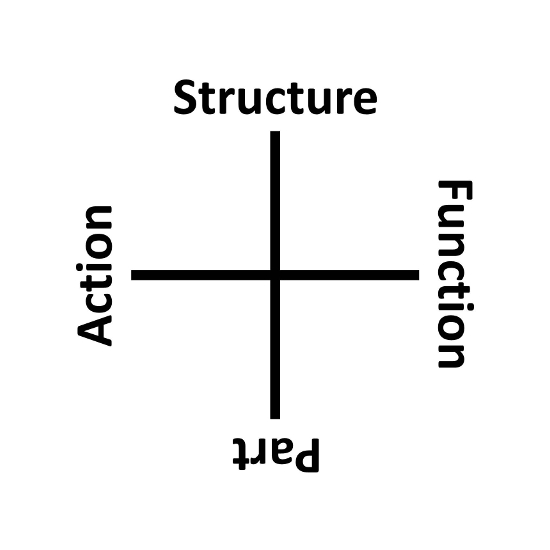
Likewise, I believe that my fourfold of Structure-Function represents these four philosophical directions in the following way: Action(s) for the Sophists, Part(s) for Democritus, Structure for Plato, and Function for Aristotle.

[*6.108]
<>


Plato’s Divided Line

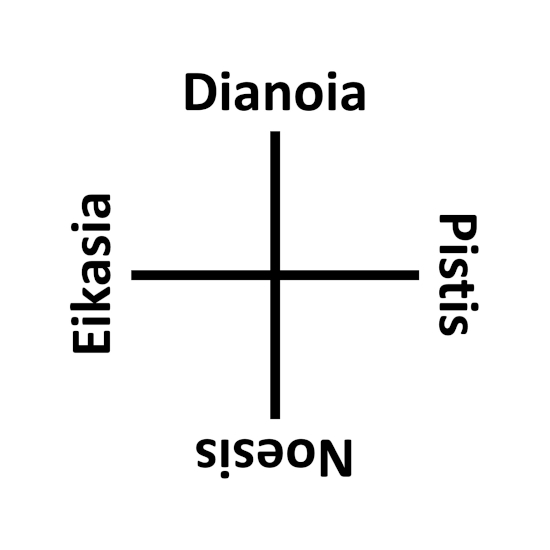
How to display Plato’s Divided Line? Instead of a continuous line going from low to high as it is usually shown, I’ve shown it as two continuous crossed lines, a fourfold or double dual. Eikasia (imagining) and Pistis (belief) together are Doxa, the phenomenal. Dianoia (understanding) and Noesis (knowledge) together are Episteme, the intelligible. Doxa should indeed be horizontal, corresponding to the phenomenal of Richard McKeon’s Aspects of Knowing, and the subjective or content of other double duals. I believe Eikasia should come before Pistis, as the substance and form of content in Hjelmslev’s Net. Considering the vertical axis, Episteme as Dianoia and Noesis should surely be there for Plato, corresponding to McKeon’s ontic. But how do Dianoia and Noesis relate?

By the measure of the Aspects of Knowing or the Archic Matrix, Dianoia could be considered the method/knowledge and Noesis the reality/knowable of Plato’s Divided Line. Thus Dianoia should be above Noesis, as method/knowledge is above reality/knowable. Yet by other measures, that of the Here and Now or Hjelmslev’s Net, Noesis should be above and Dianoia below. Noesis is the form to the substance of Dianoia. Dianoia can also be thought of as meroscopic, reducing all to number and quantity, and Noesis can be thought of as holoscopic, combining all thing into the hierarchy of forms that culminate in that ultimate form, “The Good”.

The difficulty may be because the lower position, here Noesis, serves both as the position of the real in some fourfolds, as well as the position of earth and matter in others. This is a bias that I would like to avoid, but a resolution will need to come later.

References:

http://en.wikipedia.org/wiki/Analogy_of_the_Divided_Line

Images of Plato’s Divided Line:

https://www.google.com/search?udm=2&q=plato%27s+divided+line&sa=X

[*6.158-*6.165, *6.186]

<>