 References:
Stephen C. Pepper / World Hypotheses: a study in evidence
http://en.wikipedia.org/wiki/World_Hypotheses
[*4.124, *5.22, *5.70]
<>
References:
Stephen C. Pepper / World Hypotheses: a study in evidence
http://en.wikipedia.org/wiki/World_Hypotheses
[*4.124, *5.22, *5.70]
<>

| Creative | cause functioning by virtue of (indeterminate) potentiality | transcend what is given, functioning caused is without limit | different for different things, indeterminate in kind of functioning caused |
| Elemental | cause functioning by virtue of (determinate) potentiality | immanent in what is given, from which the functioning emerges | same for all things, all things are the same in their being |
| Comprehensive | cause functioning by virtue of actuality (of totality) | transcend what is given, functioning of all things transcends any given thing | same for all things, all things are differentiated parts of same whole |
| Reflexive | cause functioning by virtue of actuality (of functionality) | immanent in what is given, as the functioning itself | different for different things, determinate in kind of functioning caused |
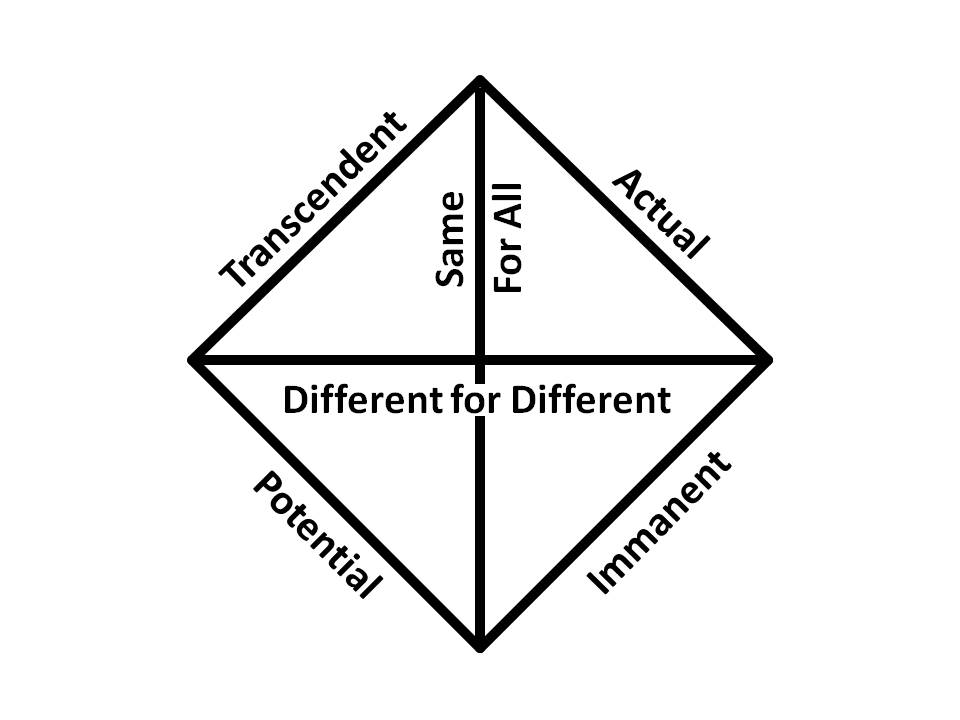
Since the Archic Matrix can be thought of as the union of four separate fourfolds, each of the fourfolds of perspective, reality, method, principle can be considered on its own. Here is the fourfold of principles consisting of creative, elemental, comprehensive, and reflexive principles. The content of the table and the bottom figure is derived from Walter Watson’s Architectonics of Meaning.
[*6.146-*6.148]
<>

| Agonistic | parts are primary, producing whole through endeavors | two voices are tested against each other to organize whole | close off intermediate wholes because of external forces |
| Logistic | parts are primary, producing whole while remaining same | one voice beginning from determinate towards determinate whole | extend towards ultimates (least parts) |
| Dialectic | whole determines parts directly | two voices are united with each other to organize whole | extend towards ultimates (all-inclusive whole) |
| Problematic | whole determines parts reciprocally | one voice beginning from indeterminate towards determinate whole | close off intermediate wholes because of own internal unity |
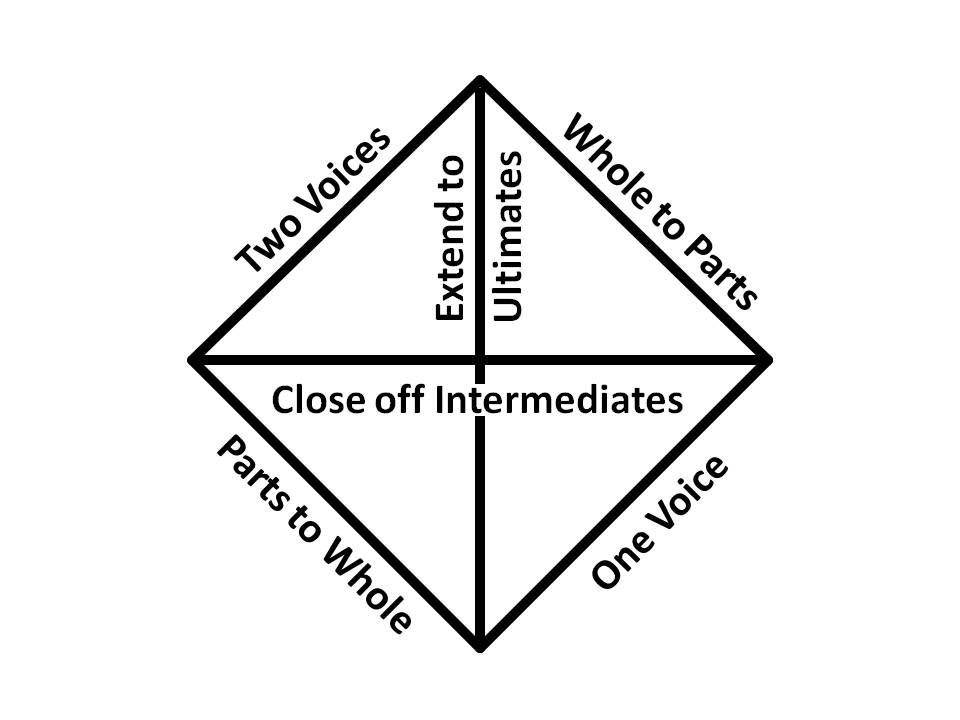
Since the Archic Matrix can be thought of as the union of four separate fourfolds, each of the fourfolds of perspective, reality, method, principle can be considered on its own. Here is the fourfold of methods consisting of agonistic, logistic, dialectic, and problematic methods. The content of the table and the bottom figure is derived from Walter Watson’s Architectonics of Meaning.
[*6.146-*6.148]
<>
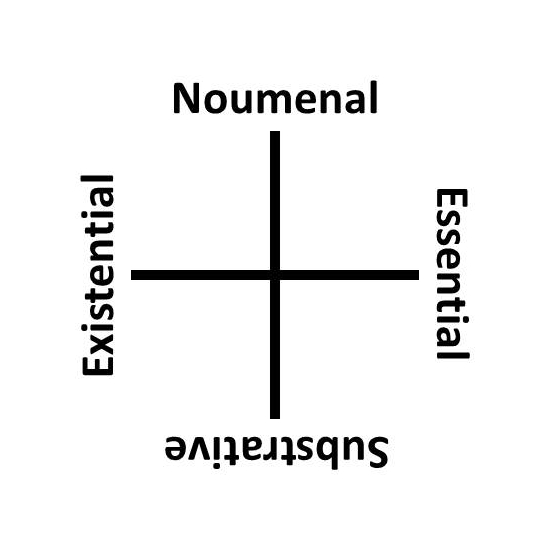
| Existential | individual, infinite | separate changing (real) from unchanging | reality found in appearances (themselves) |
| Substrative | individual, infinite individuations of common substratum | persists through change (substratum) | reality lies behind appearances (underlying) |
| Noumenal | general, one ideal individual apart from many | separate changing from unchanging (real) | reality lies behind appearances (transcending) |
| Essential | general, many individuals themselves | persists through change (essence) | reality found in appearances (that which appears) |

Since the Archic Matrix can be thought of as the union of four separate fourfolds, each of the fourfolds of perspective, reality, method, principle can be considered on its own. Here is the fourfold of realities consisting of existential, substrative, noumenal, and essential realities. The content of the table and the bottom figure is derived from Walter Watson’s Architectonics of Meaning.
[*6.146-*6.148]
<>
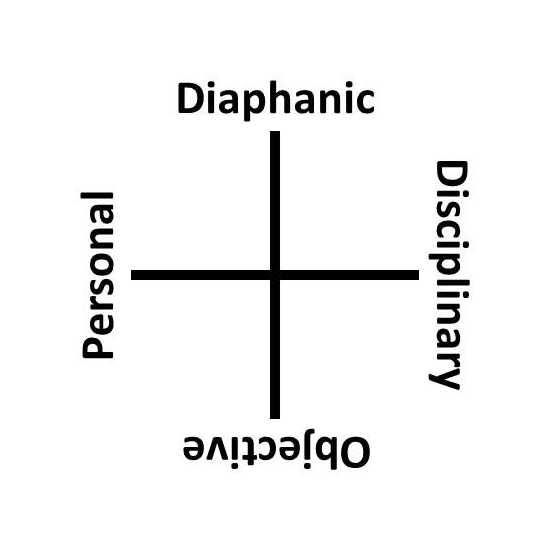
| Personal | distinction between (primary) subject and object | personal, merely but infinite in number | constitutive of (individual) content |
| Objective | distinction between subject and (primary) object | impersonal, subjectivity excluded | non-constitutive, subordinate to content |
| Diaphanic | unity between subject and object (to be obtained) | personal, subordinated to higher and absolute perspectives | non-constitutive, subordinate to superior views |
| Disciplinary | unity between subject and object (initial condition) | impersonal, subjectivity universalized | constitutive of (universal) content |
 Since the Archic Matrix can be thought of as the union of four separate fourfolds, each of the fourfolds of perspective, reality, method, principle can be considered on its own. Here is the fourfold of perspectives consisting of personal, objective, diaphanic, and disciplinary perspectives. The content of the table and the bottom figure is derived from Walter Watson’s Architectonics of Meaning.
[*6.146-*6.148]
<>

Steven H. Cullinane has a great wealth of interesting material about square and cubic figures on various blogs and web sites. This figure was inspired by his arrangement of von Franz’s “box” style representation of the hexagrams. In the above figure, solid and open lines are shown as they are in the regular hexagrams. At the top is 01 The Creative, at the bottom is 02 The Receptive, at left is 64 Before Completion, and at right is 63 After Completion. It’s not quite symmetric, but I think it looks pleasing. The trigrams can be separated into two N and Z figures, but I’m still trying to find the best arrangement to display them.
Further Reading:
http://finitegeometry.org/sc/64/iching.html
The Eight Trigrams of the Bagua
<>
To teach superstitions as truth is a most terrible thing.
– Hypatia of Alexandria
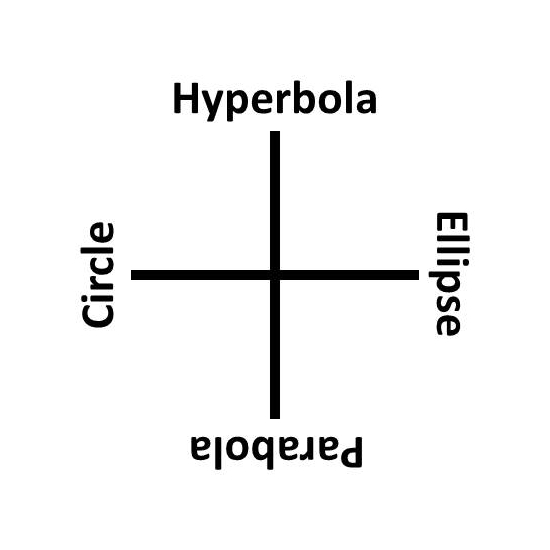 In mathematics, the four conic sections are the different shapes that can be formed by the intersection of a three dimensional right double cone and a plane: the circle, the ellipse, the parabola, and the hyperbola. The conics have been studied since the dawn of Greek mathematics. These shapes have interest as pure mathematical constructions, as well as many practical uses in applied mathematics.
Special points (focus or foci, plural) and lines (directrix or directrices, plural) can also be used to generate the conic sections in analytic geometry. A circle or parabola has one focus; the ellipse or hyperbola has two. The circle is a special case of the ellipse, one whose two foci coincide at a unique center, and in a different sense, the parabola can also be considered as a special case of the ellipse, having one of its foci at infinity. All circles can be transformed into each other by uniform scaling, a property shared by all parabolas. Thus the circle can be considered to be a singular shape, as well as the parabola. In contrast, ellipses and hyperbolas have a multitude of shapes and cannot be transformed into others of the same kind by uniform scaling. However, a nonuniform scaling or affine transformation can be used to achieve this goal. In even more abstract projective geometry, one could consider that all the conics are the same.
If the double cone is considered as the so-called light cone in Minkowski Space-time, many interesting concepts in special relativity can be considered. In this simplified model, space has two dimensions and time has one. The light cone divides all of space-time into four parts: the past, the present, the future, and the rest. The observer is located in time and space at the common apex of the two cones. Light travels on the surface of the cones, in straight lines towards and away from the observer. Anything traveling strictly within the space-time of a cone must necessarily be traveling slower than the speed of light. One cone can be thought of as the past: the interior of which contains all space-time that could have been observed by the observer, bounded by the circles of light traveling towards her. The second cone can be thought of as the future: the interior of which contains all space-time that could possibly be observed by the observer, bounded by the circles of other observers observing her light. Everything outside of the light cone cannot be observed or influenced by the observer at that instant, since light from it would have to travel faster than the speed of light in order to be seen or acted on by the observer.
Letting my analogical thinking run rampant, I can think of several associations with other fourfolds presented here. The circle is the shape of perfection, of identity and wholeness. It has one center or focus. In Minkowski Space-time, it is formed by the plane cutting the light cone at a constant time, so that all light arrives at the observer simultaneously from the past. Thus it is the shape of the knower or perspective. The parabola has the shape of gravity, the arc of an object thrown from and falling towards the earth. The shape reminds me of a reality that flies up from the opaque depths of the knowable only to fall away again. Numbers that are perfect squares may have started ancient mathematicians thinking about arithmetic. The ellipse has the shape of cosmology. Once astronomers could consider orbits of planets not to be circles or epicycles, only then science changed from idealism to empiricism. The hyperbola’s asymptotes form the crossed lines of my ever-present double duals, dividing yet unifying, as well as the profile of Minkowski Space-time. In fact, space and time occur over and over in many of the fourfolds I have considered.
Circles and ellipses could be considered the shapes of time, subjectivity, conjunction, and content: closed, finite, and bounded, yet cyclic. Parabolas and hyperbolas could be considered the shapes of space, objectivity, disjunction, and expression: open, infinite, and unbounded, acyclic.
In the recent movie Agora, the main character is Hypatia, the daughter of the last librarian of the great Library of Alexandria. A mathematician, astronomer, and philosopher, only fragments of Hypatia’s writings are available to us today. After the sack of the library, Hypatia is shown in her new study with a beautiful wooden model of the conics that she saved from destruction. For any that love wisdom over superstition, the movie is heartbreaking. As an echo to the loss of the contents of the library, it is offered (without any proof) that she considered the truth of the Heliocentric model of the solar system with the planets moving in elliptical orbits. Her senseless murder meant her insights were destroyed without legacy, falling away into the gravity of the dark unknown. Fortunately, even if she had, Copernicus and Kepler rediscovered these insights well over a thousand years later and brought them to light. The library’s loss will never be recovered.
References:
http://en.wikipedia.org/wiki/Conic_section
http://babelniche.wordpress.com/2010/09/28/more-on-agora-and-hypatia/
http://www.skepticforum.com/viewtopic.php?f=85&t=14979
[*6.170, *6.172]
<>
 As Proclus wrote: The Pythagoreans considered all mathematical science to be divided into four parts: one half they marked off as concerned with quantity, the other half with magnitude; and each of these they posited as twofold. A quantity can be considered in regard to its character by itself or in its relation to another quantity, magnitudes as either stationary or in motion. Arithmetic, then, studies quantities as such, music the relations between quantities, geometry magnitude at rest, spherics [astronomy] magnitude inherently moving.
Thus arithmetic is number in itself, music is number in time, geometry is number in space, and cosmology is number in space and time.
References:
http://en.wikipedia.org/wiki/Quadrivium
http://quadriformisratio.wordpress.com/2013/07/01/the-curriculum-in-ancient-times/
[*6.66, *7.40]
<>

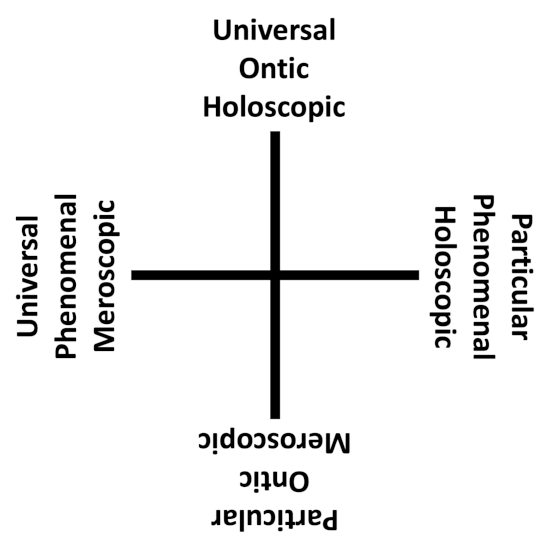
The duals in Richard McKeon’s system of Philosophical Semantics can also be arranged in a three-dimensional tetrahedron, where the dual pairs are on opposing edges. The universal and particular methods, the phenomenal and ontic interpretations, and the meroscopic and holoscopic principles are shown above.
Universal methods, between knower and knowledge, are applicable to all problems and all subject matters. Particular methods, between the knowable and the known, require distinct methodological procedures for different problems or subject matters.
Holoscopic principles, looking at or seeing the whole, provide a coincidence of knowledge and known. Meroscopic principles, looking at or seeing the parts, separate the knower and the knowable from each other and from influence between each other.
Ontic interpretations, between the knowable and knowledge, derive their character from a reality assumed to transcend or to underlie phenomena and statements. Phenomenal interpretations, between knower and the known, may reduce reality and values to aspects or consequences of phenomena.
Alternatively, the four vertices of knower, knowledge, known, and knowable can be labeled by their method, principle, and interpretation as shown below.
 References:
http://en.wikipedia.org/wiki/Richard_McKeon
[*6.136]
<>
 Graham Harman’s book The Quadruple Object is now available in English, and hopefully it will clarify some of the questions I have about his metaphysics. I have made an attempt at orienting his fourfold of real object, sensual object, real qualities, and sensual qualities with respect to the other fourfolds presented here. The fourfold object emerges from Harman’s analysis of Heidegger’s das Geviert.
Further Reading:
Graham Harman / Guerrilla Metaphysics: phenomenology and the carpentry of things
Graham Harman / Prince of Networks: Bruno Latour and metaphysics
Graham Harman / The Quadruple Object
<>
Because there are way more than seven wonders in the world.
Always Forward Between Heaven and Earth
Psychological Musings
Critiquing anime and everything else
"For man has closed himself up, till he sees all things thro' narrow chinks of his cavern" -- William Blake
Category Theory, Haskell, Concurrency, C++
Reviewing fascinating science books since 2017
Every Fourth Thing
Derek Wise's blog: Mathematics, Physics, Computing and other fun stuff.
integrating 4 binary opposites in life, learning, art, science and architecture
integrating 4 binary opposites in life, learning, art, science and architecture
Chasing the Paper Rabbit
experiments in a reaction from the left
A blog about computers, evolution, complexity, cells, intelligence, brains, and minds.
mind maps, infographics, and expositions
neat ideas from unusual places
Introduction to a Quadralectic Epistomology
Astronomy, space and space travel for the non scientist
Every Fourth Thing
A Serious Look at Trivial Things
A Survey of Tetradic Testimonials in Architecture
Musings from a Naturalist
Why Evolution is True is a blog written by Jerry Coyne, centered on evolution and biology but also dealing with diverse topics like politics, culture, and cats.
Four-fold thinking4you
Craig Weinberg's Cosmology of Sense
Purveyors of Fine Anime Reviews and Ratings Since 2010
Between Subject and Object
Every Fourth Thing
Every Fourth Thing
Every Fourth Thing
Every Fourth Thing
Every Fourth Thing
Sometimes those Sticking their Heads in the Sand are Looking for Something Deep
Online Home of Christopher Vitale, Associate Professor of Media Studies, The Graduate Program in Media Studies, Pratt Institute, Brooklyn, NY.
Linking Ideas
RESEARCHING THE DEMANDS OF THOUGHT
Explorations in the Paradoxes of Meaning
"The centaur of classical metaphysics shall be mated with the cheetah of actor-network theory."
objects & things, design, art & technology
 Equivalent Exchange