Category Archives: Space and Time

The Space-Time Tetrahedron

In honor of April Fool’s Day, I present the Space-Time Tetrahedron.

The Internet is full of crackpot and nutty websites, and one of the most famous concerns the so-called Time Cube.

Since the ideas expressed on this website are pretty much ignored, it is hoped that it could at least find some recognition as being slightly crackpot or somewhat nutty.

Let’s examine the similarities between Time Cube theory and my theory.

The number four is very important in each. In fact, the Time Cube is a fourfold, although quite a puzzling one.

The notions of space and time are crucial to Time Cube; many of my fourfolds involve some aspect of space and time or spacetime.

How about the differences? I don’t think one can find any common claims between the two theories. At least I hope not!

References:

http://en.wikipedia.org/wiki/Time_Cube

http://knowyourmeme.com/memes/the-time-cube

[*7.150]

<>

Equivalent Exchange

There is an old riddle that asks, what is the value of a human body? It goes on to enumerate the quantities of the various chemicals that constitute an average body, and then price those chemicals to come up with a total material value. This might come as a shock to the one who tried to answer the riddle, because the value is so low.

Of course that analysis ignores the real value of the body because it ignores the spatial arrangement of those chemicals in the various tissues and organs of the body. It ignores the form of the body as an hierarchical arrangement of structured parts. These parts are very valuable for someone needing an organ donation, for example.

This static analysis is lacking as well because it neglects the dynamic actions that a body can perform. Taken as a set of discrete individual acts, this is like considering the individual chemicals that constitute a body. One can enumerate the acts too, as in counting the number of breaths or the number of heart beats over a lifetime.

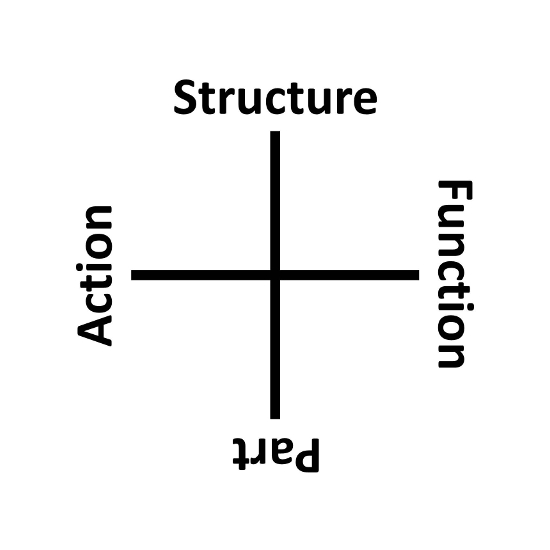
But we are still not finished, because this enumeration of actions also overlooks the functions that a body can perform, as arrangements of actions in time. These functions are the most important value of a body because they include but are not limited to being alive, thinking, and feeling.

So it seems to me that there is a heirarchy here, that goes from parts to structure to actions to function, with parts being at the lowest level and function being at the highest. Each level of the hierarchy is dependent on the level below, but the nature of a level is fundamentally different from the level below it, as well as the level above it. Please see my previous post Structure-Function.

The term “equivalent exchange” comes from an alchemy-centric anime, where through a process called “human transmutation” it is attempted to recreate a body starting from a pile of the basic chemicals that constitute it. Even with some high-powered magic, the attempt fails due to the fact that much more is required to fashion a body or even a living, breathing person.

Further Reading:

http://chemistry.about.com/b/2011/02/06/how-much-are-the-elements-in-your-body-worth.htm

http://www.datagenetics.com/blog/april12011/index.html

https://briankoberlein.com/post/four-elements/

<>

Structure-Function

Aristotle’s Four Causes is an important fourfold that seems to be the basis for many of the fourfolds, both original and not, presented in this blog. Two of the causes, efficient and material, are acceptable to modern scientific inquiry because they can be thought of as motion and matter, respectively, but the other two causes, formal and final, are not. Why is that?

The formal cause is problematic because the formal is usually considered to be an abstract concept, a construction of universals that may only exist in the human mind. The final cause is also problematic because it is associated with the concept of telos or purpose. There, too, only human or cognitive agents are allowed to have goals or ends. So for two causes, efficient and material, all things may participate in them, but for the two remaining, formal and final, only agents with minds may.

These problems may be due to the pervasive influence of what the recent philosophical movement of Object Oriented Philosophy calls correlationism: ontology or the existence of things is limited to human knowledge of them, or epistemology. The Four Causes as usually described becomes restricted to the human creation and purpose of things. Heidegger’s Tool Analysis or Fourfold, which also appears to have been derived from the Four Causes, is usually explained in terms of the human use of human made things: bridges, hammers, pitchers. Even scientific knowledge is claimed to be just human knowledge, because only humans participate in the making of this knowledge as well as its usage.

Graham Harman, one of the founders of Speculative Realism of which his Object Oriented Ontology is a result, has transformed Heidegger’s Fourfold so that it operates for all things, and so the correlationism that restricts ontology to human knowledge becomes a relationism that informs the ontology for all things. Instead of this limiting our knowledge even more, it is surprising what can be said about the relations between all things when every thing’s access is as limited as human access. However, this transformation is into the realm of the phenomenological, which is not easily accessible to rational inquiry.

I wish to update the Four Causes, and claim that they can be recast into a completely naturalistic fourfold operating for all things. This new version was inspired by the Four Operators of Linear Logic. Structure and function are commonplace terms in scientific discourse, and I wish to replace formal and final causes with them. It may be argued that what is obtained can no longer be properly called the Four Causes, and that may indeed be correct.

First, let us rename the efficient cause to be action, but not simply a motion that something can perform. I’m not concerned at the moment with whether the action is intentional or random, but it must not be wholly deterministic. Thus there are at least two alternatives to an action. I’m also not determining whether one alternative is better than the other, so there is no normative judgement. An action is such that something could have done something differently in the same situation. This is usually called external choice in Linear Logic (although it makes more sense to me to call it internal choice: please see silly link below).

Second, let us call the material cause part, but not simply a piece of something. Instead of the material or substance that something is composed of, let us first consider the parts that constitute it. However, a part is not merely a piece that can be removed. A part is such that something different could be substituted for it in the same structure, but not by one’s choice. Like an action, I am not concerned whether one of the alternatives is better than the other, but only that the thing is still the thing regardless of the alternative. This is usually called internal choice.

Next, we will relabel the formal cause to be structure, but not simply the structure of the thing under consideration. Ordinarily structure is not a mere list of parts, or a set of parts, or even a sum or integral of parts, but an ordered assembly of parts that shapes a form. Ideally structure is an arrangement of parts in space. However, in this conceptualization, structure will be only an unordered list of parts with duplications allowed.

Last, instead of final cause we will say function, but not simply the function of the thing as determined by humans. Ordinarily function is not a mere list of actions, or a set of actions, or a sum or integral of actions, but an ordered aggregate of actions that enables a functionality. Ideally function is an arrangement of actions in time. However, like structure, function will be only an unordered list of actions with duplications allowed.

As we transform the Four Causes from made things to all things, both natural and human-made, we will later examine how that changes them.

References:

http://en.wikipedia.org/wiki/Speculative_realism

http://en.wikipedia.org/wiki/Object-oriented_ontology

http://en.wikipedia.org/wiki/Graham_Harman

http://wiki.cmukgb.org/index.php/Internal_and_External_Choice

[*6.144, *7.32, *7.97]

<>

 

Noether’s Theorem

Nature is thrifty in all its actions.

    — Pierre Louis Maupertuis

From Wikipedia:

Noether’s (first) theorem states that any differentiable symmetry of the action of a physical system has a corresponding conservation law. The theorem was proved by German mathematician Emmy Noether in 1915 and published in 1918. The action of a physical system is the integral over time of a Lagrangian function (which may or may not be an integral over space of a Lagrangian density function), from which the system’s behavior can be determined by the principle of least action.

Noether’s theorem can be stated informally:

If a system has a continuous symmetry property, then there are corresponding quantities whose values are conserved in time.

Note:

Symmetries are transformations or exchanges in space or time that leave systems structurally or functionally equivalent to what they were before. The equivalence may or may not be an identity, but only the same in appearance or behavior.

Conservation laws are equivalences for quantitative properties of systems. A given property of matter or energy is quantitatively the same before and after, or continuously through space or time. The functional measure of this property remains constant.

So consider an analogy between Noether’s Theorem and the concept of Equivalent Exchange: for (symmetrical, differentiable) exchanges, there are properties that are equivalent (conserved)!

http://en.wikipedia.org/wiki/Noether’s_theorem

http://en.wikipedia.org/wiki/Action_%28physics%29

http://en.wikipedia.org/wiki/Lagrangian

http://en.wikipedia.org/wiki/Principle_of_least_action

http://math.ucr.edu/home/baez/noether.html

<>

A Digital Universe

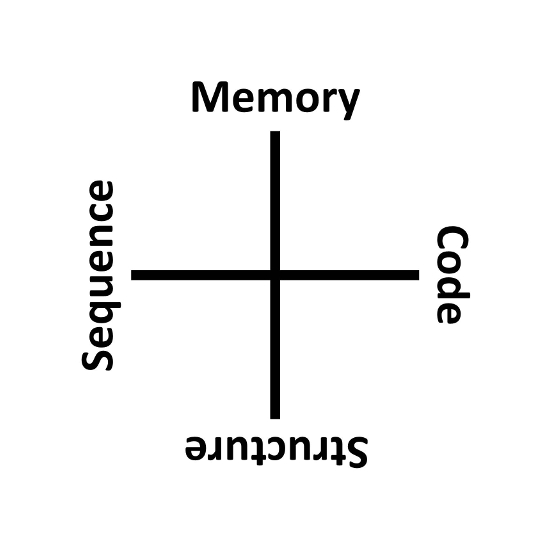
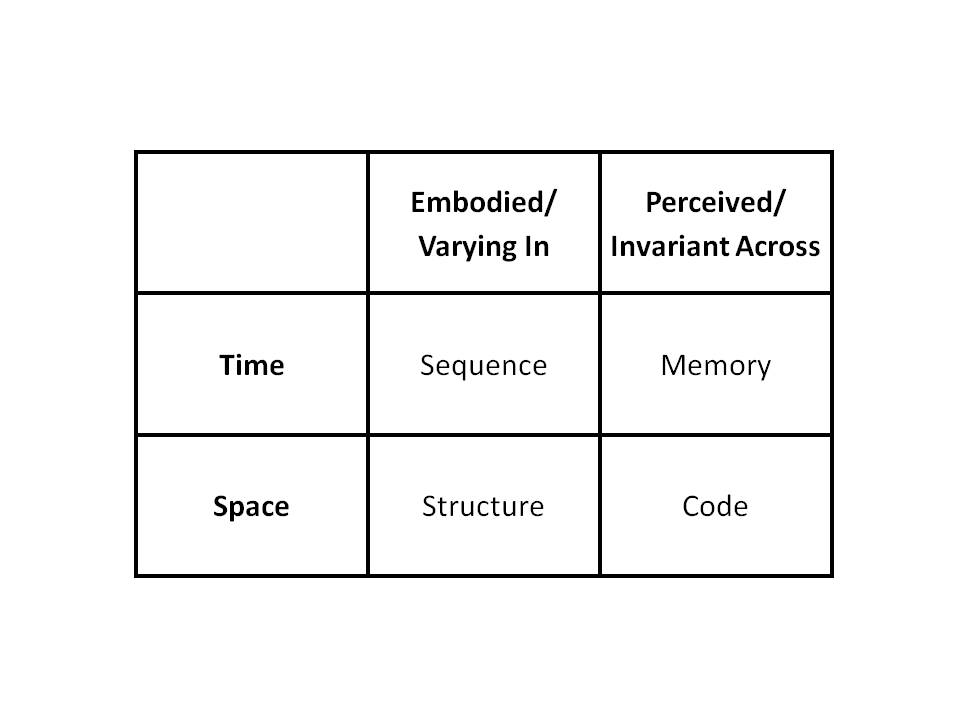
A digital universe – whether 5 kilobytes or the entire Internet – consists of two species of bits: differences in space, and differences in time. Digital computers translate between these two forms of information – structure and sequence – according to definite rules. Bits that are embodied as structure (varying in space, invariant across time) we perceive as memory, and bits that are embodied as sequence (varying in time, invariant across space) we perceive as code. Gates are the intersections where bits span both worlds at the moments of transition from one instant to the next.

— George Dyson, from Turing’s Cathedral

Further Reading:

George Dyson / Turing’s Cathedral: the origins of the digital universe

[*7.82, *7.83, *7.153]

<>

Spacetime

What is space? Is space merely extension? What makes up extension, but a set of locations?

What is time? Is time merely duration? What makes up duration, but a series of successions?

Is space a void for things to be located in, or do things create the space between them?

Is time a continuance for events to happen in, or do events create the time that joins them?

Does space and time exist objectively, or only subjectively? Are they absolute or are they relative?

Does space and time enframe all that exists? Does anything exist outside of space or time? How could we know if it did?

What is spacetime? Is it space plus time, disjoint, or is it a reciprocal enfolding of space and time, so that neither can exist without the other?

[*7.4]

<>

The Four Conic Sections

To teach superstitions as truth is a most terrible thing.

– Hypatia of Alexandria

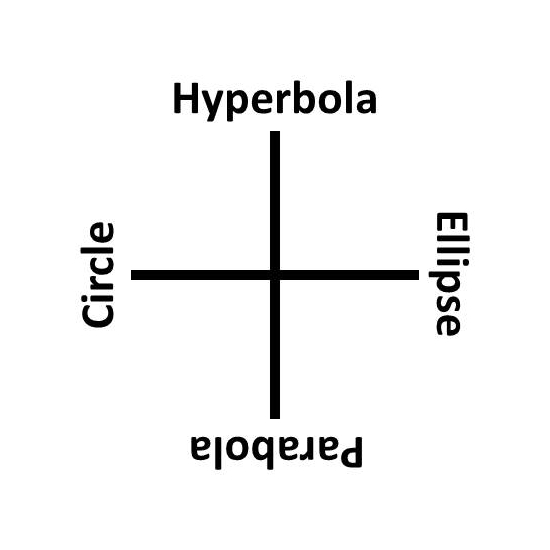
In mathematics, the four conic sections are the different shapes that can be formed by the intersection of a three dimensional right double cone and a plane: the circle, the ellipse, the parabola, and the hyperbola. The conics have been studied since the dawn of Greek mathematics. These shapes have interest as pure mathematical constructions, as well as many practical uses in applied mathematics.

Special points (focus or foci, plural) and lines (directrix or directrices, plural) can also be used to generate the conic sections in analytic geometry. A circle or parabola has one focus; the ellipse or hyperbola has two. The circle is a special case of the ellipse, one whose two foci coincide at a unique center, and in a different sense, the parabola can also be considered as a special case of the ellipse, having one of its foci at infinity. All circles can be transformed into each other by uniform scaling, a property shared by all parabolas. Thus the circle can be considered to be a singular shape, as well as the parabola. In contrast, ellipses and hyperbolas have a multitude of shapes and cannot be transformed into others of the same kind by uniform scaling. However, a nonuniform scaling or affine transformation can be used to achieve this goal. In even more abstract projective geometry, one could consider that all the conics are the same.

If the double cone is considered as the so-called light cone in Minkowski Space-time, many interesting concepts in special relativity can be considered. In this simplified model, space has two dimensions and time has one. The light cone divides all of space-time into four parts: the past, the present, the future, and the rest. The observer is located in time and space at the common apex of the two cones. Light travels on the surface of the cones, in straight lines towards and away from the observer. Anything traveling strictly within the space-time of a cone must necessarily be traveling slower than the speed of light. One cone can be thought of as the past: the interior of which contains all space-time that could have been observed by the observer, bounded by the circles of light traveling towards her. The second cone can be thought of as the future: the interior of which contains all space-time that could possibly be observed by the observer, bounded by the circles of other observers observing her light. Everything outside of the light cone cannot be observed or influenced by the observer at that instant, since light from it would have to travel faster than the speed of light in order to be seen or acted on by the observer.

Letting my analogical thinking run rampant, I can think of several associations with other fourfolds presented here. The circle is the shape of perfection, of identity and wholeness. It has one center or focus. In Minkowski Space-time, it is formed by the plane cutting the light cone at a constant time, so that all light arrives at the observer simultaneously from the past. Thus it is the shape of the knower or perspective. The parabola has the shape of gravity, the arc of an object thrown from and falling towards the earth. The shape reminds me of a reality that flies up from the opaque depths of the knowable only to fall away again. Numbers that are perfect squares may have started ancient mathematicians thinking about arithmetic. The ellipse has the shape of cosmology. Once astronomers could consider orbits of planets not to be circles or epicycles, only then science changed from idealism to empiricism. The hyperbola’s asymptotes form the crossed lines of my ever-present double duals, dividing yet unifying, as well as the profile of Minkowski Space-time. In fact, space and time occur over and over in many of the fourfolds I have considered.

Circles and ellipses could be considered the shapes of time, subjectivity, conjunction, and content: closed, finite, and bounded, yet cyclic. Parabolas and hyperbolas could be considered the shapes of space, objectivity, disjunction, and expression: open, infinite, and unbounded, acyclic.

In the recent movie Agora, the main character is Hypatia, the daughter of the last librarian of the great Library of Alexandria. A mathematician, astronomer, and philosopher, only fragments of Hypatia’s writings are available to us today. After the sack of the library, Hypatia is shown in her new study with a beautiful wooden model of the conics that she saved from destruction. For any that love wisdom over superstition, the movie is heartbreaking. As an echo to the loss of the contents of the library, it is offered (without any proof) that she considered the truth of the Heliocentric model of the solar system with the planets moving in elliptical orbits. Her senseless murder meant her insights were destroyed without legacy, falling away into the gravity of the dark unknown. Fortunately, even if she had, Copernicus and Kepler rediscovered these insights well over a thousand years later and brought them to light. The library’s loss will never be recovered.

References:

http://en.wikipedia.org/wiki/Conic_section

http://www.npr.org/blogs/13.7/2011/07/11/137743796/agora-most-intelligent-movie-on-science-and-religion-ever?ft=1&f=114424647

http://babelniche.wordpress.com/2010/09/28/more-on-agora-and-hypatia/

http://www.skepticforum.com/viewtopic.php?f=85&t=14979

[*6.170, *6.172]

<>

The Medieval Quadrivium

As Proclus wrote:  The Pythagoreans considered all mathematical science to be divided into four parts: one half they marked off as concerned with quantity, the other half with magnitude; and each of these they posited as twofold. A quantity can be considered in regard to its character by itself or in its relation to another quantity, magnitudes as either stationary or in motion. Arithmetic, then, studies quantities as such, music the relations between quantities, geometry magnitude at rest, spherics [astronomy] magnitude inherently moving.

Thus arithmetic is number in itself, music is number in time, geometry is number in space, and cosmology is number in space and time.

References:

http://en.wikipedia.org/wiki/Quadrivium

http://quadriformisratio.wordpress.com/2013/07/01/the-curriculum-in-ancient-times/

[*6.66, *7.40]

<>

The Duality of Time and Information

The states of a computing system bear information and change time, while its events bear time and change information.

from The Duality of Time and Information by Vaughan Pratt

The most promising transformational logic seems to us to be Girard’s linear logic.

— from Rational Mechanics and Natural Mathematics by Vaughan Pratt

References:

Vaughan Pratt / The Duality of Time and Information http://boole.stanford.edu/pub/dti.pdf

Vaughan Pratt / Time and Information in Sequential and Concurrent Computation http://boole.stanford.edu/pub/tppp.pdf

Vaughan Pratt / Rational Mechanics and Natural Mathematics http://chu.stanford.edu/guide.html#ratmech

 [*5.170]

<>

Aristotle’s Four Causes

Material: That from which something is made.

Efficient: That by which something is made.

Formal: That into which something is made.

Final: That for the sake of which something is made.

— from Aristotle for Everybody by Mortimer Adler

“Happy is he who can recognize the causes of things.”

Virgil

Aristotle’s Four Causes is likely the most familiar of all the double duals that I will present. The causes are closer to being “becauses” since they are usually thought of as the reasons or explanations for things. Why not call them the four prepositions?

The standard example of the four causes is what is needed for the building of a house. A house is built by the craftsmen, from the raw materials, into the form shown on blueprints, for the homeowner to live in. This and other usual examples are concerned with the making of something.

Formal and final causes have gotten the short shift since the beginning of the scientific revolution. Francis Bacon stated that the only scientific reasons for things were the efficient and material causes. For those critical of materialism this is often termed mere “matter in motion”. Matter can be thought to exist in space, and motion in time. Where does form or finality exist? I will say in space and time as well.

References:

Max Hocutt / Aristotle’s Four Becauses, in Philosophy, Vol. 49, No. 190. (Oct., 1974), pp. 385-399.

http://en.wikipedia.org/wiki/Four_causes

http://plato.stanford.edu/entries/aristotle-causality/

http://en.wikipedia.org/wiki/The_purpose_of_a_system_is_what_it_does

http://faculty.washington.edu/smcohen/320/4causes.htm

Notes:

John Sowa’s Thematic Roles: initiator, resource, essence, goal.

http://www.jfsowa.com/ontology/thematic.htm

[*4.112, *5.73, *5.162, *5.168, *7.47]

<>