Category Archives: sociology

The Four Cultures Model of Fons Trompenaars

sq_trompenaarHere is a model of cultural differences, with two major axes:

Egalitarian (Decentralized) vs. Hierarchical (Centralized)
Person (Informal) vs. Task (Formal)

Leading to the following types (and orientations):

  • Incubator (Fulfilment) [Egalitarian/Person]
  • Family (Power) [Hierarchical/Person]
  • Guided Missile (Project) [Egalitarian/Task]
  • Eiffel Tower (Role) [Hierarchical/Task]

Trompenaars’ research later expanded these into seven cultural differences (universalism vs. particularism, individualism vs. communitarianism, neutral vs. emotional, specific vs. diffuse, achievement vs. ascription, sequential vs. synchronic, and internal vs. external control)! I’m not clear on how the four map into the seven.

Another model of cultural dimensions was developed by Geert Hofstede, who first found four dimensions (power distance index, individualism vs. collectivism, uncertainty avoidance index, and masculinity vs. femininity), and later increased these to six (adding long-term vs. short-term, and indulgence vs. restraint). Again, I’m unsure what the differences are between Trompenaars’ and Hofstede’s models.

Trompenaars’ model of four cultures is somewhat similar to another fourfold I found in the article “How to Build Scenarios”. It consists of two axes: individual vs. community and fragmentation vs. coherence.

  • Ectopia [Community/Fragmented]
  • I Will [Individual/Fragmented]
  • Consumerland [Individual/Coherent]
  • New Civics [Community/Coherent]

This fourfold is also mentioned in the book “The Power of the 2×2 Matrix”, which looks quite interesting. I think it is generally geared towards business decision applications, but has a compendium of various 2×2 matrices that appear to be broadly useful.

Also, the ChangingMinds.org website looks like it has a wealth of models and introductory information about them (and not only those with four aspects).

References:

http://changingminds.org/explanations/culture/trompenaars_four_cultures.htm

https://en.wikipedia.org/wiki/Fons_Trompenaars

http://en.wikipedia.org/wiki/Trompenaars’_model_of_national_culture_differences

http://en.wikipedia.org/wiki/Hofstede’s_cultural_dimensions_theory

Books / Articles:

Fons Trompenaars, Peter Woolliams / Business Across Cultures

Lawrence Wilkinson / How to Build Scenarios (in Wired Scenarios 1.01)

Alex Lowy, Phil Hood / The Power of the 2×2 Matrix: using 2×2 thinking to solve business problems and make better decisions

[*4.130, *9.64, *9.82]

<>

The Four Requisites of Randall Collins

sq_four_requisites2“Everything in the human world has four aspects” states sociologist Randall Collins, and I couldn’t agree more. For his view of sociology, these four aspects are the Social, the Political, the Cultural, and the Economic.

These four requisites are adapted from Talcott Parsons, who was Collins’ undergraduate teacher. Parsons’ four requisites were named differently, and together they are known as the “AGIL” model. “A” stood for Adaptation, “G” for Goal-attainment, “I” for Integration, and “L” for Latency. It was also called the Structural-Functional model of society. Besides the change in names, Collins also says that the functionalism inherent in Parsons’ model has been downplayed in his because a biological, functional approach cannot model conflict, which is pervasive in human interaction.

Collins wrote a book on the historical “sociology” of philosophies, “The Sociology of Philosophies”. This book was the reason I first noted Collins, but I haven’t studied the book in any detail to note if any fourness falls out of the analysis. This kind of historical and organizational model of philosophy seems to be popular, and several others have attempted to compile something similar.

Collins also wrote “Four Sociological Traditions”, a history of sociology organized around the development of four classic schools of thought: the conflict tradition of Marx and Weber, the ritual solidarity of Durkheim, the microinteractionist tradition of Mead, Blumer, and Garfinkel, and the utilitarian/rational choice tradition. This book was the second reason I noted Collins, but not having read the book, I wasn’t sure how to interpret these four schools as a four-fold.

References:

http://sociological-eye.blogspot.com/2015/07/four-requisites-for-success-or-failure.html

https://en.wikipedia.org/wiki/Randall_Collins

https://en.wikipedia.org/wiki/Talcott_Parsons

Books by Randall Collins:

Four Sociological Traditions

The Sociology of Philosophies : a global theory of intellectual change

Philosophical Family Trees:

http://www.philosophyforlife.org/the-kevin-bacon-history-of-philosophy/

http://kevinscharp.com/Kevin%20Scharp%20-%20%20Diagrams.htm

http://www.designandanalytics.com/visualizing-the-history-of-philosophy-as-a-social-network-the-problem-with-hegel

[*3.79, *4.6, *4.7, *9.7, *9.68, *9.71]

<>


Grid-group Cultural Theory

sq_grid_group

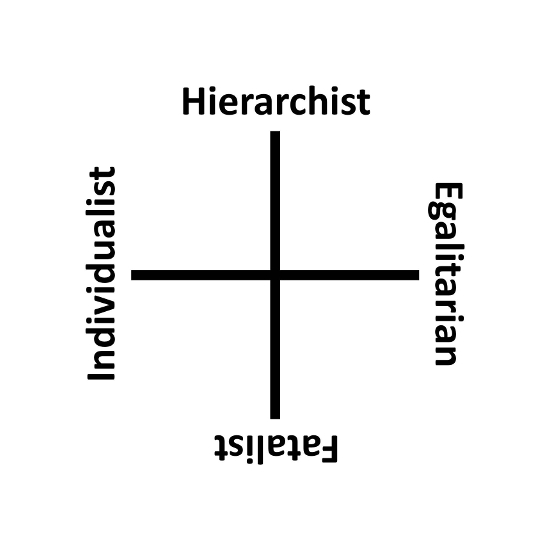
Looking over some old notes, I ran across something about the Grid-Group Cultural Theory. Also known as the Cultural Theory of Risk, it originated from the studies of anthropologist Mary Douglas and political scientist Aaron Wildavsky. Two dimensions of sociality are described, each with a low and high value (or a continuum): grid measures the differentiation between people, and group measures the cohesion or social bonds between people.

Individualist: Low group and low grid
Fatalist: Low group and high grid
Hierarchist: High group and high grid
Egalitarian: High group and low gridsq_archic_philosophers

Notes:

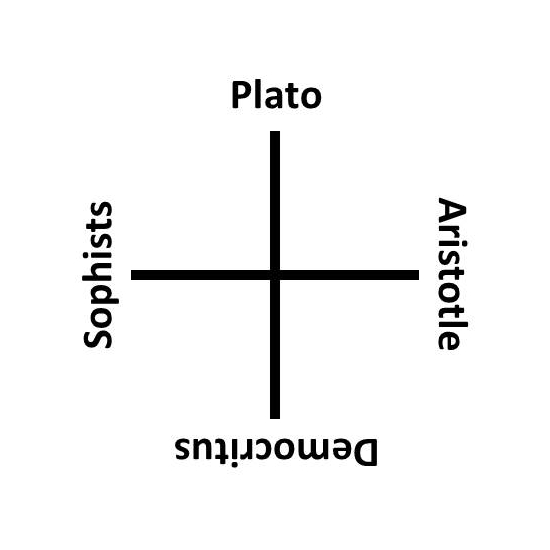
In the representation shown above, this arrangement reminds me significantly of the Archic Philosophers.

Sophists for Individualist
Democritus for Fatalist
Plato for Hierarchist
Aristotle for Egalitarian

Links:

http://en.wikipedia.org/wiki/Cultural_Theory_of_risk

http://changingminds.org/explanations/culture/grid-group_culture.htm

[*4.86, *8.112]

<>