Category Archives: Physics

Noether-Pauli-Jung, V2

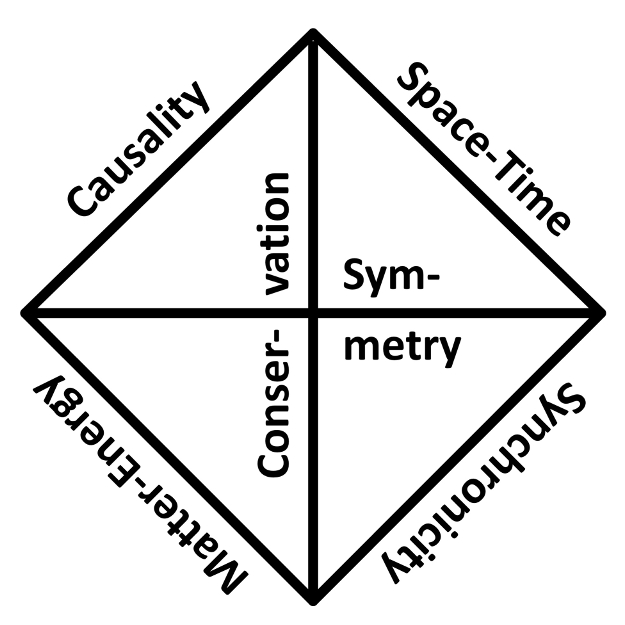
What happens when the fourfold of Noether’s Theorem is spliced together with the fourfold of Pauli-Jung? Both have Space-Time and Matter-Energy. The former has Conservation and Symmetry, and the latter has Causality and Synchronicity. And if Space-Time and Matter-Energy are both divided into Space and Time and Matter and Energy, one obtains this eight-fold.

Causality means that some action or cause in time (say a process) of things in space can have an effect (another process, say) on different things in space, and Synchronicity means that different events (say processes) separated in space can have non-causal relationships between them.  Conservation means the consistency of a quantity of matter or energy or matter-energy through time, and Symmetry means the consistency of a measure of a structure or form through space.

I am reminded of my fourfold Four Bindings, consisting of Chains, Grids, Blocks, and Cycles. Causality and Synchronicity are Chains (or non-chains for the latter) Space and Time are Grids (or flexible meshes), Matter and Energy are Blocks (or chunks of stuff), and Symmetry or Conservation are Cycles (of the group-theoretic kind or the equivalence class kind or just loops).

Further Reading:

https://en.wikipedia.org/wiki/Causality

https://en.wikipedia.org/wiki/Synchronicity

https://en.wikipedia.org/wiki/Symmetry

https://equivalentexchange.wordpress.com/2012/05/04/noethers-theorem/

https://equivalentexchange.wordpress.com/2018/01/23/atom-and-archetype/

Four Bindings

This is a reworking of a previous six-fold diagram that I believe is served better as an eight-fold.

Noether-Pauli-Jung

[*10.68, *10.155, *11.55]

<>

Colors of Light and Matter

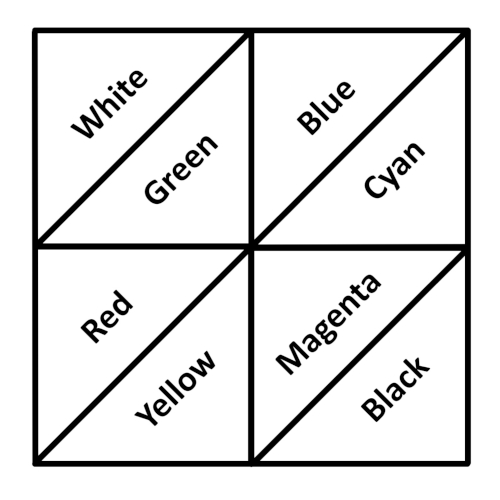
Colors of light and colors of matter operate somewhat differently from each other. Colors of lights are additive, but colors of material pigments are subtractive. Of course, they both are conditioned by the biology of the human eye and cultural preferences. Above I have tried to create a synthesis of sorts for both types, and whereas it is pleasing in some ways, it is lacking in others.

White light is combined red, green, and blue light, and combinations of green and red light yield yellow light, combinations of red and blue light yield magenta light, and combinations of green and blue light yield cyan light. Similarly, black is mixed yellow, magenta, and cyan pigments, mixing cyan and magenta pigments produce blue pigment, mixing cyan and yellow pigments produce green pigment, and mixing yellow and magenta pigments produce red pigment.

Further Reading:

Primary Colors of Light and Pigment

[*11.63]

<>


The Standard Model of Particle Physics

Until a few years ago, the Standard Model of particle physics had sixteen particles verified. Recently, the Higgs Boson was added, so just imagine another triangle hanging off somewhere. Or, alternately, one may combine the Z and W Bosons when adding the Higgs, so a sixteen-fold scheme is maintained.

Also, the Standard Model is much more than a list of these seventeen particles and their attributes. Not shown are a plethora of equations that describe the properties of these entities and their interactions.

I admit that this diagram is not very useful for scientific knowledge, but the reader may contemplate it as they please.

Further Reading:

https://en.wikipedia.org/wiki/Standard_Model

https://home.cern/about/physics/standard-model

https://physics.info/standard/

Also:

Can We Understand the Standard Model?

[*10.148]

<>


Noether-Pauli-Jung

What happens when the fourfold of Noether’s Theorem is spliced together with the fourfold of Pauli-Jung? Both have Space-Time and Matter-Energy. The former has Conservation and Symmetry, and the latter has Causality and Synchronicity.

I had to remind myself that Conservation means consistency (of matter or energy) through time (and space), and Symmetry means consistency (of form) through space (and time), so in some sense they are dualistic.

Combined, one has the three axes of dual concepts, represented above.

Further Reading:

https://equivalentexchange.wordpress.com/2012/05/04/noethers-theorem/

https://equivalentexchange.wordpress.com/2018/01/23/atom-and-archetype/

[*10.68]

<>

Atom and Archetype

A few weeks ago I ran across this nice review of the book Atom and Archetype: the Pauli-Jung letters 1932-1958. This is a collection of letters exchanged between psychiatrist Carl Jung and physicist Wolfgang Pauli over a course of years. Evidently, Pauli was quite the metaphysician and Jung was intrigued by Einstein’s physics of relative space and time. Together in dialectic they argued and struggled to join together the disparate notions of mind and matter.

What mainly caught my eye was a diagram that I’ve slightly altered and shown above. I’ve mainly just replaced energy with matter-energy for two reasons: first because matter and energy are inter-convertible and second because matter conditions space. This results in similarity to the fourfold diagram for Lucretius that I’ve shown before, consisting of Particles, the Void, Falling, and Swerving.

Further Reading:

https://www.brainpickings.org/2017/03/09/atom-and-archetype-pauli-jung/

Carl Jung and Wolfgang Pauli / Atom and Archetype: the Pauli-Jung letters 1932-1958, Princeton University Press; Updated edition (July 21, 2014)

https://equivalentexchange.wordpress.com/2011/10/10/lucretius-on-the-nature-of-things/

https://equivalentexchange.wordpress.com/2014/02/17/matter-energy-space-and-time/

https://equivalentexchange.wordpress.com/2015/01/16/wave-particle-duality/

https://equivalentexchange.wordpress.com/2012/05/04/noethers-theorem/

[*10.60]

<>

A Rosetta Stone

Abstract of Physics, Topology, Logic and Computation: A Rosetta Stone by John Baez and Michael Stay:

In physics, Feynman diagrams are used to reason about quantum processes. In the 1980s, it became clear that underlying these diagrams is a powerful analogy between quantum physics and topology: namely, a linear operator behaves very much like a “cobordism”. Similar diagrams can be used to reason about logic, where they represent proofs, and computation, where they represent programs. With the rise of interest in quantum cryptography and quantum computation, it became clear that there is extensive network of analogies between physics, topology, logic and computation. In this expository paper, we make some of these analogies precise using the concept of “closed symmetric monoidal category”. We assume no prior knowledge of category theory, proof theory or computer science.

  • Physics
  • Logic
  • Topology
  • Computation

Perhaps Category Theory is a “Fifth Essence”?

Further Reading:

Click to access rose3.pdf

https://arxiv.org/abs/0903.0340

[*9.168, *10.50]

<>

The Sackur-Tetrode Equation

sq_sackur_tetrode

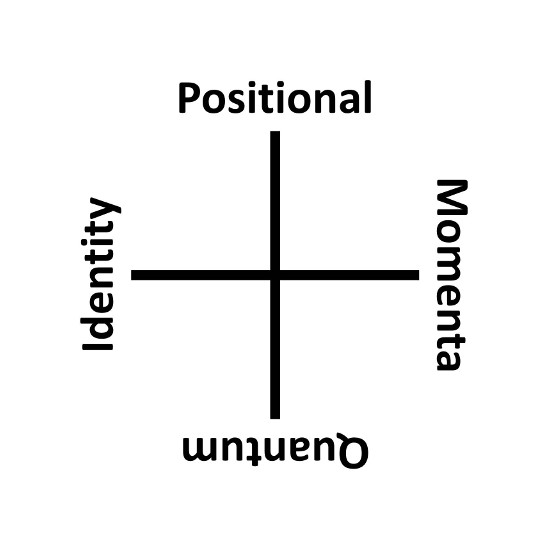
The Sackur-Tetrode Equation expresses the entropy of a monatomic classical ideal gas. Including quantum aspects of the system gives this formula a more detailed description than it would have otherwise. Above I’ve tried to represent the four uncertainties that constitute the equation in its information theoretic version: positional, momenta, quantum, and identity.

From Wikipedia:

In addition to using the thermodynamic perspective of entropy the tools of information theory can be used to provide an information perspective of entropy. The physical chemist Arieh Ben-Naim rederived the Sackur–Tetrode equation for entropy in terms of information theory, and in doing so he tied in well known concepts from modern physics. He showed the equation to consist of the sum of four entropies (missing information) due to positional uncertainty, momenta uncertainty, the quantum mechanical uncertainty principle and the indistinguishability of the particles.

http://en.wikipedia.org/wiki/Sackur%E2%80%93Tetrode_equation

http://en.wikipedia.org/wiki/Entropy_%28information_theory%29

[*9.4]

<>

Wave-Particle Duality

sq_wave_particle_dualityIs the fundamental nature of light and matter more like a wave or is it more like a particle? After hundreds of years of scientific research the answer is … Yes! Light and matter have aspects of both: sometimes one and sometimes the other. Kind of like that duck-rabbit illusion where the drawing flips back and forth between a duck or a rabbit.

Now that we have the irreconcilable duality of wave and particle, can we add to the confusion and enlarge it into a four-fold? Two additional aspects (from physics) come to mind: motions, as in the motions of particles, and fields, as in electric and magnetic fields.

We immediately can see this four-fold as a play of dimensions: (idealized) particles have 0 dimensions, motions have 1 (along a path), waves have 2 (or more), fields have 3 (or more).

sq_lucretiusWe can also see this four-fold in a weak analogy with the Four Elements: particles for earth, waves for water, motions for fire, and fields for air (or space). Also compare to the four-fold for Lucretius!

Should fields above be replaced with wave-functions? I guess a wave-function is a kind of field of probabilities of existence over space and time, so perhaps it makes no difference!

Links:

http://en.wikipedia.org/wiki/Wave%E2%80%93particle_duality

http://en.wikipedia.org/wiki/Field_%28physics%29

http://en.wikipedia.org/wiki/Rabbit%E2%80%93duck_illusion

http://dl.acm.org/citation.cfm?id=2811288&picked=formats

Charis Anastopoulos / Particle or Wave: The Evolution of the Concept of Matter in Modern Physics

Notes:

I like Forces or Speeds better than Motions. Atoms better than Particles at top?

[*7.152, *8.32]

<>


Maxwell’s Equations

sq_maxwell_eq2

Actually, just the left hand side of the equations, because it looks better that way. The right hand sides are just a click away.

E and B are the electric and magnetic fields, respectively. is the “del” operator.

The divergences ∇ · E and ∇ · B are the “fields emanating from the sources.”

The curls ∇ x E and ∇ x B are the “circulation of the fields.”

Further Reading:

http://en.wikipedia.org/wiki/Maxwell%27s_equations

<>

Matter, Energy, Space, and Time

sq_MESTThe first little ball is red and green
Oh it’s pretty, yes I know what you mean
I call it Substance, do dio dio do
And what it will do I just don’t know

The next little ball is silver and black
See it chase the first one forward and back
I call it Space, do dio dio do
What it will do I just don’t know

The next little ball is too hot to hold
I have to keep tossing it and I hope it gets cold
I call it Power do dio dio dio
What it will do I just don’t know

The next little ball is orange and blue
I can’t juggle four so I’ll toss it to you
And I call it Time…

— From “The Juggler’s Song” by The Incredible String Band

Here’s a nice little fourfold that I’ve overlooked until now, kind of like a four-leaf clover. If you search for images of matter, energy, space, and time, several websites show a diagram quite similar to this, and some have interesting things to say.

One shows free energy instead of energy in general. Free energy is energy that is able to do work, and that is an important distinction, especially if you are thinking about the Four Causes. Then the four can be considered fundamental resources.

There are some other things to consider from these references. One is that there is the familiar equivalence between matter and energy. Another is the equivalence principle between gravity and acceleration.

Also, there are obvious analogies between this fourfold and the Four Elements and the Four States of Matter. sq_Noether's TheoremI have also used the pairs space-time and matter-energy as two parts of the fourfold Noether’s Theorem, the other two parts being symmetry and conservation. There is also the fourfold Spacetime that has some similarities to this one. And let’s not forget the atomism of On the Nature of Things by Lucretius.

Be sure and watch the upcoming television series Cosmos: a Spacetime Odyssey, hosted by Neil deGrasse Tyson. I’m sure there will be much talk of Matter, Energy, Space, and Time.

Notes:

There is even a term coined for Matter-Energy-Space-Time: MEST. Of course, MEST also stands for Math, Engineering, Science, and Technology! No, sorry, that’s STEM!

Links:

http://abyss.uoregon.edu/~js/ast123/lectures/lec09.html

http://billmoyers.com/2014/01/10/the-new-cosmos-a-spacetime-odyssey/

[*7.90, *8.32]

<>