 Further Reading:
https://eclipse2017.nasa.gov/science
https://en.wikipedia.org/wiki/Solar_eclipse_of_August_21,_2017
<>
 A digital universe – whether 5 kilobytes or the entire Internet – consists of two species of bits: differences in space, and differences in time. Digital computers translate between these two forms of information – structure and sequence – according to definite rules. Bits that are embodied as structure (varying in space, invariant across time) we perceive as memory, and bits that are embodied as sequence (varying in time, invariant across space) we perceive as code. Gates are the intersections where bits span both worlds at the moments of transition from one instant to the next.
— George Dyson, from Turing’s Cathedral
Further Reading:
George Dyson / Turing’s Cathedral: the origins of the digital universe
Notes:
Embodied as Structure, Perceived as Memory
Invariant across Time: ¬ΔT
Varying in Space: ΔS
Embodied as Sequence, Perceived as Code
Varying in Time: ΔT
Invariant across Space: ¬ΔS
https://equivalentexchange.wordpress.com/2012/04/12/a-digital-universe/
[*7.82, *7.83, *7.153, *10.14]
<>
 As conservative capitalism whips itself into an ecstasy of fevered apoplexy over the change in political climate, it is fun to step back and imagine what might transpire after capitalism’s eventual passing. To offer help, Peter Frase has written the excellent and cautionary “Four Futures: life after capitalism”.
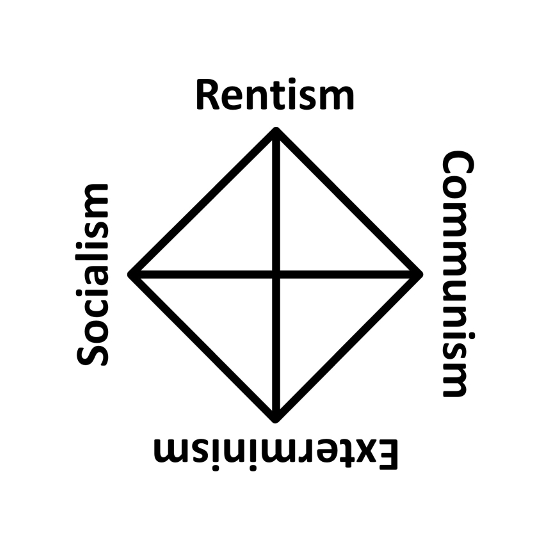
Frase gives us four idealized futures blocked out by a matrix of two variables each ranging over two possibilities: 1) the structure of the social environment being either egalitarian or hierarchical, and 2) the resources of the natural environment being either scarce or abundant. What’s nice about the descriptions of these futures are the ample examples from science fiction media: TV, movies, novels, etc.
One assumption over all four futures is that, given sufficient resources of material and energy, technology, automation, and robotics will improve to the extent that human work as we know it will eventually be made unnecessary. Another is that climate change is real and will demand solutions and amelioration or it will only get much worse. And a big take home message is that the rich and powerful are in a much better position to benefit from ignoring climate change than you and me.
What will happen to the common person when their labor is superfluous? Not detailed are the possibilities if even the humans at the top are deemed unnecessary and the machines revolt. In order of diminishing happiness for most of us:
The cover has a nice iconography for the futures: a conveyor belt on a 3D printer assembly line shows a glass of wine for Communism (Cheers!), a key hole for Rentism, a watering can for Socialism, and a skull for Exterminism (Ouch!).
References:
Peter Frase / Four Futures: life after capitalism
Some better reviews than mine:
https://lareviewofbooks.org/article/art-possible-peter-frases-four-futures
Notes:
There’s a similar fourfold of futures I forgot I mentioned in my article on Trompenaars, although fragmentation-coherence is used instead of scarcity-abundance, and there is a more positive spin:
https://equivalentexchange.wordpress.com/2015/12/18/the-four-cultures-model-of-fons-trompenaars/
Also, Frase has a blog that can be found at:
http://www.peterfrase.com/blog/
[*9.82, *9.190, *9.191]
<>
 Is humankind selfish by nature or altruistic? Are people competitive or cooperative? Tribal or cosmopolitan? The short answer to all these questions is yes. We are both of those things, and often at the same time.
In this new age of nationalism and protectionism, we are diminished by our choices made from fear and small mindedness. Almost all the knowledge we have is from the choices, both good and bad, made by our forebearers, and those they have met and helped and been helped by along the way. Certainly our individual hard work does us credit, but most of the credit goes to what is automatically given to us at birth.
This includes but is not limited to: our language and our culture; our knowledge and science; our heritage and cultural relationships; our technology and skills; our education and institutions. All this and more, generated by our ancestor’s struggle to survive and flourish, as well as for the survival and flourishing of their progeny and their society.
As we think the horizons of our future recede we squabble over our claims and our distrust. I think we are made better more by our sharing of knowledge than our hoarding. Of course the things shared must have value; they cannot be lies or false or fake. Let us extend our concerns to all of humankind and to the earth we share.
Pass it on!
Also See:
Invention and Discovery
https://equivalentexchange.wordpress.com/2016/04/15/invention-and-discovery/
[*9.87]
<>
 It is often asked, why is there something rather than nothing?
Instead why not ask, why is there a rich diversity of things, rather than a dull sameness? And even though the closer and the further one looks the diversity is almost without limit, one also sees the world divided into natural kinds that partition it into a differentiated but interrelated mixture.
Several ancient philosophers thought that the entire world was an indivisible whole, a solid “being”. Others thought that you can’t even step into the same river twice, thus a fluid “becoming”. The real world seems to be somewhere in-between these two poles, moving continuously back and forth to now generate difference and newness, and then returning to sameness and oldness, and next continuing on to newness again.
Why drives these generative processes? One could say evolution, but evolution merely means “change over time”. And it would need to be an evolution at all levels of the cosmos, from the physical constituents of matter to the psychological constructs of culture. What do these disparate systems have in common?
Perhaps the commonality lies in the relations between small and large ensembles of chunks of space and time. In theories of statistical thermodynamics, the associations between micro states and macro states as well as micro events and macros events may drive entropy.
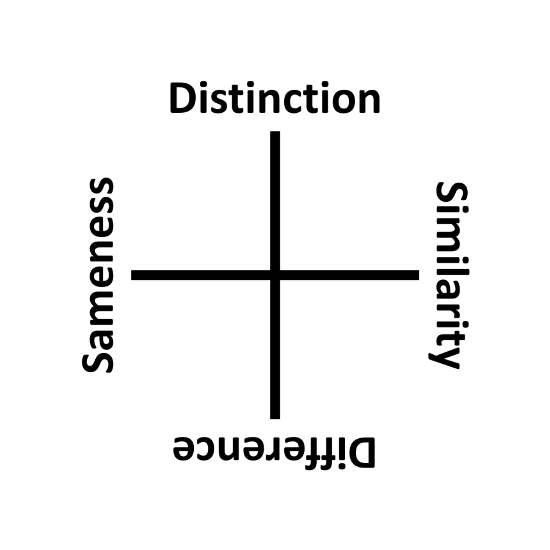
Here I present a schema that divides the continuum between one and many into four: Sameness, Similarity, Distinction, and Difference.
A member of the “being” camp might say these aren’t really different, whereas one from the “becoming” camp could say there really isn’t any sameness to begin with. Here I’ve chosen neither camp but struggled to bridge the gap between them.
References:
https://en.wikipedia.org/wiki/Being
https://en.wikipedia.org/wiki/Becoming_(philosophy)
https://en.wikipedia.org/wiki/Distinction_without_a_difference
Also see:
[*9.110]
<>
 What drives the arrow of time? How does macroscopic irreversibility arise from microscopic reversibility? What makes entropy increase for closed systems, but decrease in certain open systems?
From the viewpoint of statistical thermodynamics, one can model the evolution of any discrete system by its possible macro states and micro states.
Those macro states having more possible micro states will be more likely to occur, and the macro states having less micro states will be less likely.
Similarly, those macro events caused by more possible micro events will be more likely to obtain, and the macro events caused by less micro events will be less likely.
Therefore, the probabilities of how the past effects the future are determined by the arrangements of the parts making up the micro states and macro states, and similarly the chains of causes constituting the relations between the micro events and macro events.
Apparently time is a progression of events unfolding from the more ordered to the less ordered. However, we know that local order can increase while global order decreases, even if we are unclear as to why. Information and organization can grow; nature and biological evolution are proof of it.
So there is an arrow of time, yet one might think that time is more like a river. (Heraclitus said you could not step into the same river twice.) There is a main flow of the current that carries most everything downstream to disorganization and increasing entropy, but there are eddies here and there that actually increase information and organization.
What enables this to happen? Some say thermodynamic gradients. Some say quantum entanglement. Some say gravity. Some say by the expansion of the universe. Some say dark matter or dark energy. Some say sorting processes.
Can we think of time as being “reversed” in these eddies where information and organization increase locally? No, but it’s an interesting (unscientific) thought.
References and Further Reading:
http://www.informationphilosopher.com/problems/arrow_of_time/
https://en.wikipedia.org/wiki/Arrow_of_time
https://en.wikipedia.org/wiki/Statistical_mechanics
https://en.wikipedia.org/wiki/Entropy
https://en.wikipedia.org/wiki/Introduction_to_entropy
https://en.wikipedia.org/wiki/Entropy_(arrow_of_time)
https://en.wikipedia.org/wiki/Entropy_(statistical_thermodynamics)
https://en.wikipedia.org/wiki/Entropy_(classical_thermodynamics)
https://en.wikipedia.org/wiki/Entropy_(order_and_disorder)
https://en.wikipedia.org/wiki/Entropy_(information_theory)
https://en.wikipedia.org/wiki/Sorting
Italo Scardovi / Time and Chance: a statistical hendiadys
https://rivista-statistica.unibo.it/article/viewFile/75/71
[*7.136, *8.43]
<>
 Four new elements have been named! They are Nihonium (Nh 113), Moscovium (Mc 115), Tennessine (Ts 117), and Oganesson (Og 118).
References:
IUPAC is naming the four new elements nihonium, moscovium, tennessine, and oganesson
Also see:
https://equivalentexchange.wordpress.com/2010/07/21/the-four-elements-of-empedocles/
[*9.136]
<>
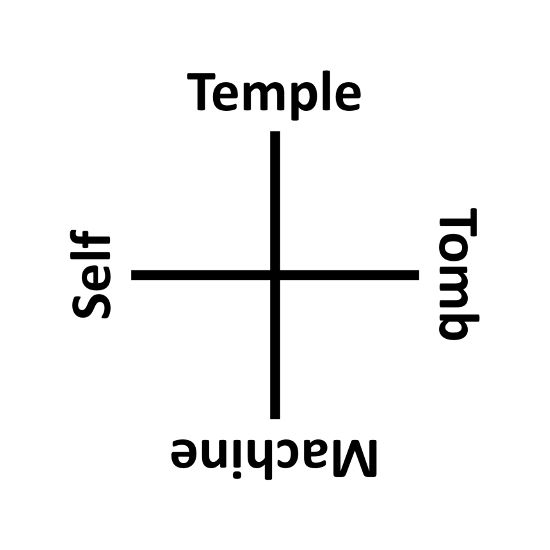 As an addendum to my previous post, I remembered the nice article below.
Anthony Synnott / Tomb, Temple, Machine and Self: The Social Construction of the Body, The British Journal of Sociology, Vol. 43, No. 1 (Mar., 1992), pp. 79-110
Abstract:
The body is socially constructed; and in this paper we explore the various and ever-changing constructions of the body, and thus of the embodied self, from the Greeks to the present. The one word, body, may therefore signify very different realities and perceptions of reality; and we consider briefly how and why these meanings changed.
Plato believed the body was a ‘tomb’, Paul said it was the ‘temple’ of the Holy Spirit, the Stoic philosopher Epictetus taught that it was a ‘corpse’. Christians believed, and believe, that the body is not only physical, but also spiritual and mystical, and many believed it was an allegory of church, state and family. Some said it was cosmic: one with the planets and the constellations. Descartes wrote that the body is a ‘machine’, and this definition has underpinned bio-medicine to this day; but Sartre said that the body is the self.
In sum, the body has no intrinsic meaning. Populations create their own meanings, and thus their own bodies; but how they create, and then change them, and why, reflects the social body.
Also a book!
Anthony Synnott / The Body Social: symbolism, self, and society (1993)
[*6.142, *9.139]
<>
 “Suppose,” said Zeno, “that Achilles and a tortoise are planning to race”.
Such is the beginning of a famous thought experiment by an ancient philosopher. Since athletic Achilles was much faster than the slow tortoise, he let the tortoise start first. But alas, he could never catch up to it, since every time Achilles made it to where the tortoise had been, the tortoise had moved just a little further ahead. Of course Achilles was faster so he had to pass the tortoise quickly unless it had started near the finish line. So, paradox!
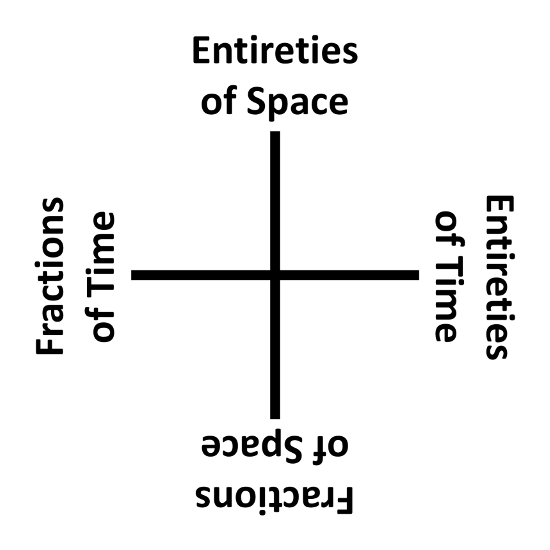
Most of the paradoxes of Zeno were about fractions and entireties of time and space. Can an infinite series of fractions of space add up to a finite entirety of space in a finite entirety of time? Some might say that integral calculus solves these basically mathematical problems, yet others think they point to metaphysical issues as regards to the discreteness and the continuity of time and space.
This fourfold reminds me of my previous fourfold Spacetime which dealt with succession (as parts of time), location (as parts of space), extension (as wholes of space), and duration (as wholes of time). It must have been in the back of my mind.
References:
https://en.wikipedia.org/wiki/Zeno%27s_paradoxes
https://equivalentexchange.wordpress.com/2011/09/23/spacetime/
[*9.122]
<>
 For almost 100 years, there have been linkages forged between certain notions of logic and of computation. As more associations have been discovered, the bonds between the two have grown stronger and richer.
The separate work of various logicians and computer scientists (and their precursors) can be paired:
Logic and computation are the sequential chains of efficient causation and actions. Propositions and types are the abstract grids of formal causation and structures. Proofs and programs are the normative cycles of final causation and functions. Simplification and evaluation are the reductive solids of material causation and parts.
References:
Philip Wadler / Propositions as Types, in Communications of the ACM, Vol. 58 No. 12 (Dec 2015) Pages 75-85.
http://cacm.acm.org/magazines/2015/12/194626-propositions-as-types/fulltext
Preprint at
Click to access propositions-as-types.pdf
Also see:
http://www.drdobbs.com/old-ideas-form-the-basis-of-advancements/184404384
https://en.wikipedia.org/wiki/Hindley%E2%80%93Milner_type_system
https://en.wikipedia.org/wiki/System_F
https://en.wikipedia.org/wiki/Curry%E2%80%93Howard_correspondence
[*9.92-9.94]
<>
Because there are way more than seven wonders in the world.
Always Forward Between Heaven and Earth
Psychological Musings
Critiquing anime and everything else
"For man has closed himself up, till he sees all things thro' narrow chinks of his cavern" -- William Blake
Category Theory, Haskell, Concurrency, C++
Reviewing fascinating science books since 2017
Every Fourth Thing
Derek Wise's blog: Mathematics, Physics, Computing and other fun stuff.
integrating 4 binary opposites in life, learning, art, science and architecture
integrating 4 binary opposites in life, learning, art, science and architecture
Chasing the Paper Rabbit
experiments in a reaction from the left
A blog about computers, evolution, complexity, cells, intelligence, brains, and minds.
mind maps, infographics, and expositions
neat ideas from unusual places
Introduction to a Quadralectic Epistomology
Astronomy, space and space travel for the non scientist
Every Fourth Thing
A Serious Look at Trivial Things
A Survey of Tetradic Testimonials in Architecture
Musings from a Naturalist
Why Evolution is True is a blog written by Jerry Coyne, centered on evolution and biology but also dealing with diverse topics like politics, culture, and cats.
Four-fold thinking4you
Craig Weinberg's Cosmology of Sense
Purveyors of Fine Anime Reviews and Ratings Since 2010
Between Subject and Object
Every Fourth Thing
Every Fourth Thing
Every Fourth Thing
Every Fourth Thing
Every Fourth Thing
Sometimes those Sticking their Heads in the Sand are Looking for Something Deep
Online Home of Christopher Vitale, Associate Professor of Media Studies, The Graduate Program in Media Studies, Pratt Institute, Brooklyn, NY.
Linking Ideas
RESEARCHING THE DEMANDS OF THOUGHT
Explorations in the Paradoxes of Meaning
"The centaur of classical metaphysics shall be mated with the cheetah of actor-network theory."
objects & things, design, art & technology
 Equivalent Exchange