Category Archives: Psychology

A Four-dimensional Theory of Self-governance

Here’s an interesting sounding book by Suzy Killmister: “Taking the Measure of Autonomy: a four-dimensional theory of self-governance.”

The Amazon blurb:

This book takes a radically different approach to the concept of autonomy. Killmister defends a theory of autonomy that is four-dimensional and constituted by what she calls ‘self-definition,’ ‘self-realisation,’ ‘self-unification,’ and ‘self-constitution.’ While sufficiently complex to inform a full range of social applications, this four-dimensional theory is nonetheless unified through the simple idea that autonomy can be understood in terms of self-governance. The ‘self’ of self-governance occupies two distinct roles: the role of ‘personal identity’ and the role of ‘practical agency.’ In each of these roles, the self is responsible for both taking on, and then honouring, a wide range of commitments. One of the key benefits of this theory is that it provides a much richer measure not just of how autonomous an agent is, but also the shape—or degree—of her autonomy. Taking the Measure of Autonomy will be of keen interest to professional philosophers and students across social philosophy, political philosophy, ethics, and action theory who are working on autonomy.

From the NDPR review:

This ambitious book cuts against the grain. Killmister lays out a framework for thinking about autonomy that eschews the received view in many quarters. Difficulty reconciling the various uses to which “autonomy” is put has led to calls for a moratorium on our use of the term. Killmister demurs. Good for her. Her view centers on the idea that there are several dimensions to autonomy, and while they are related, one may fall short in one but not the others. The result is a nuanced theory of autonomy that illuminates how the concept applies in a range of domains and to a range of agents.

Further Reading:

https://ndpr.nd.edu/news/taking-the-measure-of-autonomy-a-four-dimensional-theory-of-self-governance/

The Fourfold Self

[*10.83, *10.84]

<>


The Myers-Briggs Type Indicator

I am not a number, I am a free man!

— Number Six from the 1960’s television series, The Prisoner

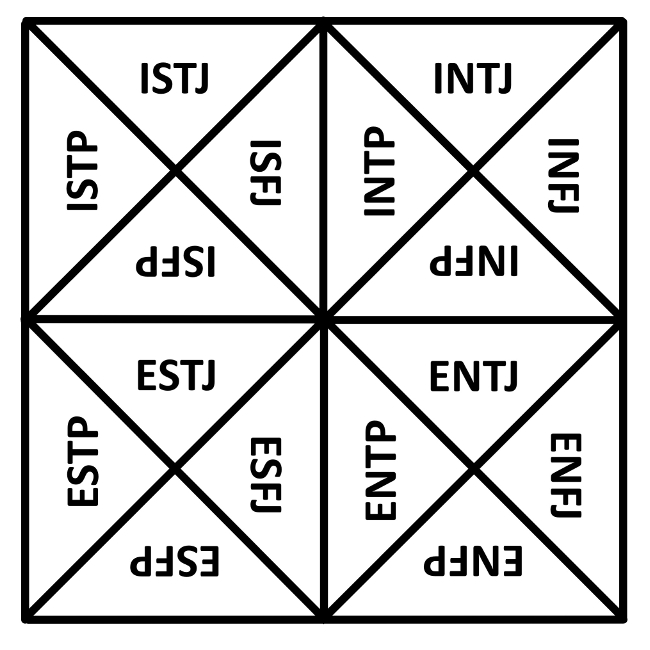
The Myers-Briggs Type Indicator (MBTI) is usually shown as a four-by-four grid of “personality types”. Rebel that I am, here is a triangular version for your personal edification or confusion.

Interestingly, some say that there is an association between the MBTI and Astrology. If they are being positive, they are seeing parallels between the personality pigeonholes of the two schemas. If they are being negative, they are saying that both classification systems are pseudo-science rubbish.

One might think that this is part of the larger discussion of a person being a “blank slate”, and whether we are determined by nature or nurture or a combination of the two, or are free to be who we desire to be.

Further Reading:

https://en.wikipedia.org/wiki/Myers%E2%80%93Briggs_Type_Indicator

The Four Dichotomies of the MBTI

https://en.wikipedia.org/wiki/The_Prisoner

More Images of the MBTI:

https://www.google.com/search?q=mbti&tbm=isch

Comparisons of MBTI and Astrology to chew on:

https://www.porosconsulting.com/news-notes/2018/3/8/your-myers-brigg-personality-type-according-to-your-zodiac-sign

[*10.150]

<>


Seven Sermons to the Dead, Part 2

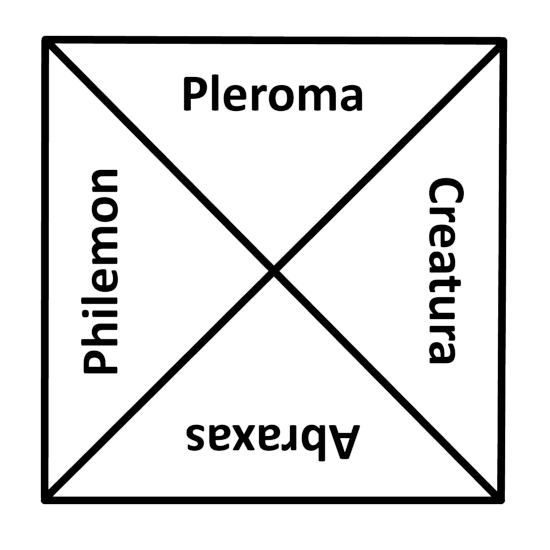
Here with inadequate description is another fourfold of entities from Seven Sermons to the Dead.

  • The Pleroma: The spiritual universe as the abode of gods and of the totality of the divine powers and emanations.
  • The Creatura: The living world, subject to perceptual difference, distinction, and information
  • Abraxas: The supreme power of being transcending all divinities and demons and uniting all opposites into one
  • Philemon: Jung’s spiritual guide, the narrator

Further Reading:

https://en.wikipedia.org/wiki/Seven_Sermons_to_the_Dead

https://en.wikipedia.org/wiki/Pleroma

https://en.wikipedia.org/wiki/Abraxas

Who is Philemon?

[*10.76]

Seven Sermons to the Dead

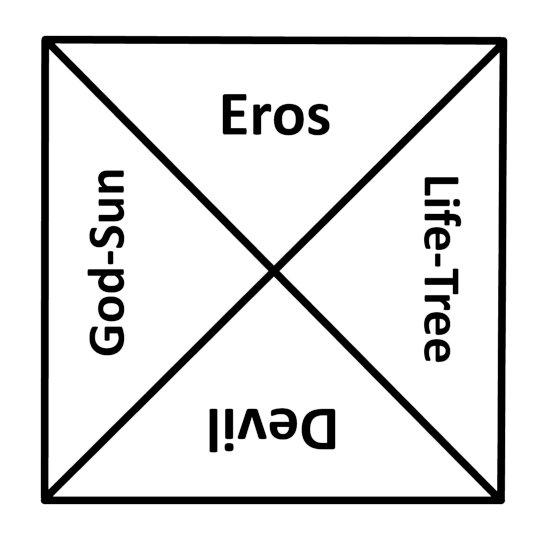
Four is the number of the principal gods, as four is the number of the world’s measurements.

One is the beginning, the god-sun.

Two is Eros; for he bindeth twain together and outspreadeth himself in brightness.

Three is the Tree of Life, for it filleth space with bodily forms.

Four is the devil, for he openeth all that is closed. All that is formed of bodily nature doth he dissolve; he is the destroyer in whom everything is brought to nothing.

— Carl Jung, from Seven Sermons to the Dead

Further Reading:

http://gnosis.org/library/7Sermons.htm

https://jungiangenealogy.weebly.com/seven-sermons.html

https://en.wikipedia.org/wiki/Tree_of_life

[*10.76]

<>

Atom and Archetype

A few weeks ago I ran across this nice review of the book Atom and Archetype: the Pauli-Jung letters 1932-1958. This is a collection of letters exchanged between psychiatrist Carl Jung and physicist Wolfgang Pauli over a course of years. Evidently, Pauli was quite the metaphysician and Jung was intrigued by Einstein’s physics of relative space and time. Together in dialectic they argued and struggled to join together the disparate notions of mind and matter.

What mainly caught my eye was a diagram that I’ve slightly altered and shown above. I’ve mainly just replaced energy with matter-energy for two reasons: first because matter and energy are inter-convertible and second because matter conditions space. This results in similarity to the fourfold diagram for Lucretius that I’ve shown before, consisting of Particles, the Void, Falling, and Swerving.

Further Reading:

https://www.brainpickings.org/2017/03/09/atom-and-archetype-pauli-jung/

Carl Jung and Wolfgang Pauli / Atom and Archetype: the Pauli-Jung letters 1932-1958, Princeton University Press; Updated edition (July 21, 2014)

https://equivalentexchange.wordpress.com/2011/10/10/lucretius-on-the-nature-of-things/

https://equivalentexchange.wordpress.com/2014/02/17/matter-energy-space-and-time/

https://equivalentexchange.wordpress.com/2015/01/16/wave-particle-duality/

https://equivalentexchange.wordpress.com/2012/05/04/noethers-theorem/

[*10.60]

<>

I Dare You!

In 1931, William H. Danforth published the book “I Dare You! Four fold development: stand tall, think tall, smile tall, and live tall.” Perhaps he is better remembered as the founder of the Ralston Purina Company, maker of many fine products and particularly of Chex Cereals. Indeed, Danforth saw life as a type of checkerboard, such that four key components (or “squares”) – the mental, the physical, the social, and the religious – needed to be in balance in order to achieve fulfillment and success in life.

His book was the expression of his personal philosophy of “Four-square” personal development, and was a early example of the “self-help” style of book that has become so popular. Success! Fulfillment! So much can become yours if you take chances and work hard. If only life was that simple! His four aspects of personal development are

  • Physical: Stand Tall!
  • Mental: Think Tall!
  • Social: Smile Tall!
  • Spiritual: Live Tall!

Further Reading:

https://en.wikipedia.org/wiki/William_H._Danforth

William H. Danforth / I Dare You! Only $1 in Kindle format from Amazon! Worth every penny! Don’t delay, buy today!

[*10.31]

<>

A Study in Synthesis

An early work (1934) in the study of fourfolds is James H. Cousins’ “A Study in Synthesis”, which is available for downloading at the link below.

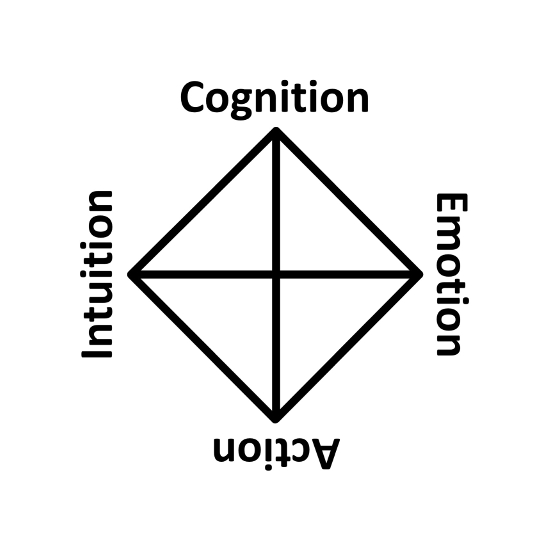
Cousins’ key fourfold is

  • Intuition
  • Cognition
  • Emotion
  • Action

which is similar to Jung’s psychological types except Action replaces Sensation.

Each fourth also has two movements (passive and active), and two sub-movements (subjective and objective) (see Fig. 20):

  • Intuition:
    • Illumination
      • Cosmic
      • Individual
    • Inspiration
      • Creative Intention
      • Creative Imagination
  • Cognition:
    • Contemplation (Philosophy)
      • Metaphysical
      • Pragmatical
    • Observation (Science)
      • Pure
      • Applied
  • Emotion:
    • Aspiration (Religion)
      • Mystical
      • Cermonial
    • Creation (Art)
      • Idealistic
      • Realistic
  • Action:
    • Organization
      • Ideas
      • Materials
    • Execution
      • Subjective
      • Objective

Cousins was an influence to Patrick Geddes, renowned as a town planner, who had several fourfolds of his own.

Further Reading:

James H. Cousins / A Study in Synthesis

https://archive.org/details/in.ernet.dli.2015.501469

James Cousins (22 Jul 1873 – 20 Feb 1956): An Effort of Synthesis

http://hodgers.com/mike/patrickgeddes/feature.html

https://en.wikipedia.org/wiki/James_Cousins

[*9.12]

<>


The Four Dichotomies of the MBTI

In the Myer-Briggs Type Indicator, there are four pairs of opposites which sort personalities into sixteen different types. These four pairs of opposites are:

  • Extroversion vs. Introversion (E, I)
  • Sensing vs. Intuition (S, N)
  • Thinking vs. Feeling (T, F)
  • Judging vs. Perceiving (J, P)

The codes for these sixteen types are formed by listing one choice per opposite (E,I), (S,N), (T,F), and (J,P), written ESTJ, for example. Interestingly, four special subsets xNTx, xNFx, xSxJ, xSxP, (usually written NT, NF, SJ, SP), are aligned to the four personality temperaments by David Keirsey.

Sensing vs. Intuition and Thinking vs. Feeling are quite similar to the fourfold of Jung’s Psychological Types: Sensation, Intuition, Thinking, and Feeling. Also in Jung’s theory Intuition and Sensation are considered Perceiving, and Thinking and Feeling and considered Judging. However, there are significant differences in the two theories.

Further Reading:

https://en.wikipedia.org/wiki/Myers%E2%80%93Briggs_Type_Indicator

https://en.wikipedia.org/wiki/Keirsey_Temperament_Sorter

http://www.personalitypage.com/four-temps.html

Spotting Keirsey/Myers-Briggs Temperaments at a Glance

Images for MBTI Dichotomies:

https://www.google.com/search?q=mbti+dichotomies&tbm=isch

[*9.228, *9.229]

<+>

Robert Plutchik’s Emotions

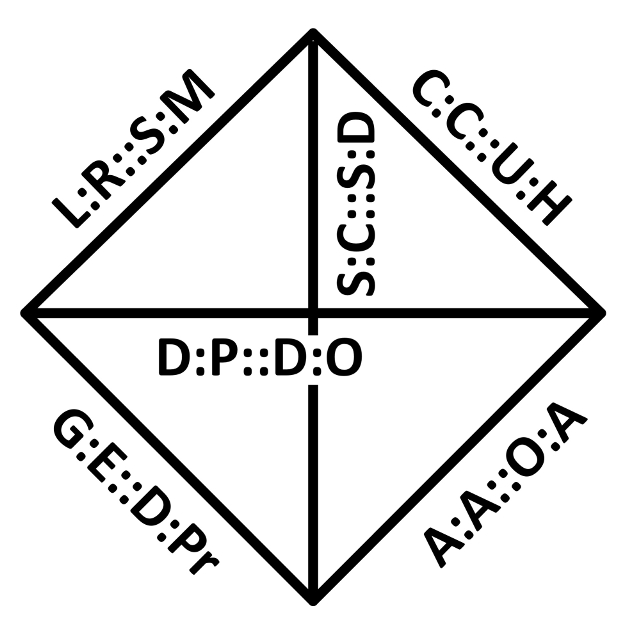
Robert Plutchik devised a schema for eight basic emotions, divided into four pairs of opposites. Each of these also has a weaker and a stronger version (but not shown here).

  • Trust vs. Disgust
  • Joy vs. Sadness
  • Fear vs. Anger
  • Surprise vs. Anticipation

In addition, emotions called dyads can be built by non-opposed combinations of the basic emotions, and each of these twelve dyads has a reverse or opposite emotion, making 24 total. Between any two opposite pairs, two dyads may be considered covariant, and the other two may be considered contravariant. So for the two pairs of opposites A + A’ and B + B’, we have covariant A*B and A’*B’, which are opposite, say C and C’, and contravariant A*B’ and A’*B, which are also opposite, say D and D’. These four dyads are labeled in the diagram as C:C’::D:D’, which I hope is not too confusing.

  • [L:R] Love (Joy * Trust) : Remorse (Sadness * Disgust)
  • [S:M] Sentimentality (Trust * Sadness) : Morbidness (Joy * Disgust)
  • [G:E] Guilt (Joy * Fear) : Envy (Sadness * Anger)
  • [D:Pr] Despair (Fear * Sadness) : Pride (Joy * Anger)
  • [C:C] Curiosity (Trust * Surprise) : Cynicism (Disgust * Anticipation)
  • [U:H] Unbelief (Surprise * Disgust) : Hope (Trust * Anticipation)
  • [A:A] Awe (Fear * Surprise) : Aggression (Anger * Anticipation)
  • [O:A] Outrage (Surprise * Anger) : Anxiety (Fear * Anticipation)
  • [D:P] Delight (Joy * Surprise) : Pessimism (Sadness * Anticipation)
  • [D:O] Disappointment (Surprise * Sadness) : Optimism (Joy * Anticipation)
  • [S:C] Submission (Trust * Fear) : Contempt (Disgust * Anger)
  • [S:D] Shame (Fear * Disgust) : Dominance (Trust * Anger)

Further Reading:

https://en.wikipedia.org/wiki/Robert_Plutchik

https://en.wikipedia.org/wiki/Contrasting_and_categorization_of_emotions#Plutchik.27s_wheel_of_emotions

http://www.personalityresearch.org/basicemotions.html

http://www.personalityresearch.org/basicemotions/plutchik.html

Plutchik’s Wheel of Emotions

[*9.224, *9.225, *9.230, *9.231]

<>


The Fourfold Self

sq_fourfold_selfA recent post by Sandeep Gautam synthesizes several distinctions of the human being as self to come up with a nice fourfold model. These are the Materialistic (or perhaps Substantive), the Experiential or Experienced, the Remembered (or perhaps Visualized), and the Prospective or Anticipatory (or perhaps Envisioned). These can also be neatly labeled as “having”, “doing”, “being”, and “becoming”.

I have talked about Gautam before in my post The Fundamental Four of Sandeep Gautam. The fourfold discussed then was developed from evolutionary problems and drives but reminds me somewhat of this new fourfold, where Food/Foes -> Materialistic Self, Family/Friends -> Experiential Self, Focus/Frame -> Remembered Self, and Flourishing/Fun -> Anticipatory Self.

There are several other fourfold models of the self that are readily found. There is the ancient “Modes of Consciousness” from the Upanishads: Physical, Emotional, Intuitional, and Absolute. There is the anthroposophical model of Rudolf Steiner: Physical, Life/Etheric, Astral/Feeling, and Ego/“I”. There is the one by Friedrich Nietzsche: Deepest, Ego/“I”, Ideal/Higher, and True. And there is the religious or new age model: Body, Mind, Soul, and Spirit.

The problem with most of these older models of the self is the lack of consensus on the meaning and existence of the terms used in their construction, much less a way to know if the set is complete or not. Thus the fourfolds seem to be rather diverse and vague. I favor a more pragmatic and psychological approach in choice of models, plus those that can be easily mapped into Aristotle’s Four Causes, both attributes of which I see in Gautam’s models.

The comparison and contrast of these models to come up with a synthesis might still be a worthwhile future effort. There are also several fourfold models of the brain itself that could be entered in to the mix.

References and Links:

To Have or to Do? To Be or to Become?

https://equivalentexchange.wordpress.com/2015/03/22/the-fundamental-four-of-sandeep-gautam/

https://www.academia.edu/4122124/Nietzsches_Fourfold_Conception_of_the_Self

http://www.universaltheosophy.com/articles/johnston/the-fourfold-selfs-three-vestures/

https://en.wikipedia.org/wiki/Anthroposophical_view_of_the_human_being

http://www.enlightened-spirituality.org/Body-Mind-Soul-Spirit.html

[*9.130, *9.132]

<>