Category Archives: Philosophy

The Ogdoad: Unity of Eight Gods

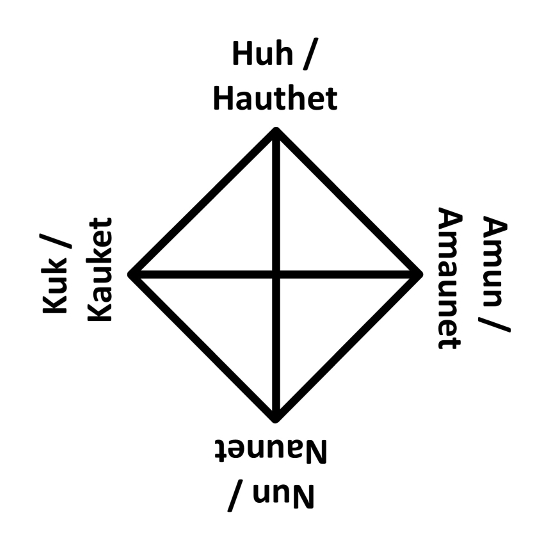
Here’s a notable fourfold of dualities: the Ogdoad, or eightfold of deities. I usually don’t stray into ancient mythology but this cosmological system evidently led the Greeks to their idea of the four elements. These paired male and female deities were personifications of certain metaphysical concepts and their opposites.

  • Amun and Amaunet: The Hidden and its opposite
  • Nun and Naunet: The Abyss and its opposite
  • Kuk and Kauket: The Darkness and its opposite
  • Huh and Hauthet: The Boundless and its opposite

Some even conjecture that the word ANKH was formed from the initial sounds of these four or eight deities.

Further Reading:

https://en.wikipedia.org/wiki/Ogdoad_(Egyptian)

http://www.sacred-texts.com/afr/stle/stle12.htm

Hermopolitan Ogdoad

http://malankazlev.com/kheper/topics/Egypt/Hermopolis.html

http://www.doremishock.com/articles/thememphitetheology.htm

[*9.232]

<>

Analogical Thinking

sq_analogicalIs analogy or metaphor the root of thinking? Some thinkers think so. But what exactly is analogy?

Looking at various lists of analogies of the A:B::C:D motif, I have distilled them into four groups: Relational, Hierarchical, Linguistical, and Mathematical. Are there analogies that don’t fit this scheme?

Relational

Object / characteristic
Order, sequence
Transformation
Agent / object, action
Function, purpose
Cause / effect
Source / product

Hierarchical

Classification, category, type, membership
Whole / part
General / specific

Linguistical

Meaning, definition
Synonym, antonym
Contrast, degree, intensity
Word parts
Expressions

Mathematical

Equivalence
Multiples
Negation
Patterns, geometries
Number
Size, magnitude
Direction, vectors
Spacial, temporal
Ratio, proportion

References:

https://en.wikipedia.org/wiki/Analogy

http://www.nyjournalofbooks.com/book-review/surfaces-and-essences-analogy-fuel-and-fire-thinking

View at Medium.com

Currently Reading:

George Lakoff, Mark Johnson / Metaphors We Live By

To Read:

Douglas Hofstadter, Emmanuel Sander / Surfaces and Essences: analogy as the fuel and fire of thinking, Basic Books (2013)

Noah Roderick / The Being of Analogy, Open Humanities Press (2016)

https://en.wikipedia.org/wiki/Functor

[*9.140, *9.141, *9.178]

<>

Distinctions with and without Differences

sq_distinction2It is often asked, why is there something rather than nothing?

Instead why not ask, why is there a rich diversity of things, rather than a dull sameness? And even though the closer and the further one looks the diversity is almost without limit, one also sees the world divided into natural kinds that partition it into a differentiated but interrelated mixture.

Several ancient philosophers thought that the entire world was an indivisible whole, a solid “being”. Others thought that you can’t even step into the same river twice, thus a fluid “becoming”. The real world seems to be somewhere in-between these two poles, moving continuously back and forth to now generate difference and newness, and then returning to sameness and oldness, and next continuing on to newness again.

Why drives these generative processes? One could say evolution, but evolution merely means “change over time”. And it would need to be an evolution at all levels of the cosmos, from the physical constituents of matter to the psychological constructs of culture. What do these disparate systems have in common?

Perhaps the commonality lies in the relations between small and large ensembles of chunks of space and time. In theories of statistical thermodynamics, the associations between micro states and macro states as well as micro events and macros events may drive entropy.

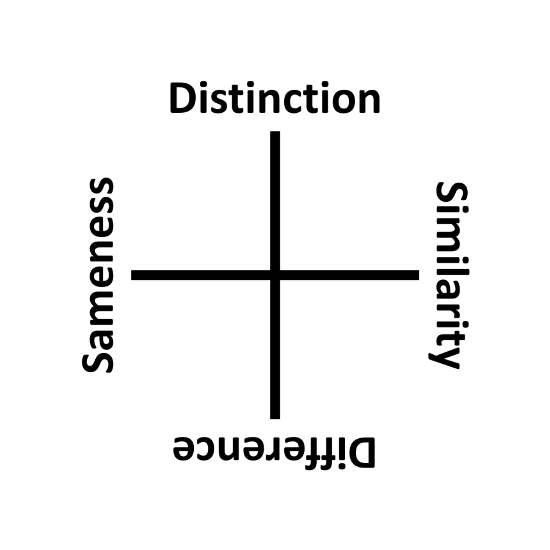
Here I present a schema that divides the continuum between one and many into four: Sameness, Similarity, Distinction, and Difference.
A member of the “being” camp might say these aren’t really different, whereas one from the “becoming” camp could say there really isn’t any sameness to begin with. Here I’ve chosen neither camp but struggled to bridge the gap between them.

References:

https://en.wikipedia.org/wiki/Being

https://en.wikipedia.org/wiki/Becoming_(philosophy)

https://en.wikipedia.org/wiki/Distinction_without_a_difference

Also see:

Statistical Thermodynamics

One and Many

[*9.110]

<>

Timothy Williamson’s Tetralogue

sq_tetralogueA recent book of introductory philosophy is Timothy Williamson’s Tetralogue: I’m Right, You’re Wrong. Instead of using a dialogue with two viewpoints used by some classical philosophers, Williamson structures his book into a tetralogue, or a conversation with four viewpoints.

The viewpoints are portrayed by four individuals as they enjoy a lengthy train ride: Zac (Relativism), Sarah (Naturalism, Empiricism, Skepticism, Fallibilism, Materialism, Scientism), Bob (Culturalism, Traditionalism, Conservatism, Ancestralism), and Roxana (Rationalism, Logicalism).

Who’s right and who’s wrong? I haven’t read it yet but it looks interesting!

Several reviews:

http://ndpr.nd.edu/news/59251-tetralogue-i-m-right-you-re-wrong/

https://www.timeshighereducation.com/books/tetralogue-im-right-youre-wrong-by-timothy-williamson/2018800.article

A Twitter account to follow (I didn’t know it would do that):

Also see:

https://equivalentexchange.wordpress.com/2015/05/14/four-philosophies/

https://equivalentexchange.wordpress.com/2011/12/09/stances-towards-truth/

[*8.149, *9.146]

<>

The Paradoxes of Zeno

sq_zeno_paradoxes5“Suppose,” said Zeno, “that Achilles and a tortoise are planning to race”.

Such is the beginning of a famous thought experiment by an ancient philosopher. Since athletic Achilles was much faster than the slow tortoise, he let the tortoise start first. But alas, he could never catch up to it, since every time Achilles made it to where the tortoise had been, the tortoise had moved just a little further ahead. Of course Achilles was faster so he had to pass the tortoise quickly unless it had started near the finish line. So, paradox!

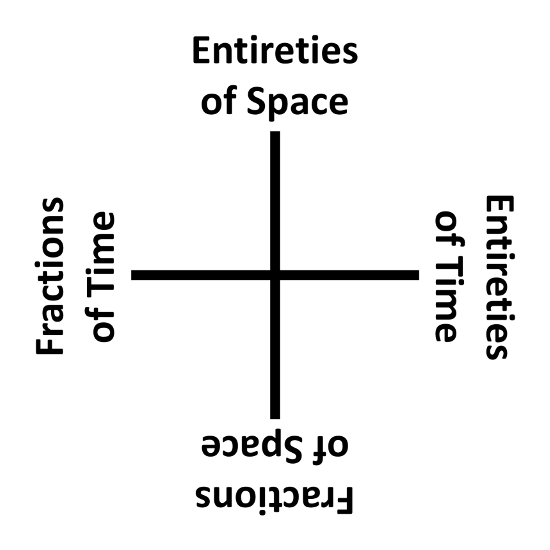
Most of the paradoxes of Zeno were about fractions and entireties of time and space. Can an infinite series of fractions of space add up to a finite entirety of space in a finite entirety of time? Some might say that integral calculus solves these basically mathematical problems, yet others think they point to metaphysical issues as regards to the discreteness and the continuity of time and space.

This fourfold reminds me of my previous fourfold Spacetime which dealt with succession (as parts of time), location (as parts of space), extension (as wholes of space), and duration (as wholes of time). It must have been in the back of my mind.

References:

https://en.wikipedia.org/wiki/Zeno%27s_paradoxes

https://equivalentexchange.wordpress.com/2011/09/23/spacetime/

[*9.122]

<>

Categories of Experience

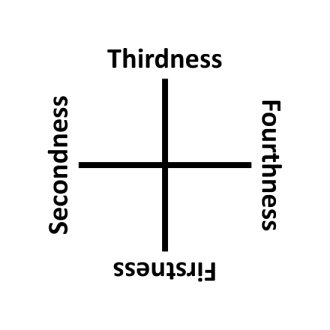
sq_categoriesThe philosophy of Charles S. Peirce is chock-full of triples, but especially present are his three universal categories of experience. Threes aren’t really my specialty, but while reading a chapter of Richard Bernstein’s book on the “pragmatic turn”, I was reminded of Peirce’s relational ontology: Firstness, Secondness, and Thirdness. Wondering how these could be extended to a Fourthness, I immediately found a fair amount of work on the subject.

Of course, Peirce argued that such a Fourthness was redundant, unnecessary to the structure of his systematic philosophy. He used various reasons for his conclusions, including mathematical, logical, and semiological. There is also a wealth of subsequent work by later researchers on defending this claim, but what is interesting is that others have investigated extending his three into a four.

So, what might be Fourthness? Some of the aspects of fourfolds collected here have commonalities with some of the attributes of Firstness, Secondness, and Thirdness. For Firstness: feeling, quality, possibility; For Secondness: will, fact, existence; For Thirdness: knowledge, law, representation. I really don’t have anything to add at the present time and I have merely gathered these notions together for my future consideration.

References:

http://en.wikipedia.org/wiki/Categories_%28Peirce%29

http://en.wikipedia.org/wiki/Hypostatic_abstraction

http://www.paulburgess.org/triadic.html

http://tetrast.blogspot.com/2006/09/compare-to-aristotle-aquinas-peirce.html

Carl G. Vaught / Semiotics and the Problem of Analogy: a critique of Peirce’s theory of categories. Trans. of the Charles S. Peirce Society, Vol. 22, No. 3 (1986) 311-326

http://www.jstor.org/stable/40320143

Carl R. Hausman / Fourthness: Carl Vaught on Peirce’s categories. Trans. of the Charles S. Peirce Society, Vol. 24, No. 2 (1988) 265-278

http://www.jstor.org/stable/40320211

Donald W. Mertz / Peirce: logic, categories, and triads. Trans. of the Charles S. Peirce Society, Vol. 15, No. 2 (1979) 158-175

Richard J. Bernstein / The Pragmatic Turn. Polity (2010)

Also:

Ben Goertzel / The Hidden Pattern: a patternist philosophy of mind

[*9.108, *9.109, *9.112]

<>

Four Transformations of Chu Spaces

sq_four_transformationsCan mathematics help us reformulate Cartesian Dualism? I have previously tried to diagram some of computer scientist Vaughan Pratt’s notions, such as a Duality of Time and Information and the Stone Gamut. Another recent attempt is the diagram above of four transformations that issue out of his analysis of Chu Spaces. Pratt’s conceptualization of these generalized topological spaces led him to propose a mathematization of mind and body dualism.

The duality of time and information was actually an interplay of several dualities, such as the aforementioned time and information, plus states and events, and changing and bearing (or dynamic and static). The philosophical mathematization in his paper “Rational Mechanics and Natural Mathematics” leads to additional but somewhat different dualities, shown in the following table:

Mind Body
Mental Physical
States Events
Anti-functions Functions
Anti-sets Sets
Operational Denotational
Infers Impresses
Logical Causal
Against time With time
Menu Object
Contingent Necessary

Pratt reveals two transformations that are “mental”: delete and copy, and two that are “physical”: adjoin and identify.

These four transformations are functions and their converses which:

  • Identify when the function is not injective.
  • Adjoin when the function is not surjective.
  • Copy when the converse is not injective.
  • Delete when the converse is not surjective.

Ordinarily we think of mind and body as being radically different in kind, but perhaps they are the same but merely viewed from a different perspective or direction. Recall what Heraclitus says, “the road up and the road down are the same thing”.

References:

https://en.wikipedia.org/wiki/Dualism_%28philosophy_of_mind%29

Click to access ratmech.pdf

http://chu.stanford.edu/

http://en.wikipedia.org/wiki/Chu_space

[*6.74, *6.75, *9.76]

<>

Pick Your Causation

sq_causationCausation is one of the most important ways in which we conceptualize the world and ourselves. The reasons that objects go through their motions and people perform the acts they do are explained by the causes that lead to these effects. Constitutive materials can also be causes for the effects on things and individuals. Even the form and function of things can be thought of as effects, dependent on the causes that make them come to be. These effects in turn can be causes for subsequent effects, and so on, in a complex chain or network of causation.

Four different “directions” inform discussion about causes and effects, organized by time (Forward and Backward) and space (Upward and Downward). Perhaps space is not the best word: consider size, distance, or even importance. These four directions can also remind one of Aristotle’s Four Causes, where Efficient Causation is Forward, Formal Causation is Downward, Material Causation is Upward, and Formal Causation is Backward.

Forward causation: Temporal causation, where causes happen before their effects. Ordinarily associated with a deterministic view of causation.

Upward causation: Scientific causation, where the smaller or lower cause the effects of the larger or higher. Ordinarily associated with a reductionistic view of causation.

Downward causation: Structural causation, where the larger or higher can cause the effects of the smaller or lower. Typical examples are free will, agency, intention, or volition, where the mind and not just the brain controls the actions of the body.

Backward causation: Reverse temporal causation, where causes are in the future of their effects. This is not quite the same as teleology, although the concepts are closely linked and require further study. Typical examples are purposes, goals, and ends (versus means) (although this is not the usual philosophical meaning of backward causation).

References:

http://plato.stanford.edu/entries/causation-backwards/

https://en.wikipedia.org/wiki/Downward_causation

https://en.wikipedia.org/wiki/Teleology

https://en.wikipedia.org/wiki/Determinism

http://www.nbi.dk/~emmeche/coPubl/2000d.le3DC.v4b.html

Also see these related posts:

https://equivalentexchange.wordpress.com/2010/08/12/aristotles-four-causes/

https://equivalentexchange.wordpress.com/2010/08/11/a-warning/

[*9.40]

<>

The Book of Nature

sq_four_senses2The purpose of a system is what it does.

— Stafford Beer

The natural world we find ourselves in is of sufficient wonder, beauty, pain, and terror that many insist that some demiurge had to have made it, and fashioned us as well. For centuries before the dawn of science, the notion of the “Book of Nature” was an influential concept of how knowledge about the world was to be found and understood, borrowed from ideas on how to read and interpret religious writings: exegesis or hermeneutics. Nature was a text, writ by its creator.

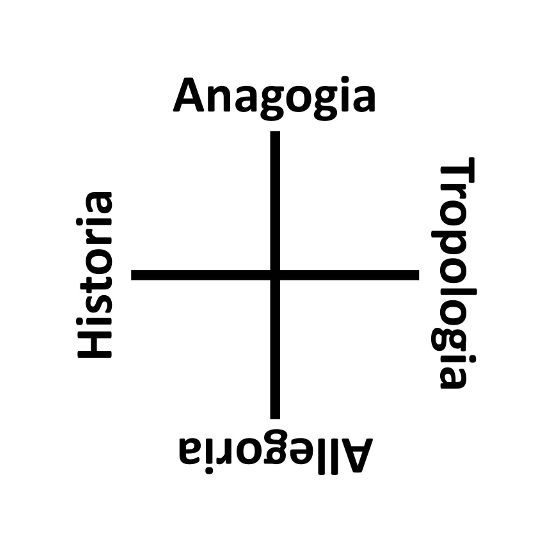
Back in Medieval times, there were four ‘senses’ of reading and understanding scripture:

  • Anagogia: the higher meaning (Invisible Invisibility*)
  • Allegoria: the deeper meaning (Invisible Visibility)
  • Historia: the literal meaning (Visible Visibility)
  • Tropologia: the moral meaning (Visible Invisibility)

Perhaps the meaning of these senses were more or less literal. Therefore on my diagram I have placed the higher above, the deeper below, the historical in the past, and the moral in the future. Morals inform us what we should do or what our purpose is. A heuretic of systems thinking coined by Stafford Beer is “the purpose of a system is what it does.” And remember the immortal words of Yoda: “Try not. Do or do not. There is no try.”

Fortunately or unfortunately, nature is nothing like a text. All texts are written by people, and are structured by human thought and language. Nature requires other methods for understanding its basis and processes. The so-called scientific method evolved by fits and starts to explore the workings of nature, its components, causes, structures and functions. And it continues to evolve because it is not in itself entirely mechanistic: no precise algorithm that we know of can be specified to turn the crank and do ‘science’. Does that mean it’s unscientific? Not at all.

References and Links:

* The terms Invisible Invisibility, etc. are from:

6. The four senses

The Quadralectics of Marten Kuilman

http://en.wikipedia.org/wiki/Book_of_Nature

http://en.wikipedia.org/wiki/Systems_theory

http://en.wikipedia.org/wiki/The_purpose_of_a_system_is_what_it_does

[*8.48, *8.52]

<>

Four Primary Relations

sq_four_ances

I’ve written previously about my fourfold Structure-Function (consisting of Structures, Functions, Actions, and Parts) and its association with four Modal Verbs (Must, Should, May, and Can). This resulted in the combined fourfold of Modal Things.

Here I present the next step: what it is that Structures Must do, what it is that Functions Should do, what it is that Actions May do, and what it is that Parts Can do.

Structures Must Maintain => Maintenance
Functions Should Perform => Performance
Actions May Occur => Occurrence
Parts Can Vary => Variance

The first column lists the four aspects of Structure-Function. They are loosely based on Aristotle’s Four Causes. Structures correspond to the formal cause. Functions correspond to the final cause. Actions correspond to the efficient cause. Parts correspond to the material cause.

The second column lists the Modal Verbs, the “modes” of each aspect. They are similar to deontic logic, two being more or less necessary and two being more or less contingent.

The third column lists the Actional Verbs, what it is that each aspect does in its modal way. One could also say these as mottos: “Structures must be maintained”, “Functions should be performed”, “Actions may have occurred”, and “Parts can be varied”.

The fifth column lists the four primary relations that correspond to each of the four aspects.

These four relations could inform a metaphysics, consisting of relations all the way down, all the way up, all the way back, and all the way forward.

Links:

http://plato.stanford.edu/entries/logic-deontic/

[*7.192, *8.40, *8.136]

<>