Category Archives: Philosophy

The Archic Matrix

Now that I am presenting sixteen-folds, let me briefly return to a subject I’ve mentioned previously. The Archic Matrix of Walter Watson and David Dilworth is a four-by-four matrix representing different aspects of the “personalities” of philosophers, determined by their writings. It is adapted from the Philosophical Semantics of philosopher Richard McKeon.

The four aspects of the Archic Matrix (also called Archic Variables) in this diagram are Perspective (upper left), Reality (lower left), Method (upper right), and Principle (lower right). The archic variable Perspective can have values Personal, Agonistic, Existential, and Creative, and similarly for the other three variables.

Each of the values of each of the variables is conditioned by one of the variables. For example, Personal is only conditioned by the Archic Variable Perspective, even though it is already a value of that variable. The value Agonistic is conditioned by the Archic Variable Method, Existential by Reality, and Creative by Principle.

Whereas the Myers-Briggs Type Indicator is a two-by-four matrix giving sixteen different combinations for its four personality “variables”, each having two values, the four-by-four Archic Matrix has four values for each of four variables and so gives 256 different combinations. It would be interesting if someone mapped the larger scheme into the smaller.

Further Reading:

Walter Watson and David Dilworth’s Archic Matrix

Archic Matrix: Perspectives

Archic Matrix: Realities

Archic Matrix: Methods

Archic Matrix: Principles

Richard McKeon’s Aspects of Knowing

http://www.ottobwiersma.nl/philosophy/archic_matrix.php

http://wwwhistoricalthreads.blogspot.com/2010/07/walter-watson-architectonics-of-meaning.html

http://www.philosophicalprofile.org/test/index.php

Notes:

The only work that seems to mention both the Archic Matrix and Myers-Briggs is as follows:

Mondo Secter / The Architectonics of Culture: A Critique, Modification, and Extension of Hofstede’s Study of Societal Culture with a Chinese-Based Typology, Ph.D. Dissertation, Simon Fraser University, August 2003

Click to access b31853754.pdf

Secter is elsewhere mentioned to be completing an adaption of this dissertation (albeit long ago), called “The Architectonics of Culture and Personality: Six Core Dimensions of Who We Are”. It would useful to know anything else about this work. Updates, anyone?

[* 10.151]

<>


Hannah Arendt: The Human Condition and the Life of the Mind

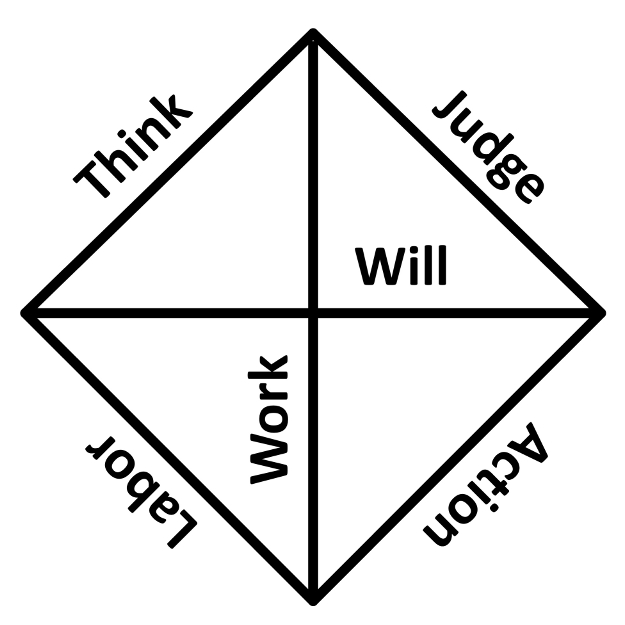
In her book “The Human Condition”, philosopher Hannah Arendt discussed the vita activa, the active life:

  • Labor
  • Work
  • Action

In “The Life of the Mind”, she wished to present the vita contemplativa, the contemplative life:

  • Thinking
  • Willing
  • Judgment

Unfortunately, she died just as started working on Judgment, so that aspect was just outlined with notes.

The differences between the active and the contemplative can also be thought of as the practical versus the theoretical. This pair of triplets is not easy to turn into a troika of duals.Further Reading:

https://en.wikipedia.org/wiki/The_Human_Condition_(book)

https://www.brainpickings.org/2014/09/16/hannah-arendt-the-life-of-the-mind/

https://www.giffordlectures.org/lectures/life-mind

https://plato.stanford.edu/entries/arendt/

https://en.wikipedia.org/wiki/Hannah_Arendt

[*9.98, *10.102]

<>


Six Types of Philosophers

I have mentioned fourfold classifications of philosophers before, most notably the Philosophical Semantics of philosopher Richard McKeon (which is similar to the Archic Matrix of Walter Watson and David Dilworth). These are actually sixteen-fold classifications, since each of four attributes have four types.

Instead, consider this six-fold classification by Justin E. H. Smith:

  • Curiosa – Particularist
  • Sage – Systematist
  • Gadfly – Social Critic, Commentator
  • Ascetic – Disciplinarian
  • Mandarin – Academic, Professional
  • Courtier – Bureaucrat, Institutionalist

In addition, here is another diagram of this same classification scheme.

tr_six_philosophersFurther Reading:

Justin E.H. Smith / The Philosopher: A History in Six Types, Princeton University Press, 2016.

https://ndpr.nd.edu/news/the-philosopher-a-history-in-six-types/

The Philosopher: A History in Six Types

http://www.jehsmith.com/

[*10.96]

<>

Fourfold Physicalism

It is not enough for a wise man to study nature and truth, he should dare state truth for the benefit of the few who are willing and able to think. As for the rest, who are voluntarily slaves of prejudice, they can no more attain truth, than frogs can fly.

— From Man a Machine, by Julien Offray de La Mettrie

Further Reading:

https://equivalentexchange.wordpress.com/2012/07/03/structure-function/

https://equivalentexchange.wordpress.com/2013/10/09/things-happen/

https://equivalentexchange.wordpress.com/2014/02/01/relations-all-the-way-down/

https://equivalentexchange.wordpress.com/2015/06/09/four-primary-relations/

https://en.wikipedia.org/wiki/Man_a_Machine

Notes:

Structures are built from parts.
Parts are reductions of structures.
Functions are assembled from actions.
Actions are the constituents of functions.

[*8.132, *9.104, *10.10]

<>

Enlightenment Now!

I want a new enlightenment and I want it now! One replete with:

  • Humanism
  • Reason
  • Science
  • Progress

Or, at least I can read the book.

Further Reading:

Steven Pinker / Enlightenment Now: The Case for Reason, Science, Humanism, and Progress

http://www.playboy.com/articles/playboy-profile-steven-pinker

Pinker’s twitter feed:

[*10.70]

<>


Atom and Archetype

A few weeks ago I ran across this nice review of the book Atom and Archetype: the Pauli-Jung letters 1932-1958. This is a collection of letters exchanged between psychiatrist Carl Jung and physicist Wolfgang Pauli over a course of years. Evidently, Pauli was quite the metaphysician and Jung was intrigued by Einstein’s physics of relative space and time. Together in dialectic they argued and struggled to join together the disparate notions of mind and matter.

What mainly caught my eye was a diagram that I’ve slightly altered and shown above. I’ve mainly just replaced energy with matter-energy for two reasons: first because matter and energy are inter-convertible and second because matter conditions space. This results in similarity to the fourfold diagram for Lucretius that I’ve shown before, consisting of Particles, the Void, Falling, and Swerving.

Further Reading:

https://www.brainpickings.org/2017/03/09/atom-and-archetype-pauli-jung/

Carl Jung and Wolfgang Pauli / Atom and Archetype: the Pauli-Jung letters 1932-1958, Princeton University Press; Updated edition (July 21, 2014)

https://equivalentexchange.wordpress.com/2011/10/10/lucretius-on-the-nature-of-things/

https://equivalentexchange.wordpress.com/2014/02/17/matter-energy-space-and-time/

https://equivalentexchange.wordpress.com/2015/01/16/wave-particle-duality/

https://equivalentexchange.wordpress.com/2012/05/04/noethers-theorem/

[*10.60]

<>

Kant’s Synthetic-Analytic Distinction, V3

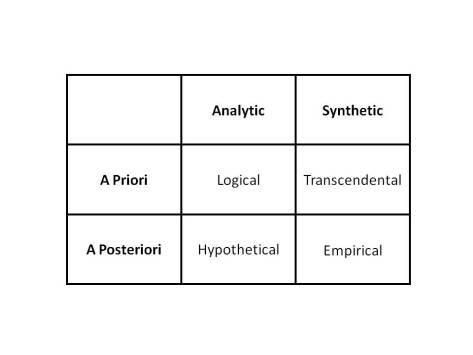
One of the oldest and most problematic philosophical questions is the comparison of the a prioria posteriori distinction with that of the analyticsynthetic distinction. Both are used in epistemology to divide knowledge, or true statements, between the innate and the learned, or the immediate and the earned, so they might even be considered the same. A priori and a posteriori statements are before “experience” and after it, respectively. Analytic statements are true only by their “meaning”, whereas synthetic statements are true only when facts about the world are combined consistently with that meaning.

It seems we have complicated the issue because now we must define and understand “experience” and “meaning”. However, these concepts are not independent because we must experience meaning, and meaning in turn conditions experience. In addition, even the a priori or the analytic are not innate or immediately obvious because deductions and the rules of logic require effort just like inductions do. Otherwise we would have Fitch’s Paradox: all truths are in fact known. What a muddle! So both experience and meaning are necessarily locked into a cooperative spiral dance to improve each other.

In addition, if you search for the two pairs a priori-a posterior and analytic-synthetic, you also find that the pair necessary-contingent is associated with them. Are these three pairs independent of one another and so give rise to eight triplets, or are they dependent in some way and reduce into fewer combinations? In addition, from Wikipedia:

Thus, the relationship between aprioricity, necessity, and analyticity is not easy to discern. However, most philosophers at least seem to agree that while the various distinctions may overlap, the notions are clearly not identical: the a priori/a posteriori distinction is epistemological, the analytic/synthetic distinction is linguistic, and the necessary/contingent distinction is metaphysical.

The web site of Stephen R. Palmquist has a great wealth of material on fourfolds in relation to Kant’s as well as his own philosophy. From my own initial reading of his extensive material I have tried to choose a canonical Kantian fourfold which has the most relevance to my project.

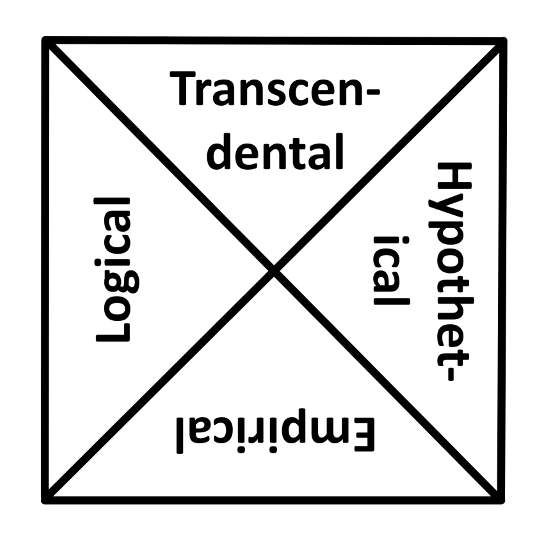
The fourfold shown to the right Dr. Palmquist calls Kant’s “reflective perspectives on experience”. Consisting of the logical, the empirical, the transcendental, and the hypothetical, these facets bear a close analogical likeness to many of the fourfolds presented here.

Logical: Analytic a priori
Transcendental: Synthetic a priori
Hypothetical: Analytic a posteriori
Empirical: Synthetic a posteriorikant_table

Dr. Palmquist also has many of his own books available on his web site for the interested reader. I will certainly be returning to his web site in the future for much enjoyable study.

Further Reading:

http://en.wikipedia.org/wiki/Analytic-synthetic_distinction

http://en.wikipedia.org/wiki/A_priori_and_a_posteriori

A Priori-A Posteriori, Analytic-Synthetic, and Necessary-Contingent Distinctions

http://plato.stanford.edu/entries/analytic-synthetic/

A Priori and A Posteriori

http://plato.stanford.edu/entries/fitch-paradox/

http://www.philosophypages.com/hy/5f.htm

http://www.hkbu.edu.hk/~ppp/

http://www.hkbu.edu.hk/~ppp/ksp2/KCR3.htm

[*7.68, *7.84, *8.126, *10.54]

<>


Richard McKeon’s Aspects of Knowing, Part 2, V3

The duals in Richard McKeon’s system of Philosophical Semantics can also be arranged in a three-dimensional tetrahedron, where the dual pairs are on opposing edges. The universal and particular methods, the phenomenal and ontic interpretations, and the meroscopic and holoscopic principles are shown above.

Universal methods, between knower and knowledge, are applicable to all problems and all subject matters. Particular methods, between the knowable and the known, require distinct methodological procedures for different problems or subject matters.

Holoscopic principles, looking at the parts from the perspective of the whole, provide a coincidence of knowledge and known. Meroscopic principles, looking at the whole from the perspective of the parts, separate the knower and the knowable from each other and from influence between each other.

Ontic interpretations, between the knowable and knowledge, derive their character from a reality assumed to transcend or to underlie phenomena and statements. Phenomenal interpretations, between knower and the known, may reduce reality and values to aspects or consequences of phenomena.

Alternatively, the four vertices of  knower, knowledge, known, and knowable can be labeled by their method, principle, and interpretation as shown at right.

Further Reading:

http://www.richardmckeon.org/

http://en.wikipedia.org/wiki/Richard_McKeon

Notes:

As McKeon said in his lecture of  October 23, 1972 (the “Topics course”, unpublished): “You can either look at things from the point of view of the whole — then the principles are holoscopic (holos means whole, skopein means to look). Or, you can take the same set of facts, and view them from the part: then you have meroscopic principles. (Meros means part, skopein still means to look at).”

[*6.136]

The Philosopher’s Wheel

Eric A. Meece’s web site philosopherswheel.com has been in existence for a while, and it claims there is a forthcoming book called “The Philosopher’s Wheel”. This seems like an interesting project and it’s a shame that the book is still “in process”.

Meece has certainly been working on these ideas for a few years. Starting with a Master’s thesis in 1979, and a presentation in 2001, he also has a collection of articles available to the reader that are related to his theme.

The philosopher’s wheel is essentially composed of three polarities:

  • Materialism vs. Spiritualism
  • Rationalism vs. Empiricism
  • Essentialism vs. Existentialism

Two polarities are related to Jung’s Psychological Types:

  • Rationalism (Thinking)
  • Empiricism (Sensing)
  • Existentialism (Feeling)
  • Essentialism (Intuiting)

I’ve tried to represent these dualities a little differently than Meece. Note in the above diagram that Materialism mediates Rationalism and Empiricism, and Spiritualism mediates Essentialism and Existentialism, similar to the wheel representation.

At right is an attempt at eliminating the “isms”. Perhaps I should have read some more of his writings before making these efforts.

Further Reading:

http://philosopherswheel.com/

http://philosopherswheel.com/philosophycircle.htm

Notes:

The more I think about it, the more I like to compare this with

https://equivalentexchange.wordpress.com/2017/09/09/simon-magus-and-the-six-roots-of-boundless-power/

Images of the Philosopher’s Wheel:

https://www.google.com/search?q=philosopher%27s+wheel&tbm=isch

<>


Four Philosophies, V2

Thinking some more on Popper’s Three Worlds, here is a set of philosophical disciplines that seem to resonate with the themes of this blog.

  • Phenomenology: the philosophical study or theory of phenomena as distinct from that of the nature of being
  • Epistemology: the theory of knowledge, especially with regard to its methods, validity, and scope
  • Ontology: the branch of metaphysics dealing with the nature of being
  • Axiology: the philosophical study of the nature of value and valuation, and of the kinds of things that are valuable

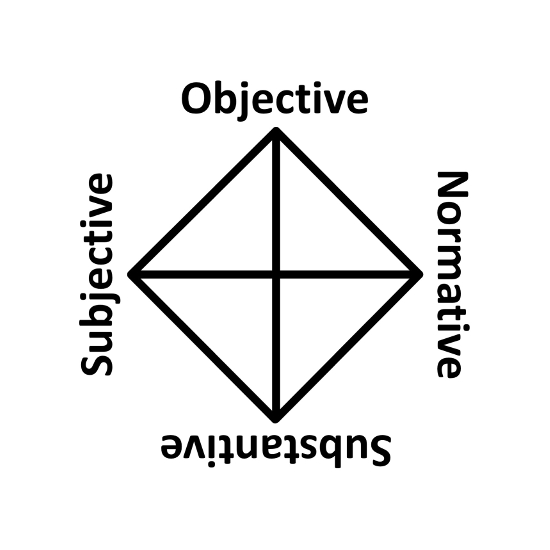
I believe that one could also make a case for associations with phenomenology to the subjective, epistemology to the objective, ontology to the substantive, and axiology to the normative.

Further reading:

https://www.quora.com/What-does-ontology-epistemology-and-axiology-mean

http://cognitive-edge.com/blog/phenomenology-epistemology-ontology/

(Note that the author of the article above, David Snowden, is the creator of the Cynefin Framework.)

https://en.wikipedia.org/wiki/Phenomenology_(philosophy)

https://plato.stanford.edu/entries/phenomenology/

Phenomenology

https://en.wikipedia.org/wiki/Epistemology

https://plato.stanford.edu/entries/epistemology/

Epistemology

https://en.wikipedia.org/wiki/Ontology

https://plato.stanford.edu/entries/logic-ontology/

https://en.wikipedia.org/wiki/Axiology

https://plato.stanford.edu/entries/value-theory/

https://equivalentexchange.wordpress.com/2015/05/14/four-philosophies/

[*10.20]

<=>