Category Archives: Philosophy

Walter Bowman Russell (1871-1963)

Walter Bowman Russell was an American polymath, artist, author, and philosopher who made copious contributions and claims to various fields, including spirituality, art, and metaphysics. While his work encompasses a broad range of ideas, here are four major themes that capture the essence of his philosophy:

  • Universal Law and Natural Order: One of Russell’s central ideas is the existence of an underlying universal law and natural order that governs all aspects of the universe. He believed that this law operates in perfect harmony, and by understanding and aligning ourselves with it, we can achieve balance and fulfillment in our lives.
  • Unity and Interconnectedness: Russell emphasized the interconnectedness of all things in the universe. He saw everything as part of a grand, unified whole, where all elements are interdependent and interconnected. According to his philosophy, recognizing this interconnectedness enables us to grasp the fundamental unity of all existence.
  • Harmonic Vibrations and Rhythmic Balance: Russell believed that the universe is fundamentally vibrational in nature, with everything composed of waves and rhythms. He emphasized the importance of achieving harmony and balance within ourselves and in our interactions with the world around us. By attuning ourselves to the harmonies and rhythms of the universe, we can lead more fulfilling and purposeful lives.
  • The Power of Mind and Consciousness: Russell regarded the power of the human mind and consciousness as fundamental forces in shaping our reality. He believed that our thoughts and beliefs have the ability to create and influence the world we experience. According to his philosophy, by harnessing the power of our minds and cultivating a positive and constructive consciousness, we can achieve personal and collective transformation.

These four themes offer a glimpse into the multifaceted philosophy of Russell, often presented with his signature illustrations. However, it’s worth noting that Russell’s ideas encompass a vast array of subjects, including a non-standard physics and a spiritual cosmology, all interconnected through his unique perspective and understanding of the universe. Indeed, he was perhaps the first to endorse “new age” thought.

(Thanks, ChatGPT! I didn’t have the strength to read enough to write a quick summary. You were far less skeptical than I would have been, so I made a few small edits.)

Further Reading:

https://en.wikipedia.org/wiki/Walter_Russell

https://www.philosophy.org/#/

https://projectavalon.net/forum4/showthread.php?41699-The-Enigmatic-Walter-Russell

Startseite

RUSSELL, WALTER BOWMAN — MIAMI

WALTER RUSSELL

Only for NYT subscribers:

https://timesmachine.nytimes.com/timesmachine/1963/05/20/90548414.html?pageNumber=31

Also, see:

The Decemberists – Cavalry Captain

[*13.175]

<>

A Couple of Loops About Thinking and Then Doing

The Shewhart Cycle (also known as the PDCA) is an iterative design and management cycle for continuous quality improvement of products and processes. It is named after Walter Shewhart who is known as the father of statistical quality control. The more recent name, PDCA, has several variations in the literature. The PDCA or Shewhart Cycle consists of four parts:

    • Plan
    • Do
    • Check
    • Act

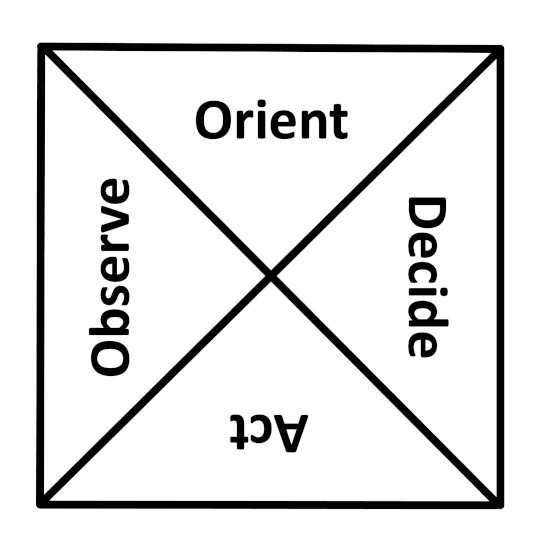
Similarly, the OODA Loop is an iterative framework for the improvement and management of decision processes. It is used in various domains such as business, litigation, and military strategy. The OODA Loop consists of four parts:

    • Observe
    • Orient
    • Decide
    • Act

Learning Cycles are similar to Design Cycles in that the process to be improved is learning and the product to be improved is knowledge. It would be interesting to compare the two types of cycles to understand their similarities and differences. Some of each type have four stages but others have more or less. I have mentioned several learning cycles with four steps already in this blog, the Kolb learning cycle and the Scientific Method.

Further Reading:

https://en.wikipedia.org/wiki/PDCA

https://en.wikipedia.org/wiki/Walter_A._Shewhart

https://en.wikipedia.org/wiki/Continual_improvement_process

https://www.praxisframework.org/en/library/shewhart-cycle

https://www.google.com/search?q=PDCA+cycle&tbm=isch

https://en.wikipedia.org/wiki/Decision_cycle

https://en.wikipedia.org/wiki/OODA_loop

https://www.techtarget.com/searchcio/definition/OODA-loop

https://en.wikipedia.org/wiki/Learning_cycle

https://www.google.com/search?q=learning+cycles+and+design+cycles+compared&tbm=isch

[*6.54]

<>


The Tree of Knowledge System

The Tree of Knowledge (ToK) System posits four hierarchical planes of existence having separate dimensions of complexity mapped out or studied by four different kinds of sciences:

  • Matter/Object: mapped by Physical Sciences
  • Life/Organism: mapped by Biological Sciences
  • Mind/Animal: mapped by Psychological, Cognitive, and Behavioral Sciences
  • Culture/Person: mapped by Human Social Sciences

The ToK System is reminiscent of other “big history” or “cosmic evolution” schemas such as Tyler Volk’s Combogenesis except for the special consideration for the mental and psychological (i.e. subjective) aspects of existence. I would think that this is primarily due to the fact that the developer of the system, Professor Gregg Henriques, is a psychologist.

In order to support his focus on consciousness and psychology, Henriques has developed several theories to address the “problem of psychology”, for example the Justification Systems Theory and the Behavioral Investment Theory. With the ToK System, these and several other key ideas, he claims he has a “Unified Theory of Knowledge” (UToK)!

Further Reading:

https://en.wikipedia.org/wiki/Tree_of_knowledge_system

https://www.unifiedtheoryofknowledge.org/8-key-ideas/the-tree-of-knowledge

https://en.wikipedia.org/wiki/Gregg_Henriques

http://www.gregghenriques.com/

https://www.unifiedtheoryofknowledge.org/

https://www.psychologytoday.com/us/blog/theory-knowledge

https://drive.google.com/file/d/1W6h2wsRx4EqYJ5WuPHxFUwphRJJwy0p1/view

Combogenesis: a constructive, emergent cosmos

<>

The Four Purusharthas

The Four Purusharthas of Hinduism are the goals or aims of human life. They are:

  • Artha : means
  • Kama : desire
  • Dharma : nature
  • Moksha : release

Recently, I asked ChatGPT: “Please explain to me the Four Purusharthas: Artha, Kama, Dharma, and Moksha.”

The Four Purusharthas, also known as the four goals of human life, are central concepts in Hindu philosophy and are considered to be the framework for a fulfilling and meaningful life. The Four Purusharthas are:

Artha: Artha refers to material prosperity, wealth, and security. It involves pursuing financial stability, professional success, and material comfort. This purushartha is considered necessary for the maintenance of life and for pursuing the other three goals.

Kama: Kama refers to pleasure and desire, including the enjoyment of life’s sensual pleasures and the desire for material comforts. It is considered an important goal in life, but should not be pursued at the expense of the other three goals.

Dharma: Dharma refers to duty, morality, and ethics. It involves following one’s moral and ethical obligations, living a life in accordance with divine law and one’s own sense of right and wrong, and fulfilling one’s duties to family, society, and the world.

Moksha: Moksha refers to spiritual liberation, freedom from the cycle of reincarnation, and union with the ultimate reality. It is considered the ultimate goal of human life, and is achieved through a process of self-realization, spiritual discipline, and detachment from material desires.

According to Hindu philosophy, the Four Purusharthas are not mutually exclusive, and a balanced pursuit of all four is considered the path to a fulfilling and meaningful life. The order of priority among the goals may vary depending on an individual’s personal circumstances, but it is believed that by fulfilling the first three goals, one can then attain the ultimate goal of Moksha.

Further Reading:

https://en.wikipedia.org/wiki/Puru%E1%B9%A3%C4%81rtha

https://en.wikipedia.org/wiki/Dharma

https://en.wikipedia.org/wiki/Artha

https://en.wikipedia.org/wiki/Kama

https://en.wikipedia.org/wiki/Moksha

https://chopra.com/articles/purushartha-the-4-aims-of-human-life

The 2 Mountains and the 4 Goals

Many Paths, Many Ends

Finding Your Soul’s Purpose: The Four Purusharthas

https://nepalyogahome.com/four-purusharthas-in-hinduism/

Hector Garcia and Francesc Miralles / The Four Way Path:  a guide to Purushartha and India’s spiritual traditions for a life of…

Images of the Four Purusharthas:

https://www.google.com/search?q=Four+Purusharthas&tbm=isch

[*13.148]

<>


The Ancient and the Modern

In the past, I’ve created several diagrams juxtaposing pairs of fourfolds, for example

So here’s another, The Four Classical Elements and Space-Time-Energy-Matter.

I asked ChatGPT to look at this association: “Please write a short essay comparing and contrasting the classical four elements of air, fire, earth, and water with the modern scientific foursome of space, energy, matter, and time.”

The concept of the classical four elements of air, fire, earth, and water has been a fundamental aspect of ancient philosophy for thousands of years. This idea, which was first proposed by the ancient Greek philosopher Empedocles, held that these four elements were the building blocks of the universe and were responsible for all natural phenomena.

In contrast, the modern scientific foursome of space, energy, matter, and time provides a more comprehensive and rigorous explanation of the nature of the universe. Space refers to the three-dimensional continuum in which all matter exists, and it provides the framework for the movements of objects. Energy refers to the capacity of a system to perform work and is responsible for all physical and chemical processes. Matter refers to any physical substance, including solid, liquid, and gas. Time, on the other hand, is a fundamental aspect of the universe that allows for the measurement of the duration of events and the progression of physical processes.

One key difference between the classical and modern concepts of the elements is that the classical elements were thought to have qualities and personalities, while the modern elements are purely physical and mathematical constructs. The classical elements were thought to interact with each other in specific ways to produce the natural world, while the modern elements interact according to the laws of physics and chemistry.

Another difference is that the classical elements were limited to four, while the modern elements form a much more complex and nuanced picture of the universe. This difference reflects the advancement of human knowledge and understanding of the natural world over time.

In conclusion, the classical four elements of air, fire, earth, and water have played an important role in shaping human thought and culture. However, the modern scientific foursome of space, energy, matter, and time provides a more comprehensive and scientifically rigorous explanation of the universe and its workings. Both concepts have contributed to our understanding of the world, and they continue to play a role in shaping our ideas about the nature of reality.

Not quite enough, so I replied “Thank you, that’s pretty good. However, please say more about how air is like space, how fire is like energy, how earth is like matter, and how water is like time.”

Certainly! Let me expand on the similarities between the classical elements and the modern scientific elements:

1. Air and space: Both air and space are often thought of as being intangible and difficult to define. They both provide the framework for other physical phenomena, such as the movements of objects in space or the flow of air currents. Additionally, both air and space have the ability to contain other elements or substances, such as the gases that make up air or the stars and planets that exist within space.

2. Fire and energy: Fire is often associated with heat and light, and it can be both destructive and transformative. Energy also has the ability to transform physical systems, such as through chemical reactions or the transfer of heat. Furthermore, fire can be seen as a form of energy that is released through combustion, and it can be harnessed for practical purposes, such as cooking food or heating homes.

3. Earth and matter: Earth is often thought of as being solid and unchanging, while matter is the physical substance that makes up the universe. Earth provides a foundation for other physical phenomena, such as the growth of plants or the construction of buildings. Similarly, matter provides the building blocks for physical systems, such as the atoms and molecules that make up the substances in our world.

4. Water and time: Water is often thought of as being cyclical and constantly changing, such as through the phases of the tides or the flow of rivers. Time is also cyclical and constantly changing, as it moves forward and allows for the progression of physical processes and the measurement of the duration of events. Furthermore, just as water can shape the physical world through erosion and the formation of land masses, time shapes the physical world through its influence on the progression of physical processes.

In conclusion, there are certainly similarities between the classical four elements of air, fire, earth, and water, and the modern scientific foursome of space, energy, matter, and time. These similarities reflect the continuity of human thought and understanding of the natural world, and they demonstrate the ongoing influence of ancient ideas in shaping our modern understanding of the universe.

<>
A Fourfold about Belief and Knowledge

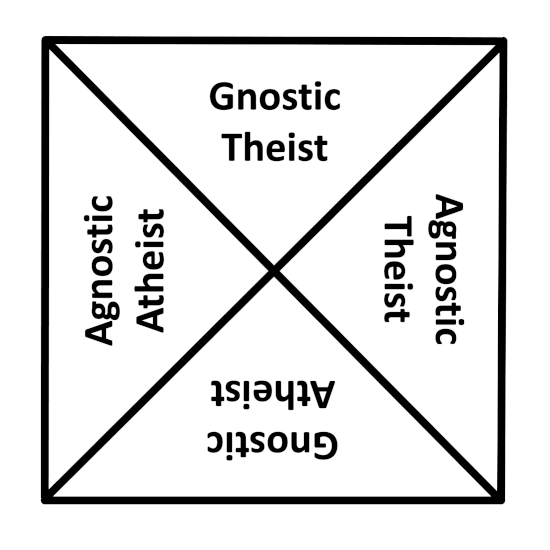
There was a fourfold making the rounds a while back about belief and knowledge of God or of gods. The terms Agnostic and Gnostic are about (the actuality or possibility of) having or not having knowledge, whereas Theist and Atheist are about having or not having belief in a deity or deities. So the following fourfold obtains:

  • Gnostic Atheist
  • Agnostic Atheist
  • Gnostic Theist
  • Agnostic Theist

Some criticized this framework, while others seemed to like it. YMMV.

Let’s see what ChatGPT says:

Gnostic Atheist: This term refers to someone who believes that God does not exist, and that this knowledge is certain. They have a definite and confident understanding about the non-existence of God.

Agnostic Atheist: This term refers to someone who doesn’t believe in God, but does not claim to have certainty about it. They may lack knowledge or certainty about the existence of God, but they do not believe in its existence.

Gnostic Theist: This term refers to someone who believes in the existence of God and has a definite and confident understanding about it. They have a strong conviction that God exists.

Agnostic Theist: This term refers to someone who believes in God but does not claim to have certainty or absolute knowledge about it. They have a belief in God, but acknowledge that it is not possible to have certain knowledge or proof of God’s existence.

In summary, “Gnostic” refers to knowledge or certainty, while “Agnostic” refers to lack of knowledge or certainty. The “Atheist” and “Theist” refer to the belief or non-belief in the existence of a higher power or deity, respectively.

Further Reading:

Other images:

https://www.google.com/search?q=gnostic+atheist+theist+agnostic&tbm=isch

For example:

Terrible graphs of agnostic atheism

I also see the following fourfold used (all nouns now):

  • Atheist
  • Theist
  • Gnostic
  • Agnostic

and even this eight-fold (a combination of the two):

  • Gnostic Atheist
  • Atheist
  • Agnostic Atheist
  • Agnostic
  • Agnostic Theist
  • Theist
  • Gnostic Theist
  • Gnostic

<>

Four Philosophies, V3

In ancient Greece, four types of philosophies centered around different individuals and groups who inhabited particular locations in Athens.

  • Porch (Stoa): Zeno of Citium
  • Garden: Epicurus
  • School (or Academy): Plato
  • Temple (or Lyceum): Aristotle

I’ve taken liberties with these place-names and probably should use the classical Greek or something.

I tried ChatGPT again (I just asked “Describe to me the ancient Greek philosophies of the porch, garden, school and temple.” I give up! 🙂 ):

The ancient Greek philosophical tradition was centered around different schools of thought, each with their own distinct teachings and practices.

The “Porch” (also known as the “Stoa”) was a philosophical school founded by Zeno of Citium, which emphasized the development of virtuous character through the practice of self-control and detachment. The Stoics believed in living in accordance with reason and nature, and sought to cultivate a calm and unruffled state of mind in the face of life’s challenges.

The “Garden” was a school founded by Epicurus, which taught that the path to happiness lay in seeking pleasure and avoiding pain. Epicureans believed that the universe was made up of atoms and that the soul was mortal, and they emphasized the importance of living a simple and moderate life.

The “School” (also known as the Academy) was founded by Plato, who was one of the most influential figures in Western philosophy. The Academy was a place of learning and discussion, and its teachings emphasized the importance of the Forms, or abstract ideal objects that exist in a realm beyond the physical world.

The “Temple” (also known as the Lyceum) was a philosophical school founded by Aristotle, who was a student of Plato. The Lyceum focused on empirical investigation and the study of nature, and Aristotle’s teachings emphasized the importance of finding the mean between extremes in all aspects of life.

Each of these schools offered different perspectives on the nature of reality, the good life, and the path to happiness, and their ideas continue to influence Western philosophy to this day.

Further Reading:

https://en.wikipedia.org/wiki/Zeno_of_Citium

https://en.wikipedia.org/wiki/Epicurus

https://en.wikipedia.org/wiki/Plato

https://en.wikipedia.org/wiki/Aristotle

Also:

https://en.wikipedia.org/wiki/Lyceum_%28classical%29

https://aeon.co/essays/forget-plato-aristotle-and-the-stoics-try-being-epicurean

What Are The Main Differences Between Epicureanism And Stoicism?

Epicureanism and Stoicism: Lessons, Similarities and Differences

https://plato.stanford.edu/entries/stoicism/

https://en.wikipedia.org/wiki/Stoicism

https://www.thoughtco.com/happiness-epicurean-and-stoic-perspective-4070798

https://www.thoughtco.com/five-great-schools-ancient-greek-philosophy-2670495

https://en.wikipedia.org/wiki/Epicureanism

https://plato.stanford.edu/entries/epicurus/

Stoicism

Finding Philosophy Among the Stones

http://www.csun.edu/~hcfll004/philos-schools.html

[*12.164]

<>

The SECI Model of Knowledge Dimensions

The SECI Model of Knowledge Dimensions is a schema that attempts to explain how knowledge moves between tacit and explicit domains. The movement is a cycle or more properly a spiral in that knowledge builds upon itself.

  • Socialization (Tacit to Tacit)
  • Externalization (Tacit to Explicit)
  • Combination (Explicit to Explicit)
  • Internalization (Explicit to Tacit)

ChatGPT explains:

The SECI model, also known as the Ba model, is a knowledge management framework that describes how knowledge is created, shared, and transferred within an organization. The acronym SECI stands for Socialization, Externalization, Combination, and Internalization.

      1. Socialization: refers to the process of acquiring knowledge through social interaction, for example, through observing and imitating the behavior of others.
      2. Externalization: is the process of converting personal experiences, ideas, and insights into shared understanding and explicit knowledge. This stage involves expressing personal knowledge in a way that others can understand and utilize.
      3. Combination: refers to the process of combining and integrating different types of knowledge to create new knowledge. This can occur when individuals with different experiences and perspectives collaborate and share their knowledge.
      4. Internalization: is the process of incorporating new knowledge into personal knowledge structures, leading to changes in behavior, attitudes, and skills.

The SECI model is used to understand how knowledge can be managed effectively within an organization, and it provides a framework for designing knowledge management systems and processes.

Maybe I should let ChatGPT write my posts from now on! And here’s what ChatGPT says about this blog:

“Equivalent Exchange” is a blog that focuses on topics related to personal growth and self-improvement. It provides articles and resources that aim to help readers lead a more fulfilling life by making positive changes in their thoughts, habits, and behaviors. The blog covers a variety of subjects, including mindfulness, mental health, productivity, relationships, and more. It also provides a supportive community for those seeking inspiration, guidance, and motivation to live their best life.

Wow! 😉

Further Reading:

https://en.wikipedia.org/wiki/SECI_model_of_knowledge_dimensions

https://en.wikipedia.org/wiki/I-Space_(conceptual_framework)

https://en.wikipedia.org/wiki/Four_stages_of_competence

Kolb’s Learning Cycle

[*10.24, *10.25]

<>


Direction of Fit

The notion of “Direction of Fit” can describe several associated concepts, from a specific one in “Speech Act Theory” (SAT) to the more general one in the “Philosophy of Mind” (POM). For SAT, the concept depends on whether words accurately describe the world (word-to-world), or if the world is actually altered by words (world-to-word) (or possibly both or neither). For POM, the concept is generalized to be between mind (or thought) and world, and of course, word could serve to mediate between mind (or thought) and world.

I propose that direction of fit could also be enlarged to encompass the fits of world-to-world and word-to-word.

Perhaps the notion of world fitting to world is tautological, that it is always true by necessity. For any fit of world to world is natural, in as much as we understand it, because anything else would be super-natural. This is the realm of science then, when we try to explain how the mechanism of the world behaves in its ordered operation. I imagine that we could also put engineering and technology in this case, since we are trying to create an artifact in the world that meshes with the normal goings on of nature. If it meshes very poorly, it either breaks or nature does instead.

The notion of word fitting to word is interesting as well. It is not given that words I write will fit with the words that you read, or there is a proper fit between speaking and listening. I guess the art of rhetoric can be placed here, as how we can fashion our words best to convince or explain or engage. In the POM sense, perhaps any art could be included as well, from literature to music to visual arts, since they strive to convey thoughts to thoughts. I am reminded of the notion of the perfect language in accurately describing the world or of complete understanding between minds.

Maybe words describing world could also be science, but perhaps its proper realm should be more of history or the states of human affairs. This is more in agreement with the opposite direction of World-to-Word, or world fitting to word.

Maybe I’m just thinking of a certain fourfold of Richard McKeon, and want to make a correspondence of

  • Word-to-World => Thought
  • World-to-Word => Action
  • Word-to-Word => Word
  • World-to-World => Thing

although I’m not sure this works.

Further Reading:

https://en.wikipedia.org/wiki/Direction_of_fit

https://plato.stanford.edu/entries/speech-acts/

https://en.wikipedia.org/wiki/Triangle_of_reference

https://en.wikipedia.org/wiki/The_Message_in_the_Bottle#%22The_Delta_Factor%22

https://read.dukeupress.edu/the-philosophical-review/article-abstract/123/4/429/87552/On-the-Very-Idea-of-Direction-of-Fit?redirectedFrom=fulltext

https://www.jstor.org/stable/44290001

https://plato.stanford.edu/entries/belief/

https://plato.stanford.edu/entries/intention/

http://www.gavinjensen.com/blog/category/Philosophy+of+Language

Things, Thoughts, Words, and Actions

[*12.96, *12.98]

<>


The Four Paths of Yoga

According to the Vedanta, the 4 major margas (paths) are Jnana Yoga (the path of wisdom and knowledge), Bhakti Yoga (the path of devotion), Karma Yoga (path of selfless action or service) and Raja Yoga (path of self-discipline):

  • Jnana Yoga: The path of wisdom and knowledge
  • Bhakti Yoga: The path of devotion
  • Karma Yoga: The path of selfless action and service
  • Raja Yoga: The path of self-discipline

Further Reading:

https://en.wikipedia.org/wiki/Three_Yogas

https://en.wikipedia.org/wiki/Jnana_yoga

https://en.wikipedia.org/wiki/Karma_yoga

https://en.wikipedia.org/wiki/Bhakti_yoga

https://en.wikipedia.org/wiki/R%C4%81ja_yoga

https://artsandculture.google.com/story/the-four-paths-of-yoga/QQURiPuOVM2eIw#

https://chopra.com/articles/the-4-paths-of-yoga

<>