 References:
John R. Searle / The Construction of Social Reality
http://lafavephilosophy.x10host.com/subjective_objective.html
[*5.198]
<>
References:
John R. Searle / The Construction of Social Reality
http://lafavephilosophy.x10host.com/subjective_objective.html
[*5.198]
<>

 There seems to be many different so-called learning cycles, but I think Kolb’s matches my other double duals most closely.
David A. Kolb / Experiential Learning : experience as the source of learning and development
References:
http://www.businessballs.com/kolblearningstyles.htm
[*6.38, *6.88, *6.134, *8.93]
<>
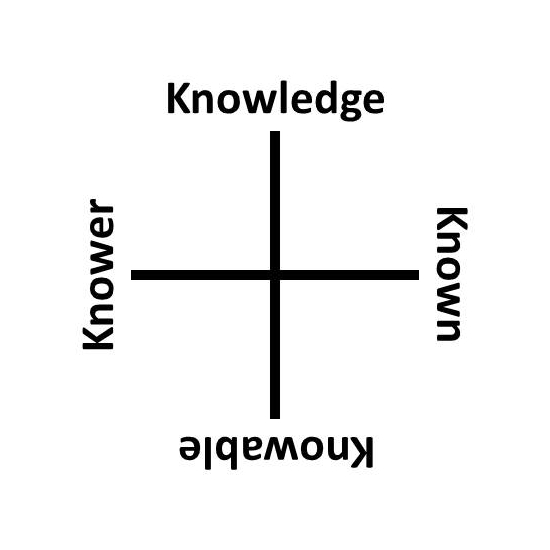 Richard McKeon’s system of Philosophical Semantics arises from the sixteen pairwise and ordered relations between his four aspects of knowing or cognates: knower, knowledge, the known, and the knowable. These sixteen relations can be sorted in four groups of four elements each: methods, interpretations, principles, and selections.
Between knower and knowledge, and between the knowable and the known, arise the four methods of two each: the universal and the particular.
Between knower and the known, and between the knowable and knowledge, arise the four interpretations of two each: the phenomenal and the ontic.
Between knower and the knowable, and between knowledge and the known, arise the four principles of two each: the meroscopic and the holoscopic.
Between each of the aspects of knowing with itself, arise the four selections.
Each method can be associated with a discursive process: operational with debate, dialectical with dialogue, logistic with proof, and problematic with inquiry. Each method is also associated with a mode of thought which in turn has two moments and one dependency or assumption: the operational method is debate by discrimination and postulation dependent on chosen theses, the dialectical method is dialogue by assimilation and exemplification dependent on changeless models, the logistic method is proof by construction and decomposition dependent on indivisible constituents, and the problematic method is inquiry by resolution and question dependent on discoverable causes.
References:
Richard McKeon / On Knowing–The Natural Sciences
Richard McKeon / Freedom and History and Other Essays: an introduction to the thought of Richard McKeon
Sadly, the following pages are no longer available:
http://net-prophet.net/mckeon/mckeon.htm
http://forums.abrahadabra.com/showthread.php?2331-Unifying-Astrology-and-I-Ching
[*4.47, *5.184-*5.187, *6.20, *6.106]
<>
I have recently come across the philosophical work of Arthur M. Young (AMY). This is an initial impression of that work since I have only read what is available from the web links below, and even then there is a great deal to digest. In addition, there is difficulty in presenting a summary of his theory because of similarities to my ideas as well as substantial differences. I am sure I will need to return to AMY’s theory after more consideration.
I have hinted at a correspondence between several double duals presented in this blog, but I have steered away from claiming that they are all linked to each other – that they are essentially equivalently exchangeable. AMY’s theory links the four elements, the four causes, Jung’s functions of the psyche, geometrical elements and transformations, as well as several other fourfolds into a cosmic theory of reality.
Some of these same fourfolds are present in my theory, and I am considering how others may be introduced. Some not mentioned by AMY are only mentioned in earlier entries on this blog, without presentation. However, from many of these same fourfolds I have reached substantially different conclusions from AMY. I believe this is because AMY’s theory of process is essentially dualistic, whereas my theory appears to be physicalistic, although one might also say it is a process and/or relational theory.
Below is a table of some of the correspondences for AMY’s theory of process:
| Aristotle’s Four Causes |
Jung’s Functions of the Psyche |
Four Elements of Empedocles |
Geometric Transform- ations |
||
| Purpose | Final | Intuition | Fire | Rotation | Spirit |
| Value | Material | Emotion | Water | Scale | Soul |
| Form | Formal | Intellect | Air | Inversion | Mind |
| Object | Efficient | Sensation | Earth | Translation | Body |
Below is a table of some of the correspondences for my theory:
| Four Elements of Empedocles |
The Here and the Now |
Aristotle’s Four Causes |
Duality of Time and Information |
Hjelmslev’s Net |
| Fire | Before | Efficient | Change time | Substance of content |
| Water | After | Final | Bear time | Form of content |
| Air | Above | Formal | Bear information |
Form of expression |
| Earth | Below | Material | Change information |
Substance of expression |
References:
Arthur M. Young / The Reflexive Universe
Arthur M. Young / The Geometry of Meaning
http://www.arthuryoung.com/barr.html
http://www.arthuryoung.com/4levels.html
http://www.arthuryoung.com/the2exc.html
[*6.84-*6.89, *7.78, *7.79, *8.2, *8.62, *8.63]
<>
“God is a lobster, or a double pincer, a double bind.”
— From A Thousand Plateaus by Deleuze and Guattari
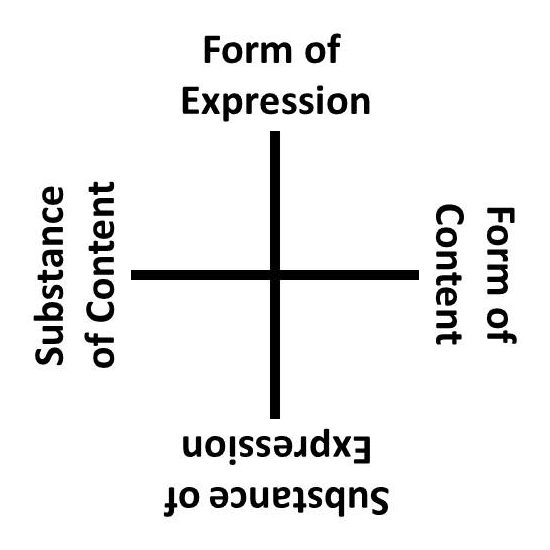
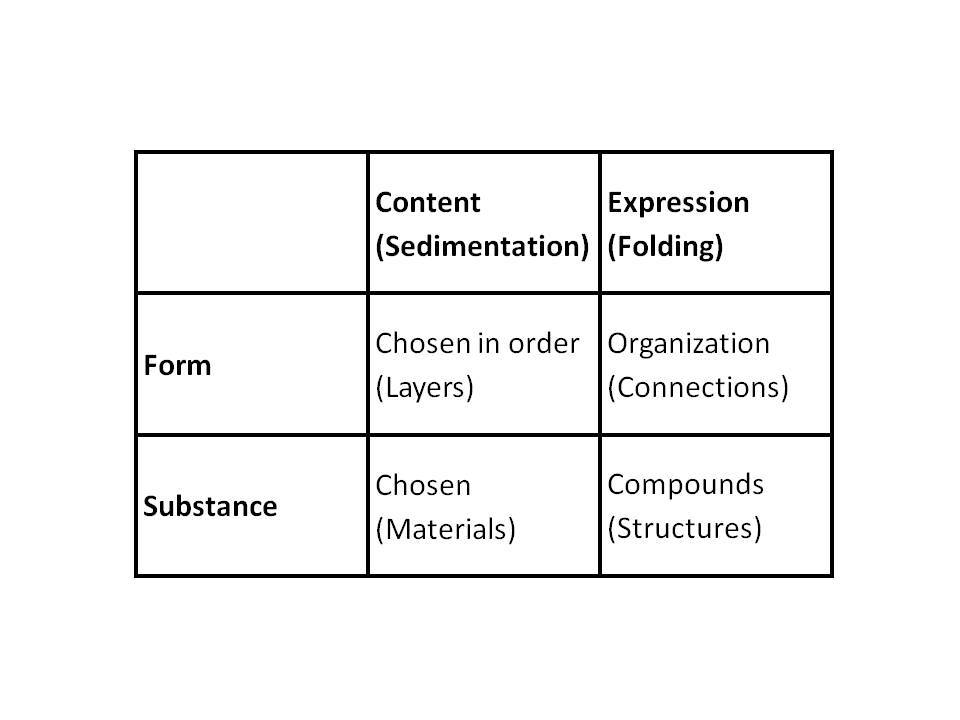 Linguist Louis Hjelmslev developed a semiotic model which elaborated Saussure’s two part signifier and signified into the double dual of the substance of content, the form of content, the substance of expression, and the form of expression. Contents are “formed matters”, and expressions are “functional structures”. Both are further separated into a substance and a form. The original signifier can be considered the form of expression, while the original signified can be considered the form of content. The two types of forms are like a net of warp and woof (why else a net?), dividing an undifferentiated unformed matter (Earth, purport) into two types of substances.
Deleuze and Guattari cast this net from Hjelmslev’s use in language into universal application by way of examples in geology and biology: sedimentation/folding and molecular genetics. The two planes of content and expression are the First Articulation and Second Articulation, respectively, the first of which “chooses or deducts”, and the second of which establishes “functional, compact, stable structures”. In their geology example, the First Articulation is the process of sedimentation, and the Second, folding. Generally, the two substances deal with territorialization, deterrritorialization, and reterritorialization, and the two forms are concerned with coding and decoding (and recoding?).
Additionally, there is talk of the molar versus the molecular (as continuous/discrete or unity/multiplicity?) but the molar is not form, nor is the molecular substance, nor vice versa. The First Articulation moves from molecular substances to molar forms; the Second Articulation moves from molecular forms to molar substances. How confusing! What does it all mean? One could spend a lifetime lost in these fun-house reflections!
I propose that the four basic logical operators of Linear Logic are in correspondence to the double articulation of Hjelmslev’s Net. Content is Conjunction, Expression is Disjunction, Substance is Additive, and Form is Multiplicative. Content and Expression is Substance or Form; Conjunction and Disjunction is Additive or Multiplicative.
References:
Gilles Deleuze and Felix Guattari / A Thousand Plateaus: capitalism and schizophrenia
Manuel De Landa / The Geology of Morals: a neo-materialist interpretation http://www.t0.or.at/delanda/geology.htm
Luke Feast / The Science of Multiplicities: post-structuralism and ecological complexities in design http://researcharchive.vuw.ac.nz/handle/10063/142
[*3.170, *4.46, *4.88, *4.112, *4.146, *5.70, *5.174, *6.10]
<>
PLURALISM = MONISM
– From A Thousand Plateaus by Deleuze and Guattari
 Jeffrey Bell’s blog entry about William James’ radical empiricism reveals relations between Hjelmslev’s Net and Linear Logic. To begin with, Hume was concerned with disjunctive relations (of expression) to the exclusion of conjunctive relations (of content). In addition, James sought the solution to the problem that consciousness (here content) has between the “one and the many”, one consciousness in relation to many consciousnesses. Unable to resolve this problem, James did not realize that conjunction can come in two modes, an additive one and a multiplicative one, a substance and a form.
The substance of content (here consciousness, agency, …) is constituted incrementally from choices between actions, either thoughts (thoughts-as-action) or actual actions (actions-as-action). This is additive AND. The form of content (essence, existence) is assembled by the ordering of those choices, a multiple choice of choices. This is multiplicative AND. These are the powers of AND.
However, Hume’s disjunction (expression) also comes in two flavors: additive and multiplicative (substance and form). It also has a problem with the “one and the many”. The substance of expression is either identity or generation (accident, substance). This is additive OR. The form of expression doesn’t seem like much in Linear Logic, but it is the very form of the logic, invertible with the connective tissue of the calculus (the comma). This is multiplicative OR. These are the powers of OR.
Content and expression are dual to each other, as conjunction is logically dual to disjunction. Is content the “subjective” and expression the “objective”? Is substance the “one” and form the “many”? Each is dual to the other, not distinguishable except by perspective. Perhaps these double duals are like a Mobius Strip, which only has one side, weaving in and out and forming a unity out of multiplicity.
Note that the elements of the double dual shown here are taken from the Protreptikos page “Monism and Pluralism”. The fourfold is made up of different “compositions in being”, each in two parts. There are many echoes to other double duals in these compositions, such as potency/actuality (existence) and substance/form.
References:
Gilles Deleuze and Felix Guattari / A Thousand Plateaus: capitalism and schizophrenia
http://schizosoph.wordpress.com/2010/08/11/monism-pluralism/
Further Reading:
https://en.wikipedia.org/wiki/Potentiality_and_actuality
https://plato.stanford.edu/entries/aristotle-metaphysics/
https://plato.stanford.edu/entries/form-matter/
https://ndpr.nd.edu/news/form-matter-substance/
https://heightsforum.org/series_post/matter-form-substance-accidents/
[*6.40]
<>
The states of a computing system bear information and change time, while its events bear time and change information.
— from The Duality of Time and Information by Vaughan Pratt
The most promising transformational logic seems to us to be Girard’s linear logic.
— from Rational Mechanics and Natural Mathematics by Vaughan Pratt

References:
Vaughan Pratt / The Duality of Time and Information http://boole.stanford.edu/pub/dti.pdf
Vaughan Pratt / Time and Information in Sequential and Concurrent Computation http://boole.stanford.edu/pub/tppp.pdf
Vaughan Pratt / Rational Mechanics and Natural Mathematics http://chu.stanford.edu/guide.html#ratmech
[*5.170]
<>
Material: That from which something is made.
Efficient: That by which something is made.
Formal: That into which something is made.
Final: That for the sake of which something is made.
— from Aristotle for Everybody by Mortimer Adler
“Happy is he who can recognize the causes of things.”
— Virgil

Aristotle’s Four Causes is likely the most familiar of all the double duals that I will present. The causes are closer to being “becauses” since they are usually thought of as the reasons or explanations for things. Why not call them the four prepositions?
The standard example of the four causes is what is needed for the building of a house. A house is built by the craftsmen, from the raw materials, into the form shown on blueprints, for the homeowner to live in. This and other usual examples are concerned with the making of something.
Formal and final causes have gotten the short shift since the beginning of the scientific revolution. Francis Bacon stated that the only scientific reasons for things were the efficient and material causes. For those critical of materialism this is often termed mere “matter in motion”. Matter can be thought to exist in space, and motion in time. Where does form or finality exist? I will say in space and time as well.
References:
Max Hocutt / Aristotle’s Four Becauses, in Philosophy, Vol. 49, No. 190. (Oct., 1974), pp. 385-399.
http://en.wikipedia.org/wiki/Four_causes
http://plato.stanford.edu/entries/aristotle-causality/
http://en.wikipedia.org/wiki/The_purpose_of_a_system_is_what_it_does
http://faculty.washington.edu/smcohen/320/4causes.htm
Notes:
John Sowa’s Thematic Roles: initiator, resource, essence, goal.
http://www.jfsowa.com/ontology/thematic.htm
[*4.112, *5.73, *5.162, *5.168, *7.47]
<>
Whosoever speculated on these four things, it were better for him if he had not come into the world —
— From the Mishnah (Hagigah 2:1)
All things have a root and a top; all events an end and a beginning. Whoever understands correctly what comes first and what follows draws nearer the Dao.
— From T’ai Hioh by Confucius
As above, so below.
— From The Emerald Tablet
 I like these quotes because they show that Above, Below, Before and After are linked together. The first quote gives a warning about thinking about these concepts, but the second, encouragement. Above and below, or higher and lower, can be thought of as directions in space, but also as terms of hierarchy. Before and after can be thought of as directions in time, but also as beginnings and endings, causes and results.
Every individual is situated in space and time (see SpaceTime). Every perspective is due to expression and content (see Hjelmslev’s Net). Here is space, now is time.
References:
http://en.wikipedia.org/wiki/Emerald_Tablet
[*5.160, *6.30]
<>
Into this wilde Abyss,
The Womb of nature and perhaps her Grave,
Of neither Sea, nor Shore, nor Air, nor Fire,
But all these in their pregnant causes mixt
Confus’dly, and which thus must ever fight,
Unless th’ Almighty Maker them ordain
His dark materials to create more Worlds,
Into this wilde Abyss the warie fiend
Stood on the brink of Hell and look’d a while,
Pondering his Voyage; for no narrow frith
He had to cross.
— From Paradise Lost by John Milton

The Four Elements of Empedocles is one of the earliest ontologies. While not of special interest in itself (except of course to alchemy), other double duals are comparable to it, such as the The Here and the Now and Heidegger’s Fourfold. Additionally, it is interesting to remember that it was thought that the four elements were the primitives of which everything is composed; for example bone was fire, air, water, and earth blended in a certain proportion. I am unsure of the origin of the choice of the elements: why these four and not others?
Also, note that with respect to light transmission, the four elements can be arranged in the sequence of bright, light, dim, and dark. This is not to say that fire is “good” and earth “bad”, or that fire and earth are the most different from each other. Perhaps this distinction will have some meaning later.
 [*5.188, *6.32, *6.56, *7.194]
<>
Because there are way more than seven wonders in the world.
Always Forward Between Heaven and Earth
Psychological Musings
Critiquing anime and everything else
"For man has closed himself up, till he sees all things thro' narrow chinks of his cavern" -- William Blake
Category Theory, Haskell, Concurrency, C++
Reviewing fascinating science books since 2017
Every Fourth Thing
Derek Wise's blog: Mathematics, Physics, Computing and other fun stuff.
integrating 4 binary opposites in life, learning, art, science and architecture
integrating 4 binary opposites in life, learning, art, science and architecture
Chasing the Paper Rabbit
experiments in a reaction from the left
A blog about computers, evolution, complexity, cells, intelligence, brains, and minds.
mind maps, infographics, and expositions
neat ideas from unusual places
Introduction to a Quadralectic Epistomology
Astronomy, space and space travel for the non scientist
Every Fourth Thing
A Serious Look at Trivial Things
A Survey of Tetradic Testimonials in Architecture
Musings from a Naturalist
Why Evolution is True is a blog written by Jerry Coyne, centered on evolution and biology but also dealing with diverse topics like politics, culture, and cats.
Four-fold thinking4you
Craig Weinberg's Cosmology of Sense
Purveyors of Fine Anime Reviews and Ratings Since 2010
Between Subject and Object
Every Fourth Thing
Every Fourth Thing
Every Fourth Thing
Every Fourth Thing
Every Fourth Thing
Sometimes those Sticking their Heads in the Sand are Looking for Something Deep
Online Home of Christopher Vitale, Associate Professor of Media Studies, The Graduate Program in Media Studies, Pratt Institute, Brooklyn, NY.
Linking Ideas
RESEARCHING THE DEMANDS OF THOUGHT
Explorations in the Paradoxes of Meaning
"The centaur of classical metaphysics shall be mated with the cheetah of actor-network theory."
objects & things, design, art & technology
 Equivalent Exchange