Category Archives: fourfolds

The Day the Earth Stood Still

sq_day_the_earth_stood_still3“I am leaving soon, and you will forgive me if I speak bluntly. The universe grows smaller every day, and the threat of aggression by any group, anywhere, can no longer be tolerated. There must be security for all, or no one is secure. Now, this does not mean giving up any freedom, except the freedom to act irresponsibly. Your ancestors knew this when they made laws to govern themselves and hired policemen to enforce them. We, of the other planets, have long accepted this principle. We have an organization for the mutual protection of all planets and for the complete elimination of aggression. The test of any such higher authority is, of course, the police force that supports it. For our policemen, we created a race of robots. Their function is to patrol the planets in spaceships like this one and preserve the peace. In matters of aggression, we have given them absolute power over us. This power cannot be revoked. At the first sign of violence, they act automatically against the aggressor. The penalty for provoking their action is too terrible to risk. The result is, we live in peace, without arms or armies, secure in the knowledge that we are free from aggression and war. Free to pursue more… profitable enterprises. Now, we do not pretend to have achieved perfection, but we do have a system, and it works. I came here to give you these facts. It is no concern of ours how you run your own planet, but if you threaten to extend your violence, this Earth of yours will be reduced to a burned-out cinder. Your choice is simple: join us and live in peace, or pursue your present course and face obliteration. We shall be waiting for your answer. The decision rests with you.”

— Klaatu’s closing words

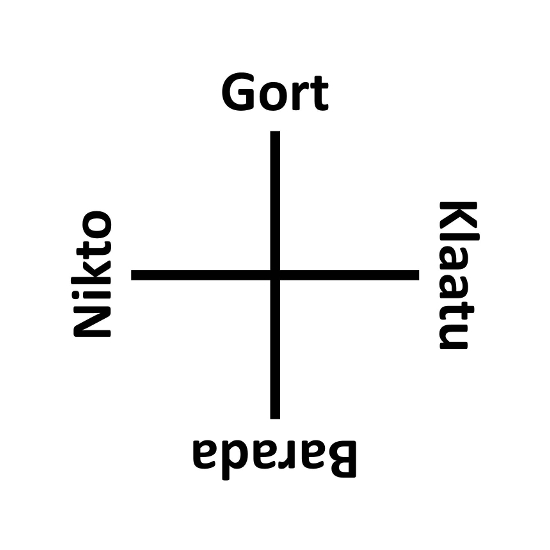
“Gort! Klaatu barada nikto!”

— Helen Benson

I, for one, welcome our new X overlords!

References:

http://www.imdb.com/title/tt0043456/quotes

https://en.wikipedia.org/wiki/The_Day_the_Earth_Stood_Still

https://en.wikipedia.org/wiki/Farewell_to_the_Master

[*9.78]

<>

The Four Requisites of Randall Collins

sq_four_requisites2“Everything in the human world has four aspects” states sociologist Randall Collins, and I couldn’t agree more. For his view of sociology, these four aspects are the Social, the Political, the Cultural, and the Economic.

These four requisites are adapted from Talcott Parsons, who was Collins’ undergraduate teacher. Parsons’ four requisites were named differently, and together they are known as the “AGIL” model. “A” stood for Adaptation, “G” for Goal-attainment, “I” for Integration, and “L” for Latency. It was also called the Structural-Functional model of society. Besides the change in names, Collins also says that the functionalism inherent in Parsons’ model has been downplayed in his because a biological, functional approach cannot model conflict, which is pervasive in human interaction.

Collins wrote a book on the historical “sociology” of philosophies, “The Sociology of Philosophies”. This book was the reason I first noted Collins, but I haven’t studied the book in any detail to note if any fourness falls out of the analysis. This kind of historical and organizational model of philosophy seems to be popular, and several others have attempted to compile something similar.

Collins also wrote “Four Sociological Traditions”, a history of sociology organized around the development of four classic schools of thought: the conflict tradition of Marx and Weber, the ritual solidarity of Durkheim, the microinteractionist tradition of Mead, Blumer, and Garfinkel, and the utilitarian/rational choice tradition. This book was the second reason I noted Collins, but not having read the book, I wasn’t sure how to interpret these four schools as a four-fold.

References:

http://sociological-eye.blogspot.com/2015/07/four-requisites-for-success-or-failure.html

https://en.wikipedia.org/wiki/Randall_Collins

https://en.wikipedia.org/wiki/Talcott_Parsons

Books by Randall Collins:

Four Sociological Traditions

The Sociology of Philosophies : a global theory of intellectual change

Philosophical Family Trees:

http://www.philosophyforlife.org/the-kevin-bacon-history-of-philosophy/

http://kevinscharp.com/Kevin%20Scharp%20-%20%20Diagrams.htm

http://www.designandanalytics.com/visualizing-the-history-of-philosophy-as-a-social-network-the-problem-with-hegel

[*3.79, *4.6, *4.7, *9.7, *9.68, *9.71]

<>


The Four Cardinal Virtues

sq_four_virtuesI shall begin with the assumption that a perfect state is one that is rightly ordered, and is therefore wise, brave, temperate and just.

— Plato, from The Republic

From Wikipedia:

The Cardinal virtues are a quartet set of virtues recognized in the writings of Classical Antiquity and, along with the theological virtues, also in Christian tradition. They are comprised of the following qualities:

    • Prudence: also described as wisdom, the ability to judge between actions with regard to appropriate actions at a given time.
    • Justice: also considered as fairness, the most extensive and most important virtue.
    • Restraint: also known as temperance, the practice of self-control, abstention, and moderation tempering the appetition.
    • Courage: also named fortitude, forbearance, strength, endurance, and the ability to confront fear, uncertainty, and intimidation.

References:

https://en.wikipedia.org/wiki/Cardinal_virtues

Images of Four Cardinal Virtues

Also see:

https://equivalentexchange.wordpress.com/2015/01/25/off-to-see-the-wizard/

[*7.146]

<>


The Johari Window

sq_johari_window

As I considered my last post, I wondered if the intersecting centers of all my diagrams represented a “blind spot”, a fifth thing that I have been consistently overlooking. Searching on Google for the topic (besides finding the new television show of the same name), I stumbled on the Johari Window.

The Johari Window is a simple four-fold table that considers what an individual knows and doesn’t know about herself, versus what everyone else knows or doesn’t know.

So, the quadrants are as follows:

Hidden self: Known by self but unknown by others (also called facade)

Public self: Known by self and known by others (also called open or free area, or arena)

Blind self: Unknown by self but known by others (also called blind spot)

Unknown self: Unknown by self and others (unknown but perhaps knowable, also unconscious)

The idea is that the public self can enlarge, and include things from all three of the other selves, and so diminish them. Because having more openness in our selves, as well as less hiddenness, blind-spotness, and unknownness, is a good thing.

And I’m glad the blind spot is really just one of the four things of the Johari Window, so I haven’t left anything out!

References:

https://en.wikipedia.org/wiki/Johari_window

Images for Johari Window

Notes:

Also remember “The Blind Spot: lectures on logic” by Jean-Yves Girard.

[*9.58]

<>

The Brain with David Eagleman

sq_whowhatSpeaking of brains, “The Brain with David Eagleman” by neuroscientist and author David Eagleman is currently showing on PBS. The first episode “What is reality?” was pretty good, showing reasons why what we think of as an objective reality is really just a temporally delayed and conceptually constructed neurological fabrication.

The six episodes are titled:

  1. What is reality?
  2. What makes me?
  3. Who is in control?
  4. How do I decide?
  5. Why do I need you?
  6. Who will we be?

I wonder if the answers to these questions will pretty much be “the brain, the brain, the brain…”. Check your local listings and tune in to find out!

Books:

David Eagleman / The Brain: the story of you

David Eagleman / Incognito: the secret lives of the brain

David Eagleman / Sum: forty tales from the afterlife

David Eagleman / Why the Net Matters: six easy ways to avert the collapse of civilization

References:

Home

https://en.wikipedia.org/wiki/David_Eagleman

[*9.56, *9.57]

<>

The Whole Brain Model of Ned Herrmann

sq_herrmann_brain

Are four different kinds of thinking performed in four distinct areas of the brain?

  • Facts: logical, analytical, fact based, quantitative (left cerebral)
  • Forms: sequential, organized, detailed, planned (left limbic)
  • Feelings: interpersonal, feeling based, kinesthetic, emotional (right limbic)
  • Futures: holistic, intuitive, integrating, synthesizing (right cerebral)

I’ve arranged the quadrants differently than usual. Some might want to see the diagram rotated 180 degrees, so that Facts are at the top. However, there are several reasons that I prefer this arrangement, with organized at top, synthesizing at right, kinesthetic at left, and quantitative at bottom. Part of my confusion is that I ordinarily want to place both Facts and Forms at top, and Feelings and Futures at right.

References:

Ned Herrmann / The Creative Brain

Ned Herrmann / The Whole Brain Business Book

https://en.wikipedia.org/wiki/Herrmann_Brain_Dominance_Instrument

https://www.thinkherrmann.com/

Facts, Form, Feelings and Future in Museum Guiding

Notes:

Images of Whole Brain Herrmann.

The images above remind one of the “Simon Says” toy! Blue, red, green, and yellow are often used in company logos. Three are pigment primary colors, and three are light primary colors. Do colors help one distinguish the quadrants?

Also see the following post, “A Story for Everyone”:

https://equivalentexchange.wordpress.com/2011/06/09/a-story-for-everyone/sq_whowhat

(Where my Who, How, Why, and What are arranged appropriately as Feelings, Forms, Futures, and Facts.)

[*6.120, *6.121, *8.92, *8.139]

<>


Bayes’ Rule

sq_bayes_ruleBayes’ Rule or Theorem or Law. Because, why not?

P(B) P(A|B) = P(A) P(B|A)

References:

https://en.wikipedia.org/wiki/Bayes’_theorem

[*6.132, *9.48]

<>

The Carnot Cycle

sq_carnotThe Carnot Cycle consists of four steps:

  1. Isothermal Expansion
  2. Adiabatic or Isentropic Expansion
  3. Isothermal Compression
  4. Adiabatic or Isentropic Compression

The cycle is ordinarily plotted on two axes in two different ways: Pressure and Volume, in which case the cycle is a curvy quadrilateral and descending to the right, or Temperature and Entropy, in which case the cycle is a nice rectangle that emphasizes the isothermal and adiabatic (isentropic) aspects of the steps.

References:

https://en.wikipedia.org/wiki/Carnot_cycle

Images of the Carnot Cycle from Google search.

Tip of the hat to:

Stuart Kauffman / Investigations

Also please see the previous posts:

https://equivalentexchange.wordpress.com/2012/01/27/thermodynamics-and-the-four-thermodynamic-potentials/

https://equivalentexchange.wordpress.com/2013/05/24/the-four-laws-of-thermodynamics/

[*9.51]

<>

King – Man + Woman = Queen

sq_king_man_woman_queen

Here is a fascinating article and paper on computational linguistics.

References:

https://www.technologyreview.com/2015/09/17/166211/king-man-woman-queen-the-marvelous-mathematics-of-computational-linguistics/

http://arxiv.org/abs/1509.01692

[*9.46]

<>


Pick Your Causation

sq_causationCausation is one of the most important ways in which we conceptualize the world and ourselves. The reasons that objects go through their motions and people perform the acts they do are explained by the causes that lead to these effects. Constitutive materials can also be causes for the effects on things and individuals. Even the form and function of things can be thought of as effects, dependent on the causes that make them come to be. These effects in turn can be causes for subsequent effects, and so on, in a complex chain or network of causation.

Four different “directions” inform discussion about causes and effects, organized by time (Forward and Backward) and space (Upward and Downward). Perhaps space is not the best word: consider size, distance, or even importance. These four directions can also remind one of Aristotle’s Four Causes, where Efficient Causation is Forward, Formal Causation is Downward, Material Causation is Upward, and Formal Causation is Backward.

Forward causation: Temporal causation, where causes happen before their effects. Ordinarily associated with a deterministic view of causation.

Upward causation: Scientific causation, where the smaller or lower cause the effects of the larger or higher. Ordinarily associated with a reductionistic view of causation.

Downward causation: Structural causation, where the larger or higher can cause the effects of the smaller or lower. Typical examples are free will, agency, intention, or volition, where the mind and not just the brain controls the actions of the body.

Backward causation: Reverse temporal causation, where causes are in the future of their effects. This is not quite the same as teleology, although the concepts are closely linked and require further study. Typical examples are purposes, goals, and ends (versus means) (although this is not the usual philosophical meaning of backward causation).

References:

http://plato.stanford.edu/entries/causation-backwards/

https://en.wikipedia.org/wiki/Downward_causation

https://en.wikipedia.org/wiki/Teleology

https://en.wikipedia.org/wiki/Determinism

http://www.nbi.dk/~emmeche/coPubl/2000d.le3DC.v4b.html

Also see these related posts:

https://equivalentexchange.wordpress.com/2010/08/12/aristotles-four-causes/

https://equivalentexchange.wordpress.com/2010/08/11/a-warning/

[*9.40]

<>