All posts by Martin K. Jones

The Four Freedoms

From Wikipedia:

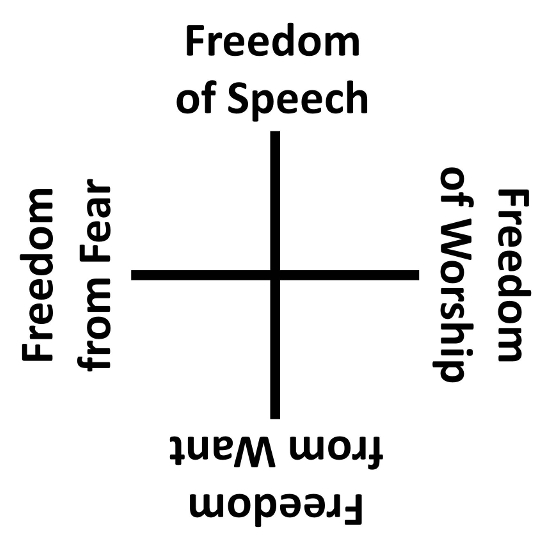
The Four Freedoms were goals articulated by US President Franklin D. Roosevelt on January 6, 1941. In an address known as the Four Freedoms speech (technically the 1941 State of the Union address), he proposed four fundamental freedoms that people “everywhere in the world” ought to enjoy:

  •     Freedom of speech
  •     Freedom of worship
  •     Freedom from want
  •     Freedom from fear

His inclusion of the latter two freedoms went beyond the traditional US Constitutional values protected by its First Amendment, and endorsed a right to economic security and an internationalist view of foreign policy. They also anticipated what would become known decades later as the “human security” paradigm in social science and economic development.

References:

http://en.wikipedia.org/wiki/Four_Freedoms

http://www.americanrhetoric.com/speeches/fdrthefourfreedoms.htm

Update:

Homepage

https://en.wikipedia.org/wiki/Franklin_D._Roosevelt_Four_Freedoms_Park

[*7.76]

<>

Systems Dynamics

Another interesting fourfold that I discovered while reading mathematical physicist John C. Baez’s blogs Azimuth and This Week’s Finds in Mathematical Physics concerns the notions of system dynamics and bond graphs. These concepts generalize the fourfold of the basic electronic components into other types of physical systems, such as mechanics, hydraulics, and to some extent even thermodynamics and chemistry.

The types of systems that can be modeled by system dynamics are described by two variables that vary functionally over time and their corresponding integrals. These four functions can be thought of as flow and effort and their respective integrals displacement and momentum.

  Displace-
ment
Flow Momentum Effort
Mechanics of translation Position Velocity Momentum Force
Mechanics of rotation Angle Angular velocity Angular momentum Torque
Electronics Charge Current Flux Voltage
Hydraulics Volume Flow Pressure momentum Pressure
Thermo-dynamics Entropy Entropy flow Temperature momentum Temperature
Chemistry Moles Molar flow Chemical momentum Chemical potential


Further Reading:

http://johncarlosbaez.wordpress.com/2012/02/02/quantizing-electrical-circuits/

http://math.ucr.edu/home/baez/week288.html

http://math.ucr.edu/home/baez/week292.html

http://ncatlab.org/johnbaez/show/Diagrams

http://magisciences.tuxfamily.org/BondGraph/co/03%20Passive%20elements.html

Dean C. Karnopp, Donald L. Margolis, Ronald C. Rosenberg / System Dynamics: modeling and simulation of mechatronic systems

[*7.60, *7.61]

<>

Relational Models Theory

The Relational Models Theory (RMT) of Alan Fiske is a framework for social relations that details four major types of interpersonal interactions: Communal Sharing (CS), Authority Ranking (AR), Equality Matching (EM), and Market Pricing (MP). These four types can also be combined and nested to form more complex social relations. Thus they are presented to be the elementary building blocks out of which all social relations are made.

John Bolender expounds on Fiske’s theory, by arguing that the four relationships are each described by the inherent mathematical symmetry of the social relation, and that all four can be ordered: in one way by inclusion (in the sense of mathematical group theory) and the opposite way by symmetry breaking (usually considered in physics). The symmetries are viewed as transformations which when applied, like a reorganization of the relationship, do not alter the substance or content of the relationship. CS is more symmetric than AR, which in turn is more symmetric than EM, which lastly is more symmetric than MP. For inclusion, the symmetries of MP are included in the symmetries of EM, those of EM in AR, and AR in CS. For symmetry breaking, a symmetry of CS can be broken to form AR, which in turn has a symmetry that can be broken to form EM, and so on to MP. Thus CS > AR > EM > MP in terms of transformations that preserve symmetry.

As we move from CS to MP, we add increasing structure to a social relation, a greater number of constraints. Additionally, consider symmetry operations in general in the context of equivalent exchange: symmetry by definition is an exchange of participants in a relation, a permutation such that the relation itself is unchanged, that is, equivalent.

References:

Alan Page Fiske / Structures of social life: the four elementary forms of human relations

John Bolender / The Self-Organizing Social Mind

http://www.rmt.ucla.edu/

http://fuquaccl.wordpress.com/tag/relational-models-theory/

http://www.sscnet.ucla.edu/anthro/faculty/fiske/RM_PDFs/Fiske_Haslam_Four_Basic_Bonds_2005.pdf

http://www.sscnet.ucla.edu/anthro/faculty/fiske/relmodov.htm

http://ndpr.nd.edu/news/24644-the-self-organizing-social-mind/

http://www.iep.utm.edu/r-models/

Notes:

Some changes: replacing the diagram and removing reference to J.-Y. Girard’s infernos of semantics. Also the very important insight from IEP: “The symmetries of solid matter form a subset of the symmetries of liquid matter which form a subset of the symmetries of gaseous matter which form a subset of the symmetries of plasma.”

[*6.110]

<>

J.-Y. Girard’s Transcendental Syntax

With the recent release of the paper found at the link below, logician Jean-Yves Girard has updated his program for a transcendental syntax to version 2.0. The first version was available last year only in French, but this new manuscript is available in English. Girard is known for his refinement of classical and intuitionistic logic, Linear Logic, and his exploration into the mechanisms of logic, Ludics.

In this new paper, Girard describes four levels of semantics, his infernos: alethic, functional, interactive, and deontic. They descend into the depths of meaning, and thus are numbered from -1 to -4. The negatively first, alethic, is the layer of truth or models. The negatively second, functional, is the layer of functions or categories. The negatively third, interaction, is the layer of games or game semantics. The negatively fourth, deontic, is the layer of normativity or formatting.

Further Reading:

https://girard.perso.math.cnrs.fr/Archives.html

[*7.34]

<>

The Four Fundamental Forces of Physics

References:

http://en.wikipedia.org/wiki/Fundamental_interaction

http://www.the-electric-universe.info/welcome.html

http://hyperphysics.phy-astr.gsu.edu/hbase/forces/funfor.html

http://www.pbs.org/wgbh/nova/teachers/activities/3012_elegant_09.html

[*7.52]

<>

Thermodynamics and the Four Thermodynamic Potentials

References:

http://johncarlosbaez.wordpress.com/2012/01/23/classical-mechanics-versus-thermodynamics-part-2/

http://en.wikipedia.org/wiki/Thermodynamic_potential

http://en.wikipedia.org/wiki/Maxwell_relations

http://hyperphysics.phy-astr.gsu.edu/hbase/thermo/thepot.html

[*7.80]

<>

Philippe Descola’s Four Ontologies

References:

Philippe Descola / Par-delà nature et culture

Structuralist Diagram of Philippe Descola’s Lecture, “Anthropology and Ontology”

[*7.42, *7.43, *7.44]

<>

Stances Towards Truth

What are the different stances towards truth? I can think of four: relativism, pluralism, dogmatism, and skepticism.

In Relativism, truths are relative to the individual, and may be associated with their personal perspective. Truths are necessarily different as individuals are different and cannot be ranked as to their correctness between individuals.

In Pluralism, truths are separate and may be combined but usually cannot be unified under one overarching truth. Truths are pragmatically different and are true in principle or function.

In Dogmatism or Absolutism, there is one truth, whether we have access to it or not. Truth is absolute and necessarily consistent with itself.

In Skepticism, there may be no absolute truths. Truth is always in doubt and there is no certainty.

I believe that few if any of us are purists with respect to any of these stances towards truth. Each of us combines these four stances into a filter that we use to adopt and maintain our personal ensemble of truths. Some of us may be highly skeptical, with a little dogmatism about our skepticism, plus a bit of relativism and pluralism thrown in for good measure. And so on. Our filter will change depending on how we perceive the current truth of those stances.

Similarly, social organizations may also operate the same way as individuals in constructing a filter towards truth. Whether the organization’s filter arises as an average of the individual’s filters, or from some inherent property of the organization, remains open.

Whether there is one transcendent truth or possibly no absolute truths depends on your valuation of dogmatism and skepticism, respectively. And thus it doesn’t depend on what you or anyone thinks at all.

Notes:

Perhaps Absolutism would be a better choice than dogmatism in the diagram.

The post The One and the Many may be used to develop these stances better.

[*7.30]

<>

Walter Watson and David Dilworth’s Archic Matrix

Throughout the history of philosophy, there have been many conflicting stances both towards claiming what exists (ontology), and how we can know our claims are valid (epistemology). There are the oppositions between idealism and realism, between rationalism and empiricism, between thinking all is change and all is changeless, between all is many and all is one, and so on. One approach to overcome these oppositions is to combine them to form their Hegelian synthesis. Another is to deconstruct them à la Derrida. Another pluralistic approach is to consider that there is a germ of truth on each side of the conflicting stance, an aspect of reality for which that stance is valid. Some might think that pluralism is the same as relativism, but it is not. Relativism and pluralism form yet another philosophical opposition like others mentioned above.

Regardless of the validity of pluralism, it can be very useful to analyze what philosophical stances are possible and how they relate to one another. The philosopher Richard McKeon created a rich schema for philosophical semantics that deserves greater recognition. This schema was both simplified and elaborated on by Walter Watson and David Dilworth in their books about the Archic Matrix. There are four main aspects, all exemplified by ancient philosophers: the Sophists, Democritus, Plato, and Aristotle. Everything else is a combination of these original aspects, or essentially a rehashing of them. The main aspects are perspective from the Sophists, reality from Democritus, method from Plato, and principle from Aristotle. These partition “what is”, however it is conceived, into four aspects, each of which can be interpreted in four different ways.

Considering Whitehead’s Criteria, note that perspective has consistency, method has coherency, reality has applicability, and principle has adequacy.

Further Reading:

Walter Watson / The Architectonics of Meaning: foundations of the new pluralism

David A. Dilworth / Philosophy in World Perspective: a comparative hermeneutic of the major theories

http://www.philosophicalprofile.org/test/index.php

http://wwwhistoricalthreads.blogspot.com/2010/07/walter-watson-architectonics-of-meaning.html

https://www.ottobwiersma.nl/philosophy/archic_matrix.php

[*4.112]

<>

The Cynefin Framework

From Wikipedia:

The Cynefin framework is a model used to describe problems, situations and systems. The model provides a typology of contexts that guides what sort of explanations and/or solutions may apply.

There are actually five domains in the framework, with the fifth one being disorder. It is not shown here. The domains are different in how cause and effect relate to one another within them. They are in the order of light transmission through the four elements: bright, light, dim, and dark.

For each domain, there is a common approach, each containing sense and respond. Simple: Sense – Categorize – Respond. Complicated: Sense – Analyze – Respond. Complex: Probe – Sense – Respond. Chaos: Act – Sense – Respond. For Simple and Complicated, sense comes first, and for Complex and Chaos, sense comes second. Respond ends the approach for each domain. Can one say the Simple and Complicated are a priori, and Complex and Chaos are a posteriori? Or that Simple and Complicated are rational, and Complex and Chaos are empirical?

Interestingly, if we examine the element of the approach that is not sense or respond, they have a close approximation to the fourfold of the Scientific Method.

References:

http://en.wikipedia.org/wiki/Cynefin

[*7.24]

<>