All posts by Martin K. Jones

Notions of Equivalence

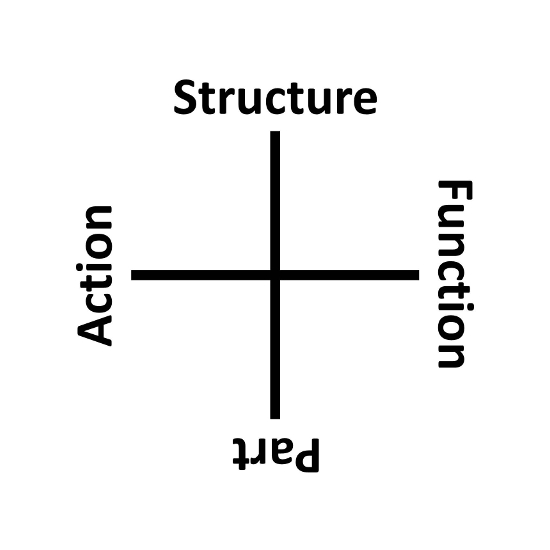
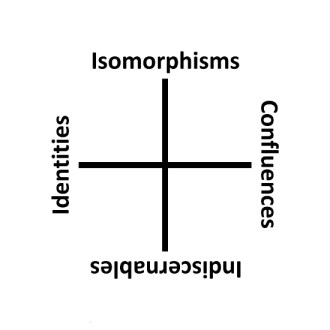
sq_equivalencesRecently I have been wondering what different notions of equivalence are possible. Thinking about one of my favorite fourfolds — Structure-Function — with help from the fourfold of The One and the Many, I have (naturally) come up with four notions: Identities, Isomorphisms, Confluences, and Indiscernibles.

Identities: One as One. In mathematics, an identity is an equivalence between two (or more) things that are really just the same thing. One can say there is an equivalence relation between the things and they are part of the same equivalence class. In equations, each thing can be substituted for the other thing because they are really just the same thing! In my consideration, Actions have these kind of identities, and so it is a reasonable term to use for Actions in the Structure-Function fourfold.

Isomorphisms: One as Many. In mathematics, an isomorphism is an equivalence between two (or more) things that have the same (mathematical) structure. Another way to consider this is to say that there is a paradigm or model that is representative of all the things that have this same structure. Thus it is a good term to use for Structures in the Structure-Function fourfold.

Confluences: Many as One. In logic, computer science (rewriting theory), and mathematics, a confluence is an equivalence between two (or more) things that can each be transformed into the same, maybe different, thing. Confluences can be used for this notion of equivalence because if one says that two rivers are confluent, then that means that they both flow into another larger river. Thus I think it is a valuable term to use for Functions in the Structure-Function fourfold.

Indiscernibles: Many as Many. In philosophy and perhaps physics, an indiscernible is an equivalence between two (or more) things where one cannot tell the difference between them. Thus it is a useful term to use for Parts in the Structure-Function fourfold. Another term to consider using is Substitutivities. Thus I do not believe I agree with the principle of the Identity of Indiscernibles since I think that would collapse my two notions of Identities and Indiscernibles into one. For instance, atoms of gold may be indiscernible from one another but that doesn’t mean they are the same atom.

To Do:

A recent foundational project for mathematics starts with the following:

Univalence Axiom: (A = B) ~ (A ~ B): Identity is equivalent to equivalence.

At this time I do not understand the implications of this axiom and how it might impact my four notions of equivalence.

Notes:

Perhaps Extensionalities would  be a better choice than Confluences.

References:

http://en.wikipedia.org/wiki/Identity_%28mathematics%29

http://en.wikipedia.org/wiki/Isomorphism

http://en.wikipedia.org/wiki/Confluence_%28abstract_rewriting%29

http://en.wikipedia.org/wiki/Indiscernibles

The HoTT Book: Homotopy Type Theory: Univalent Foundations of Mathematics

http://homotopytypetheory.org/book/

http://en.wikipedia.org/wiki/Univalence_axiom

http://plato.stanford.edu/entries/identity-indiscernible/

http://en.wikipedia.org/wiki/Extensionality

[*8.17, *8.40]

<>
Metropolis

sq_metropolis_agents“The Mediator between the head and hands must be the heart!”

— Fritz Lang’s Metropolis

A couple of years ago I watched The Complete Metropolis, the recently restored version of the 1927 silent film. The message that flashes before the viewer at the beginning and at the end of the film is “The Mediator between the head and hands must be the heart!”

I can’t remember if I’ve seen some previous version of Metropolis or not. I’m sure I’ve seen many of the scenes but I hadn’t seen all of them. I cannot speak for previous versions of the film, but this one was enjoyable and I’m glad I watched it.

Somewhat like the film Agora mentioned previously that showed the gulf between science and religion, this film details a fictional conflict between a technocratic ruling class and a subjugated working class. There is some religious imagery throughout and the epic battle between Freder and Rotwang even takes place on the rooftops of a cathedral.

Interestingly, the three elements of the epigram above correspond to three of the elements of Carl Jung’s Psychological Types: sq_jungHead with Cognition, Heart with Emotion, Hands with Sensation. What about the missing aspect, Intuition? I’ve placed Maria at that point because her meeting with Freder really initiates the plot of the film.

Actually I should have placed Grot, a worker foreman, at the Hands position instead of Rotwang. However, I think Rotwang is a more interesting character. Comparing these characters to those in The Tempest and Forbidden Planet, Rotwang is more like Prospero’s Caliban, or Morbius’s Id monster.

As evidence of his evil nature, Rotwang creates a robotic version of Maria and uses her to incite the workers to confusion and violence. Note that the spirit Ariel and Robby the Robot are also placed at Jung’s Intuition position.

Several of the images from the banner on this blog are from the movie, and are of the central tower and office of Fredersen. It is called “The New Tower of Babel” since it was inspired by Bruegel’s painting of the Tower of Babel.

Notes:

For the “4 H Club”, the four H’s are Health, Head, Hands, and Heart. Probably deserves its own post!

Links:

http://en.wikipedia.org/wiki/Metropolis_%281927_film%29

http://en.wikipedia.org/wiki/Tower_of_Babel

http://en.wikipedia.org/wiki/4-H

[*7.152]

<>

Graham Harman’s Quadruple Object, V2

The world is made up of a basic set of polarities – four of them, it turns out. They cannot be derived from a single radical root, but neither do they exist as incorruptible elements untransmutable into one another in the manner of the Empedoclean air, earth, fire and water.

— From Prince of Networks by Graham Harman

sq_harman

Objects exist as autonous units, but they also exist in conjunction with their qualities, accidents, relations, and moments without being reducible to these. To show how these terms can convert into one another is the alchemical mission of the object-oriented thinker.

— From Prince of Networks by Graham Harman

sq_harman2

I have made an attempt at orienting Graham Harman’s fourfold of real object, sensual object, real qualities, and sensual qualities with respect to the other fourfolds presented here. The fourfold object emerges from Harman’s analysis of Heidegger’s das Geviert.

References:

Graham Harman / Guerrilla Metaphysics: phenomenology and the carpentry of things

Graham Harman / Prince of Networks: Bruno Latour and metaphysics

Graham Harman / The Quadruple Object

[*6.46, *6.48, *6.62, *7.40, *7.132, *7.133]

<>

Matter, Energy, Space, and Time

sq_MESTThe first little ball is red and green
Oh it’s pretty, yes I know what you mean
I call it Substance, do dio dio do
And what it will do I just don’t know

The next little ball is silver and black
See it chase the first one forward and back
I call it Space, do dio dio do
What it will do I just don’t know

The next little ball is too hot to hold
I have to keep tossing it and I hope it gets cold
I call it Power do dio dio dio
What it will do I just don’t know

The next little ball is orange and blue
I can’t juggle four so I’ll toss it to you
And I call it Time…

— From “The Juggler’s Song” by The Incredible String Band

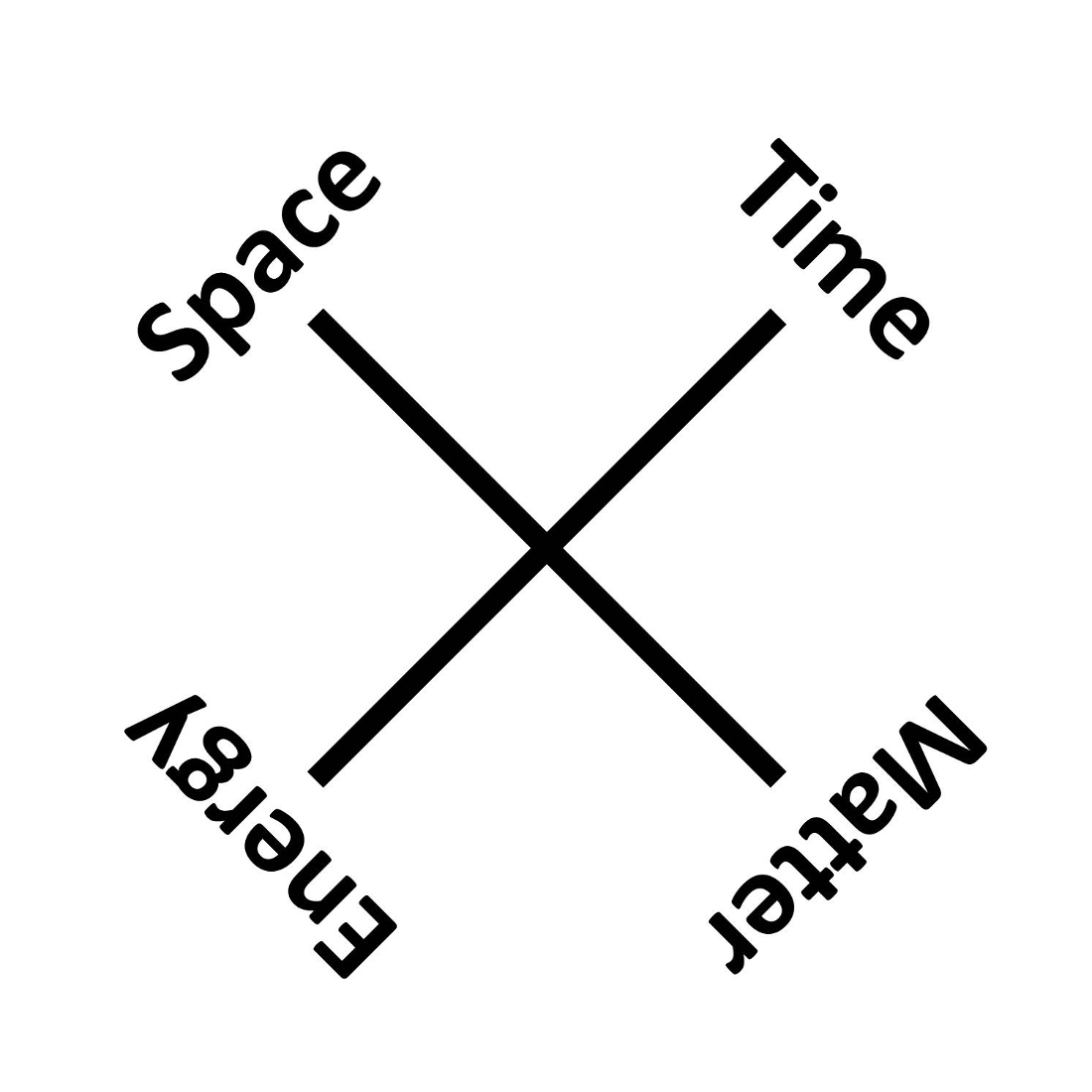
Here’s a nice little fourfold that I’ve overlooked until now, kind of like a four-leaf clover. If you search for images of matter, energy, space, and time, several websites show a diagram quite similar to this, and some have interesting things to say.

One shows free energy instead of energy in general. Free energy is energy that is able to do work, and that is an important distinction, especially if you are thinking about the Four Causes. Then the four can be considered fundamental resources.

There are some other things to consider from these references. One is that there is the familiar equivalence between matter and energy. Another is the equivalence principle between gravity and acceleration.

Also, there are obvious analogies between this fourfold and the Four Elements and the Four States of Matter. sq_Noether's TheoremI have also used the pairs space-time and matter-energy as two parts of the fourfold Noether’s Theorem, the other two parts being symmetry and conservation. There is also the fourfold Spacetime that has some similarities to this one. And let’s not forget the atomism of On the Nature of Things by Lucretius.

Be sure and watch the upcoming television series Cosmos: a Spacetime Odyssey, hosted by Neil deGrasse Tyson. I’m sure there will be much talk of Matter, Energy, Space, and Time.

Notes:

There is even a term coined for Matter-Energy-Space-Time: MEST. Of course, MEST also stands for Math, Engineering, Science, and Technology! No, sorry, that’s STEM!

Links:

http://abyss.uoregon.edu/~js/ast123/lectures/lec09.html

http://billmoyers.com/2014/01/10/the-new-cosmos-a-spacetime-odyssey/

[*7.90, *8.32]

<>


Relations All the Way Down

There is nothing to be known about anything except an initially large, and forever expandable, web of relations to other things. Everything that can serve as a term of relation can be dissolved into another set of relations, and so on for ever. There are, so to speak, relations all the way down, all the way up, and all the way out in every direction: you never reach something which is not just one more nexus of relations.

— Richard Rorty from Philosophy and Social Hope

sq_ll2

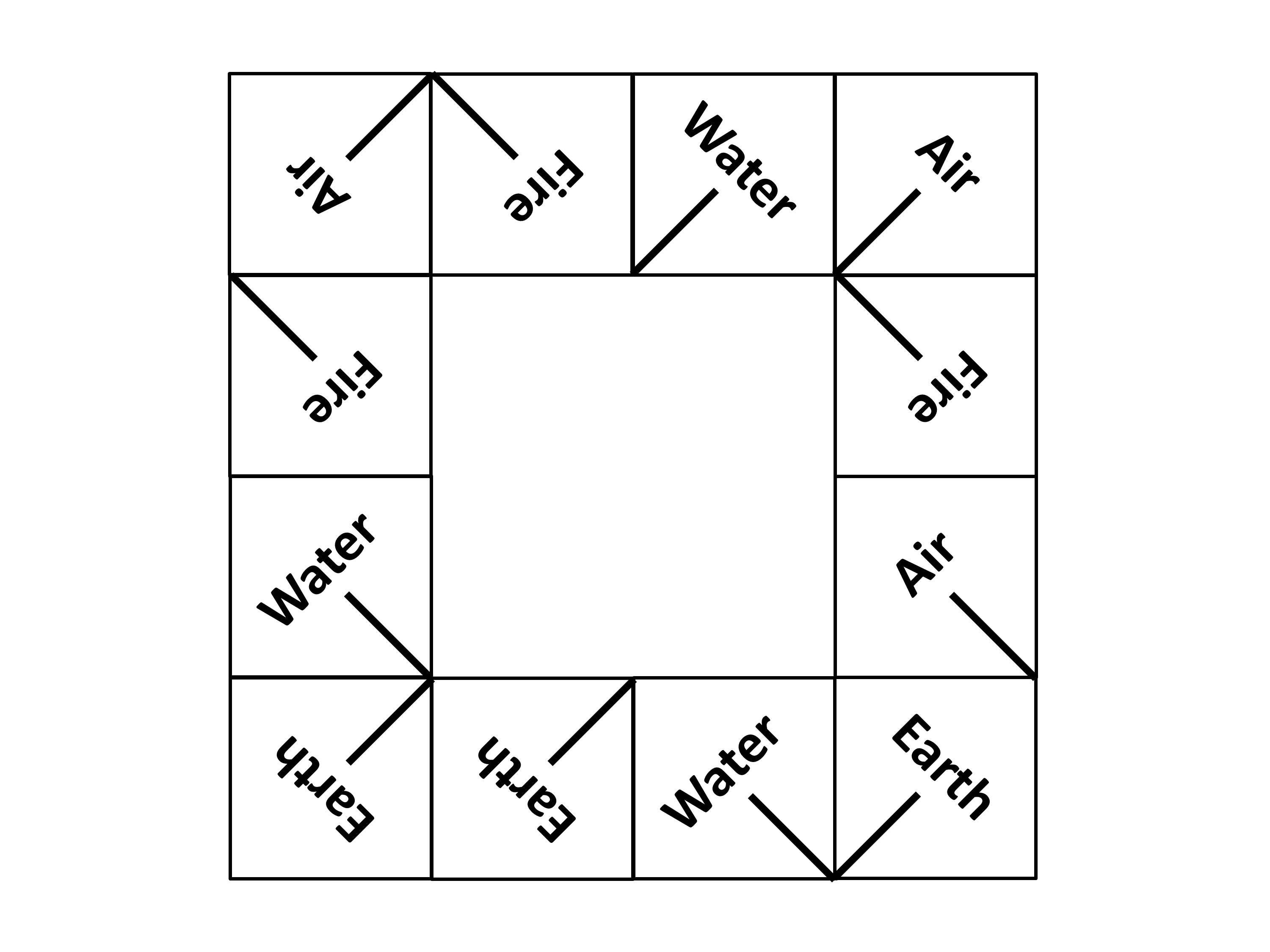
The ancient Greek philosopher Empedocles somehow reasoned that the world was made entirely from four basic elements: fire, earth, water, and air. Science as we know it has disproved this from being the case, but this idea still has a rich symbolic meaning even today that informs our popular culture.

A recent philosophical stance called “ontic structural realism” argues that science suggests that only relations between things are of lasting importance, that is the structural relationships within and between things, not the things themselves that bracket the relations. What we call a quark for instance is just the relations it has with other quarks and the other entities that have relationships with quarks. Perhaps then the world consists of “relations all the way down”, instead of stopping at some point on the lowest level with the things that constitute the world.

If this is so, what if the world was made completely from four basic relations, instead of four basic things? sq_structure_functionCould they be something like the four binary operators of linear logic? I have likened these four basic operators of Linear Logic to my fourfold Structure-Function, where in addition to Structures, we also have Functions, Actions, and Parts. But these three other relations are also structural, in that only the relation something has to another something makes it structural, functional, actional, or a part of a something.

Book Description for Every Thing Must Go:

Every Thing Must Go argues that the only kind of metaphysics that can contribute to objective knowledge is one based specifically on contemporary science as it really is, and not on philosophers’ a priori intuitions, common sense, or simplifications of science. In addition to showing how recent metaphysics has drifted away from connection with all other serious scholarly inquiry as a result of not heeding this restriction, they demonstrate how to build a metaphysics compatible with current fundamental physics (“ontic structural realism”), which, when combined with their metaphysics of the special sciences (“rainforest realism”), can be used to unify physics with the other sciences without reducing these sciences to physics itself. Taking science metaphysically seriously, Ladyman and Ross argue, means that metaphysicians must abandon the picture of the world as composed of self-subsistent individual objects, and the paradigm of causation as the collision of such objects. Every Thing Must Go also assesses the role of information theory and complex systems theory in attempts to explain the relationship between the special sciences and physics, treading a middle road between the grand synthesis of thermodynamics and information, and eliminativism about information. The consequences of the author’s metaphysical theory for central issues in the philosophy of science are explored, including the implications for the realism vs. empiricism debate, the role of causation in scientific explanations, the nature of causation and laws, the status of abstract and virtual objects, and the objective reality of natural kinds.

Stuff I need to read:

James Ladyman, Don Ross / Every Thing Must Go: Metaphysics Naturalized

http://plato.stanford.edu/entries/structural-realism/

Jason D. Taylor / Relations all the way down? Exploring the relata of Ontic Structural Realism

http://hdl.handle.net/10402/era.27885

Relations All the Way Down

https://ndpr.nd.edu/reviews/every-thing-must-go-metaphysics-naturalized/

<>


Knowledge and Its Limits

Knowledge and action are the central relations between mind and world. In action, world is adapted to mind. In knowledge, mind is adapted to world. When world is maladapted to mind, there is a residue of desire. When mind is maladapted to world, there is a residue of belief. Desire aspires to action; belief aspires to knowledge. The point of desire is action; the point of belief is knowledge.

— From Knowledge and Its Limits by Timothy Williamson

sq_knowledge_limits

Or with some substitutions:

Theory and practice are the central relations between the mental and the physical. In practice, the physical is shaped to the mental. In theory, the mental is shaped to the physical. When the physical is misshaped to the mental, there is a residue of intention. When the mental is misshaped to the physical, there is a residue of attention. Intention aspires to practice; attention aspires to theory. The point of intention is practice; the point of attention is theory.

sq_knowledge_limits2

Also, note the similarity to The Scientific Method.

Further Reading:

Timothy Williamson / Knowledge and Its Limits

[*6.24, *6.32, *8.22]

<>

The Noble Truths of Suffering

The Four Noble Truths of Suffering are:

  • Dukkha: the truth that suffering exists.
  • Samudaya: the truth that suffering has a beginning.
  • Nirodha: the truth that suffering can end.
  • Magga: the truth that there exists a path for the end of suffering.

Further Reading:

http://en.wikipedia.org/wiki/Four_Noble_Truths

[*8.24]

<>

Ægypt Tetralogy

AEgypt is a literary work by John Crowley consisting of four novels published over a period of twenty years. Each of the four books is divided into three parts, and the twelve parts are named after the astrological houses.

Many occult, alchemical, and esoteric themes run through the novels, and one might describe the work as being “magical realism”. Many of the magical elements are told as “a book within the book” about British occultist Doctor John Dee and Italian heretic Giordano Bruno. Even though some of the magical events occurring in the past and described within the novels seem to be actually magical, by the time the novels end the age of magic is now over, and the last magical event seemed to erase the fact that magic ever was.

The ending of the last book makes several references to Shakespeare’s “The Tempest”.

Further Reading:

http://en.wikipedia.org/wiki/%C3%86gypt

Some very useful reviews of the first three books can be found below.

http://watershade.net/wmcclain/jc-index.html

http://en.wikipedia.org/wiki/House_%28astrology%29

http://www.latimes.com/features/la-bkw-park7oct07,0,4224148.story#axzz2lmoAGKzp

http://www.latimes.com/features/la-bkw-park4nov04,0,6059163.story#axzz2lmoAGKzp

<>

The Medicine Wheel

The Native American Medicine Wheel is a symbol system that associates several fourfolds together, such as the Four Seasons, the Four Cardinal Directions, the Four Elements, etc. Another fourfold that does this is the Four Temperaments.

There should be a good word for this amalgamation of fourfolds into one hyper- or mega- or uber- fourfold. What about quadriphilia? No, that’s just love of fours, but it is in the Urban Dictionary. Quadrasyncretism? I like the neologism tetrasyncretism, from tetra meaning four, and syncretism, meaning combining different (or many) beliefs into one.

The aspect of the Medicine Wheel illustrated above is similar to the Four Temperaments.

The colors Red, White, Black, and Yellow are important for the Medicine Wheel. The colors often occur in a certain order within quadrants of the circle of the wheel. The colors also correspond to the Four Seasons: Black for Autumn, White for Winter, Yellow for Spring, and Red for Summer, although there can be other mappings.

These same four colors are also important in alchemy and represent stages of the Magnus Opus or Great Work, where Red is Rubedo or Iosis, White is Albedo or Leukosis, Black is Nigredo or Melanosis, and Yellow is Citrinitas or Xanthosis. The order is usually Black, White, Yellow, and then Red, through beginning to ending stages of the work.

In addition, the current anime RWBY has characters with these main costume colors. Apparently it is a story with some magic and much fighting with large weapons by four young women.

Further Reading:

http://en.wikipedia.org/wiki/Medicine_wheel

http://en.wikipedia.org/wiki/Magnum_opus_%28alchemy%29

http://en.wikipedia.org/wiki/Cardinal_direction

http://en.wikipedia.org/wiki/RWBY

Angeles Arrien / The Four-Fold Way: Walking the Paths of the Warrior, Teacher, Healer, and Visionary

Google search for images of the Medicine Wheel.

Google search for images of the Four Cardinal Directions.

[*7.194, *8.12]

<>


The Tempest and Forbidden Planet

To work mine end upon their senses that
This airy charm is for, I’ll break my staff,
Bury it certain fathoms in the earth,
And deeper than did ever plummet sound
I’ll drown my book.

Prospero from The Tempest

In times long past, this planet was the home of a mighty, noble race of beings who called themselves the Krell. Ethically and technologically they were a million years ahead of humankind, for in unlocking the mysteries of nature they had conquered even their baser selves, and when in the course of eons they had abolished sickness and insanity, crime and all injustice, they turned, still in high benevolence, upwards towards space. Then, having reached the heights, this all-but-divine race perished in a single night, and nothing was preserved above ground.

Dr. Morbius from Forbidden Planet


Further Reading:

http://en.wikipedia.org/wiki/The_Tempest

http://en.wikipedia.org/wiki/Forbidden_Planet

http://en.wikipedia.org/wiki/Return_to_the_Forbidden_Planet

https://grg.org/charter/Krell2.htm

[*7.154, *8.11]

<>