All posts by Martin K. Jones

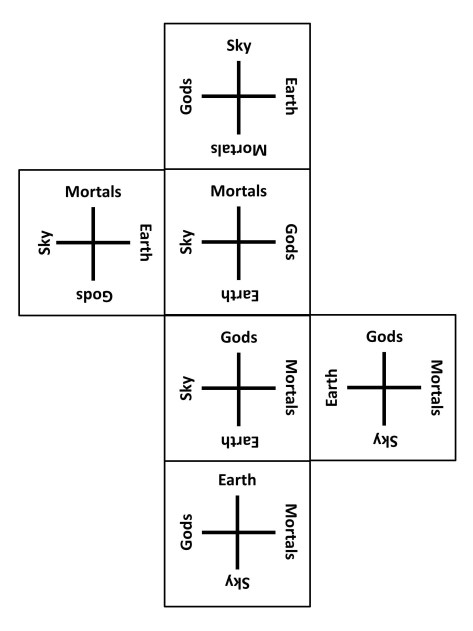
Plato Redux

sq_plato_redux

What is, is The True
What is, is The Good
What is, is The Beautiful
What is, is The Real

— Anonymous

I recently finished reading Rebecca Goldstein’s Plato at the Googleplex: Why Philosophy Won’t Go Away. In it there was much talk of The Beautiful, The True and The Good.

Besides Plato’s Divided Line, which was mentioned in The Republic and consists of four parts, the threesome of The Beautiful, The True and The Good is mentioned in various dialogues.

Being the quadraphile I am, I thought adding The Real to the threesome makes the now foursome nicely balanced. Usually one hears of just the three, without the fourth, but why is that?

Some argue loud and long that The Real has no part in this threesome of Universals, that the three are sufficient among themselves. Others disagree. Which side would you say I’d be on?

Further Reading:

http://en.wikipedia.org/wiki/Transcendentals

http://en.wikipedia.org/wiki/Analogy_of_the_Divided_Line

Henry Rutgers Marshall / The True, The Good and the Beautiful (The Philosophical Review, Vol. 31, No. 5, Sep. 1922 pp. 449-470)

Michael Boylan / The Good, the True and the Beautiful

[*4.82, *8.72, *8.82]

<>


Hayden White’s Metahistory

sq_metahistory

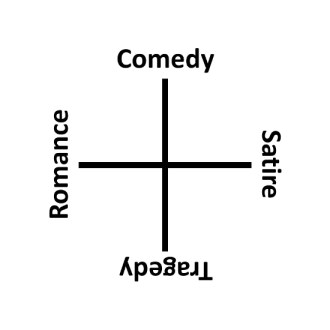
In 1973, historian Hayden White published Metahistory: The Historical Imagination in Nineteenth-century Europe. His key fourfold was that of literary emplotments due to Northrop Frye: Romance, Comedy, Satire, and Tragedy. White also derived a synoptic table that associated other fourfolds by Stephen Pepper (Organicist, Mechanicist, Formist, and Contextualist), tropes (Metaphor, Metonymy, Synecdoche, and Irony), plus various modes, ideologies, representational historians, and key philosophers.

I’ve had this fourfold sitting around for a while, and I haven’t written anything about it, because I don’t really agree with the synopticisms as given. For instance, I would pair Romance with Organicism, Comedy with Formism, Satire with Contextualism, and Tragedy with Mechanism. Why? Romance is the “drama of self-identification”, as the organism is self-identified, being that the “individual part of the whole is more than the sum of its parts”. Comedy is “harmony between the natural and the social”, as Formism is created by social “classifying, labelling, and categorizing” of natural objects. Tragedy is about the “limitations of the world”, as Mechanism is “finding laws the govern the operations of human activities”. Finally, Satire is the “opposite of romance — people are captives in the world until they die”, whereas Contextualism is “events explained by their relationships to similar events”. That last one isn’t very convincing, but I’ve only switched Romance and Comedy, and left Satire alone.

Again, as with my problems with the synoptic table of Arthur M. Young, it would be nice to play the Game of Fourfolds to see if I can find better arguments for my synoptic claims, or to convince myself that the claims of others are better. Of course, it would probably help for me to read the original works, instead of reading summaries. One might care to look elsewhere for better exposition.

Perhaps I could elaborate further at a later time:

  • Romance: The individual succeeds.
  • Comedy: Most succeed. Society wins.
  • Satire: Most fail. Society comes up short.
  • Tragedy: The individual fails.

Further Reading:

http://en.wikipedia.org/wiki/Metahistory

[*3.172, *3.173]

<>


Northrop Frye’s Anatomy of Criticism

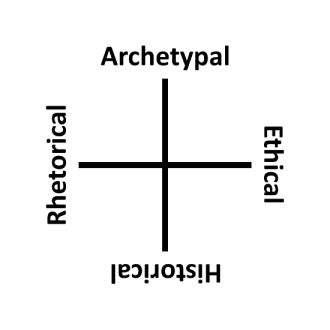
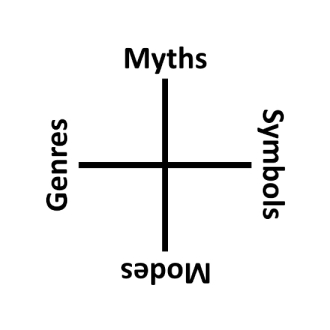
sq_frye_criticism In the late 50’s literary critic Northrop Frye published Anatomy of Criticism: Four Essays, where his analysis of the criticism of literature followed literature itself in being systemically separated into Rhetorical, Historical, Archetypal, and Ethical criticism. Each of these criticisms in turn corresponded to theories of Genres, Modes, Myths, and Symbols.sq_frye_theories

References:

http://en.wikipedia.org/wiki/Northrop_Frye

http://en.wikipedia.org/wiki/Anatomy_of_Criticism

[*7.7]

<>

Four Dimensional Space-time

sq_4d_spacetime

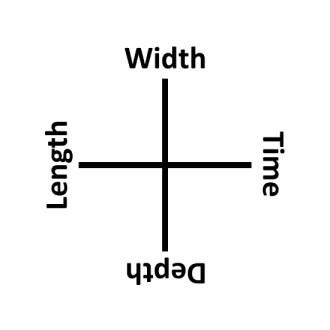
Here’s a simple fourfold I’ve been ignoring just because it’s so trivial, but that triviality can be deceiving. Space-time as formulated in special relativity has four dimensions: three of space and one of time. Our everyday experience shows us the three dimensions of space: length, width (or breadth), and depth (or height), but time is a different kind of thing because we cannot see or move forward and backward through time with our eyes or body, like we can along the axes of space.

Personally, only our memory and imagination can let us range through time. Of course, after the invention of language and more recent technologies, the spoken word, writings, photographs, audio recordings, and videos can also be used. But it’s not the same as shifting one’s gaze along the length of something or moving one’s body across a width.

So, we can move semi-freely through the three spatial dimensions but our movement in time seems to be fixed into a relentless forward motion that we have no control over. And because gravity pulls us down onto the surface of the world, one of the spatial dimensions (depth or height) is more limiting than the other two.

sq_ll2Thus another interesting comparison to this fourfold is to that of linear logic. One observation is that length and width can be considered reversible but depth and time can be considered somewhat irreversible. That’s not true of course, but because of gravity it is easier to descend than to ascend, and it’s far easier to move into the future than into the past. But we can see into the distant past, just not our own, as we turn our telescopes to the heavens.

Space without time could have four or even higher dimensions, but we have no empirical evidence that it is so. Mathematically, however, we can easily construct multidimensional spaces. One representation of four dimensional space is by using quaternions, which have four dimensions to the complex numbers’ two. Tuples of real numbers or even vector spaces can also be used. However, the geometry of space-time is not Euclidean; it is described by the Minkowski metric.

Novels about characters living in different numbers of spatial dimensions are an interesting way to learn and think about them. The very first was Flatland by Edwin Abbott Abbott, about a being limited to two dimensions that learns about a third outside his experience when a three dimensional being comes to visit. Just recently I’ve finished reading Spaceland by Rudy Rucker, about an ordinary human person limited to the three dimensions of space that learns about the fourth dimension by similar reasons.

Links:

http://en.wikipedia.org/wiki/Special_relativity

http://en.wikipedia.org/wiki/Minkowski_space

http://en.wikipedia.org/wiki/Four-dimensional_space

http://en.wikipedia.org/wiki/Flatland

http://en.wikipedia.org/wiki/Flatland_%282007_film%29

http://en.wikipedia.org/wiki/Spaceland_%28novel%29

[*8.72]

<>
Maxwell’s Equations

sq_maxwell_eq2

Actually, just the left hand side of the equations, because it looks better that way. The right hand sides are just a click away.

E and B are the electric and magnetic fields, respectively. is the “del” operator.

The divergences ∇ · E and ∇ · B are the “fields emanating from the sources.”

The curls ∇ x E and ∇ x B are the “circulation of the fields.”

Further Reading:

http://en.wikipedia.org/wiki/Maxwell%27s_equations

<>

All Watched Over

sq_all_watchedI like to think
(it has to be!)
of a cybernetic ecology
where we are free of our labors
and joined back to nature,
returned to our mammal
brothers and sisters,
and all watched over
by machines of loving grace.

— Richard Brautigan from All Watched Over by Machines of Loving Grace

References:

http://en.wikipedia.org/wiki/All_Watched_Over_by_Machines_of_Loving_Grace

http://en.wikipedia.org/wiki/All_Watched_Over_by_Machines_of_Loving_Grace_(TV_series)

[*6.150, *8.70]

<>

There is Nothing Wrong

sq_outer_limits

There is nothing wrong with your television set. Do not attempt to adjust the picture. We are controlling transmission. If we wish to make it louder, we will bring up the volume. If we wish to make it softer, we will tune it to a whisper. We will control the horizontal. We will control the vertical. We can roll the image, make it flutter. We can change the focus to a soft blur or sharpen it to crystal clarity. For the next hour, sit quietly and we will control all that you see and hear. We repeat: there is nothing wrong with your television set. You are about to participate in a great adventure. You are about to experience the awe and mystery which reaches from the inner mind to – The Outer Limits.

— The Control Voice from The Outer Limits

Links:

http://en.wikipedia.org/wiki/The_Outer_Limits_%281963_TV_series%29

http://tvtropes.org/pmwiki/pmwiki.php/Series/TheOuterLimits

[*8.70]

<>

A Game of Four-folds, Part 2

elements_tetraflexagon_s1elements_tetraflexagon_s2

One way to have all six arrangements of the quadrants for each four-fold card is to make a tetraflexagon for each card. Above are the two sides of a sheet that should be printed out by flipping it on the short edge, so that the upper right corner of the bottom image will end up behind the upper left corner of the top image. Then fold the tetraflexagon by the simple instructions found at the link below. Then you will have all six arrangements of the four-fold for the Four Elements! There are actually seven states for the tetraflexagon, six of which have a valid arrangement on just one side of it, and one that doesn’t have a valid arrangement on either side. Seems like a lot of work, though.

How to Fold a Hexa-tetraflexagon

[*8.59]

<>


A Game of Four-folds

sq_MESTsq_structure_function

One thing those that love four-folds (quadraphiles?) like to do is compare and contrast them. A solitaire card game based on four-folds might be fun for some individuals obsessed by tetrads and such. But how would it work?

If two four-fold cards are chosen at random, then insight into their relationship might be obtained. For example: Structure-Function and Matter-Energy-Space-Time (MEST). The simple observation is that each quadrant of Structure-Function requires a corresponding quadrant of MEST. Actions require Energy. Parts require Matter. Structures require Space. Functions require Time. Energy is necessary for Actions, etc.

One problem is that not everyone agrees how the quadrants of two different four-folds can correspond, or be “lined up”. In general, the only things that are available to explain the reasoning for the arrangement are analogical thinking and argumentation, so it is at least half subjective. This isn’t science, after all.

Note that the different poles of each four-fold can be ordered in six different ways. If we have a square four-fold of A B C D, we can always place A at the Left or West position. Then the remaining 3 letters can be arranged in six different ways.

A B C D
A C D B
A D B C
A B D C
A C B D
A D C B

If one just has a fixed card for each four-fold, then the other five permutations are not available. You could have six versions of each card, but I think that would be a poor solution, since you are only picking one of them at any time.

To acheive flexibility in arrangement, each card could be divided into its quadrants, for example by right triangles. But then you’d have triangular cards. Plus the fact that you couldn’t combine them well on a web page.

Or you could have the four-folds turned to be X’s, and then the quadrants could be squares. That’s somewhat appealing, since this blog is titled “Equivalent eXchange”, after all. For example:

sqx_MEST

sqx_MEST_energysqx_MEST_spacesqx_MEST_timesqx_MEST_matter

However, if you are picking two cards at random, then the four quadrants won’t be together as a group.

Notes:

Is Mahjong called “Game of Four Winds” or is it just a name of a computer version of it? From what I can tell, the players are named after the four winds (i.e. cardinal directions). But there are also four flowers and four seasons.

[*8.56]

<>

The Quadralectics of Marten Kuilman

sq_quadralectics Marten Kuilman has written extensively on four-folds and what he calls quadralectics, division-thinking, or four-fold thinking.

Publishing in the Netherlands, his books aren’t available on Amazon. Graciously, he has made several of his works available on the internet via his blogs Quadralectics and Quadriformisratio. Quadriformisratio presents Four – A Rediscovery of the ‘Tetragonus Mundus’, a treatise of four-folds through history, and Quadralectics is his two volume work on Quadralectic Architecture.

Not only does Kuilman expound at length on various four-folds throughout the ages and how they affected the intellectual and artistic developments of the time, his work unifies many of them into his four aspects of visibility: invisible invisibility, invisible visibility, visible visibility, and visible invisibility. Above, I’ve arranged these four aspects by my positions for the four elements. Unfortunately, they aren’t in the same sequence as Kuilman’s quadrants.

Because Kuilman emphasizes a recurring association of  his four-fold of visibility with communication, it is also reminiscent of Hjelmslev’s Net. Then, invisibility could be understood as content, and visibility as expression.

Interestingly, my four-fold of Bright-to-Dark (here or here) is most relatable to this four-fold of visibility, but in the reverse sense that the invisible invisibility is bright, and the visible visibility is dark. One could quickly reconcile this opposition by considering the empty circle as most invisible, and the full circle as most visible.

Another interesting result of Kuilman’s investigations is to derive his four-fold of Unity, Muun (Multi-unity), Part, and Whole, which I believe has important associations with my four-fold Structure-Function.

References:

Marten Kuilman / Four – A Rediscovery of the ‘Tetragonus Mundus’

Marten Kuilman / QUADRALECTIC ARCHITECTURE – A Panoramic Review

http://quadriformisratio.wordpress.com/

http://quadralectics.wordpress.com/

http://quadralectics.wordpress.com/7-the-quadralectic-theory/

[*8.48, *8.52, *8.53, *8.54, *8.55]

<>