All posts by Martin K. Jones

The Diurnal Cycle and Chinese Hours

Long ago in a distant land, I, Aku… wait… let me start over.

Long ago in China, the diurnal cycle of day, dusk, night, and dawn was divided into twelve two-hour hours and each hour was named after an animal in the Chinese Zodiac. The Hour of the Rat was from 11 P.M. to 1 A.M., and so on. These animals were also assigned directions: Rat being North, Ox being NNE, etc. Many are familiar with the animals having “years”, so if you were born in a certain animal’s year, you might have certain attributes. These twelve animals are certainly multi-purpose!

Further Reading:

https://en.wikipedia.org/wiki/Diurnal_cycle

https://simple.wikipedia.org/wiki/Chinese_Zodiac

https://www.thoughtco.com/chinese-zodiac-in-mandarin-2278416

The Diurnal Cycle

[*10.144]

<>


The Seasons and the Zodiac

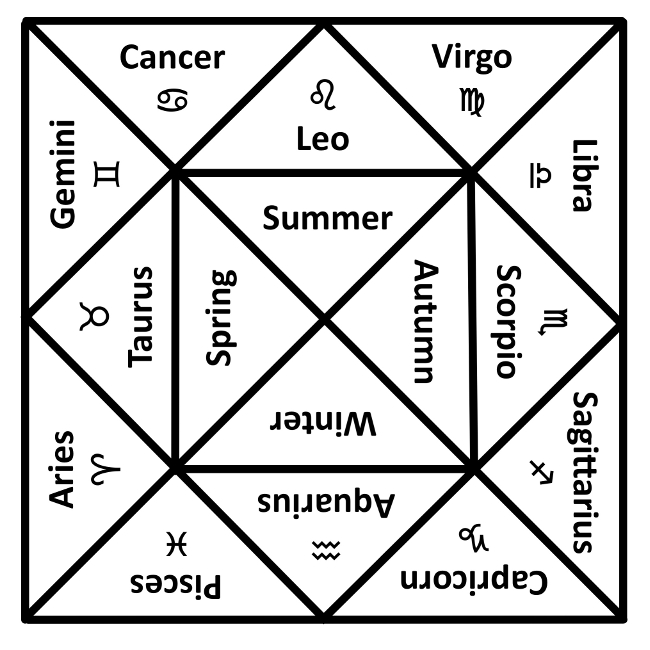
This isn’t a bad little diagram of the four seasons along with the twelve zodiac names and symbols. However, it might be oriented wrong by convention or going clockwise instead of counter-clockwise.  Interestingly, old horoscope charts that show what was in the sky (the positions of the zodiac stars and the eight or nine planets in regards to the twelve “astrological houses”) at the time of a person’s birth were shown using the outside ring of twelve triangles instead of the more familiar circle that is used today. The inner square might be for notes or some nice drawing.

Further Reading:

https://en.wikipedia.org/wiki/Zodiac

https://www.completehoroscope.org/envelope-diagram-horoscope.htm

The Four Seasons

[*10.145]

<>


Ohm’s Law

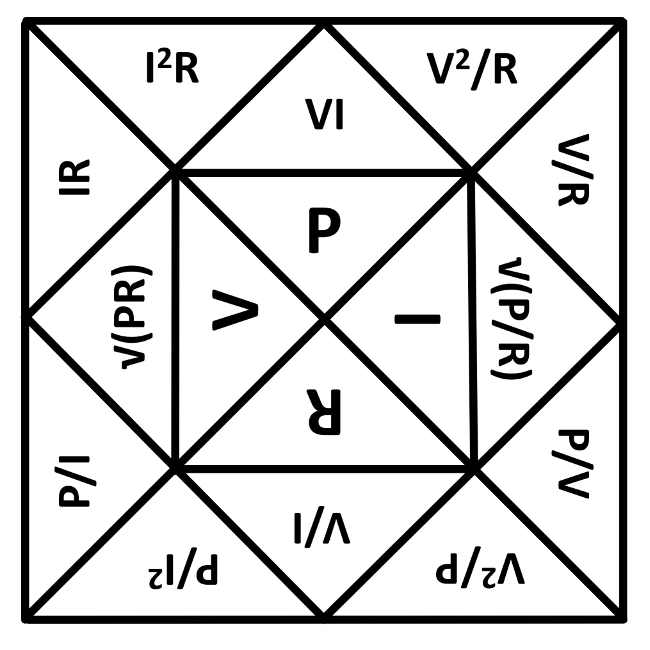
Unfortunately it has finally come to this: enter the sixteenfolds!

  • Voltage = V = P/I = sqrt(P·R) = I·R
  • Resistance = R = V^2/P = V/I = P/I^2
  • Current = I = V/R = sqrt(P/R) = P/V
  • Power = P = I^2·R = V·I = V^2/R

Further Reading:

https://en.wikipedia.org/wiki/Ohm%27s_law

Ohm’s Law

[*8.4, *8.5, *8.8-8.10, *10.62, *10.112]

<>


Free Four

One, two, free, four!

— Pink Floyd

There ain’t no such thing as a free lunch.

— Origin unknown

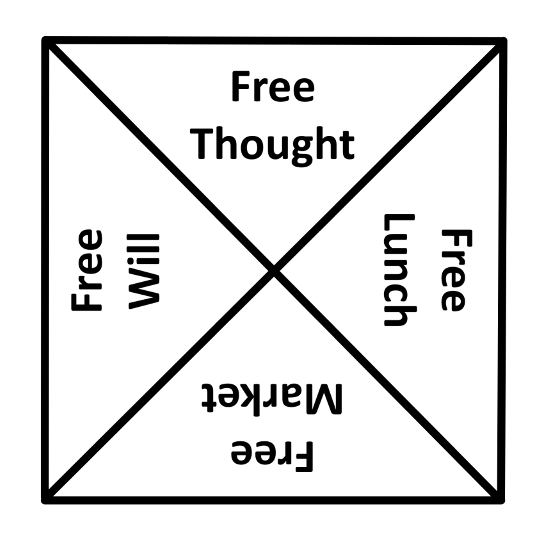
In the United States of America we celebrated freedom on July 4th. Here are four free or not so free things.

It is useful to consider Richard McKeon’s words on freedom from his Philosophic Semantics and Philosophic Inquiry:

The question, What is freedom? is one of the recurrent ambiguous questions of philosophy which has opened up new dimensions in contemporary thought and action. It is a significant question because the initial interpretation, “freedom is the absence of external impediments to action,” focuses attention on the need to remove the ambiguities of “absence”, “external”, “impediments”, and “actions” and the growing host of ambiguities in each clarifying statement. The semantic scheme constructed from the modes of thought sets forth, thus far (see chart p.253), three sets of determinations of the question, What is freedom? What is freedom in fact or interpretation, What things are free?; What is freedom in thought or method, What property do free things share?; What is freedom in being or principle, What are the grounds of the possibility or the actuality of freedom? The question takes on a vast scope of meanings under these distinctions; and since a complete interpretation of the question makes use of all four semantic headings, the number is increased by the number of possible combinations of the four. The indefinitely large number of possible meanings is the source of the richness of philosophic inquiry, for each interpretation may be used as the hypothesis for further investigation.

Further Reading:

Click to access McK-PhilosophicSemantics&Inquiry.pdf

https://en.wikipedia.org/wiki/Free_will

https://en.wikipedia.org/wiki/Freethought

https://en.wikipedia.org/wiki/Free_market

https://en.wikipedia.org/wiki/Free_lunch

https://en.wikipedia.org/wiki/There_ain%27t_no_such_thing_as_a_free_lunch

Also:

https://en.wikipedia.org/wiki/Information_wants_to_be_free

https://en.wikipedia.org/wiki/Freedom_of_the_press

https://en.wikipedia.org/wiki/Free_Bird

Four Freedoms

The Four Freedoms

[*9.184]

<>


The Eisenhower Matrix

What is important is seldom urgent and what is urgent is seldom important.

— Dwight Eisenhower, 34th President of the USA.

For your self improvement, here is a simple two by two matrix that can help you decide how to prioritize your “To Do” list. Sort everything into four groups, depending on whether it is important or not, and whether it is urgent or not:

  • Important & Urgent : Do First
  • Not Important & Urgent : Delegate
  • Important & Not Urgent : Do Later
  • Not Important & Not Urgent : Eliminate

Further Reading:

https://blog.trello.com/eisenhower-matrix-productivity-tool-trello-board?utm_source=pocket&utm_medium=paid-content&utm_content=trello-blog-4&utm_campaign=trello_pocket_sponsor-content-h218

Other images of the Eisenhower Matrix:

https://www.google.com/search?q=eisenhower+matrix&tbm=isch

[*10.120]

<>


Tanabata

Soon it will be Tanabata (七夕) in Japan on July 7th.

Make a wish!

  • Orihime: 織姫
  • Hikoboshi: 彦星
  • Vega: 織女星
  • Altair: 牽牛星
  • Deneb: デネブ
  • Amanogawa (Milky Way): 天の川 or 銀河?

Further Reading:

https://en.wikipedia.org/wiki/Tanabata

http://www.iromegane.com/japan/make-a-wish-for-tanabata/

https://en.wikipedia.org/wiki/Summer_Triangle

Altair IV was the planet journeyed to in the movie Forbidden Planet. But that was a different story.

[*10.48]

<>


Fearless Living

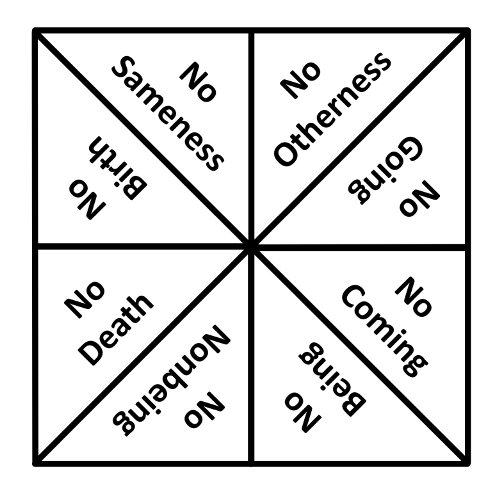
We can live with no fear if we remove these four pairs of opposites and have Right View.

— Thích Nhất Hạnh

  • No Birth
  • No Death
  • No Sameness
  • No Otherness
  • No Coming
  • No Going
  • No Being
  • No Non-being

Further Reading:

https://en.wikipedia.org/wiki/Th%C3%ADch_Nh%E1%BA%A5t_H%E1%BA%A1nh

https://tnhaudio.org/tag/pairs-of-opposites/

[*9.226]

<>

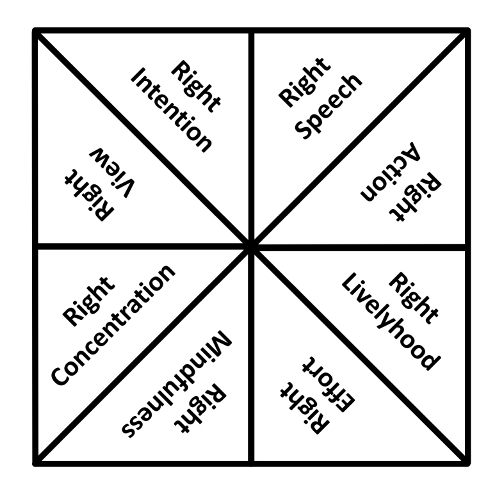
The Eightfold Path

The Noble Eightfold Path of Buddhism (八正道):

  • Right View (also Understanding) (正見)
  • Right Intention (also Thought) (正思唯)
  • Right Speech (正語)
  • Right Action (正業)
  • Right Livelyhood (正命)
  • Right Effort (正精進)
  • Right Mindfulness (正念)
  • Right Concentration (正定)

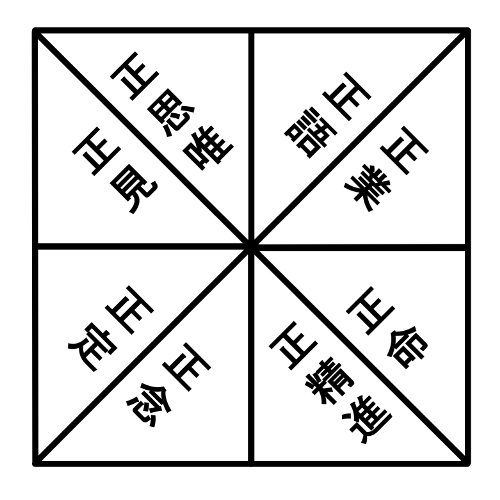
I’ve also translated the diagram into Chinese.

Further Reading:

https://en.wikipedia.org/wiki/Noble_Eightfold_Path

The Noble Eightfold Path

https://www.buddha101.com/p_path.htm#The%20Eightfold%20Path

https://www.orientaloutpost.com/shufa.php?q=eightfold

Note:

In the anime “One Piece,” marines often have the characters 正義 on the back of their coats. This means “Seigi,” or Right Morality or Justice. Note that this isn’t part of the Eightfold Path.

https://onepiece.fandom.com/wiki/Justice

[*10.118]

<>

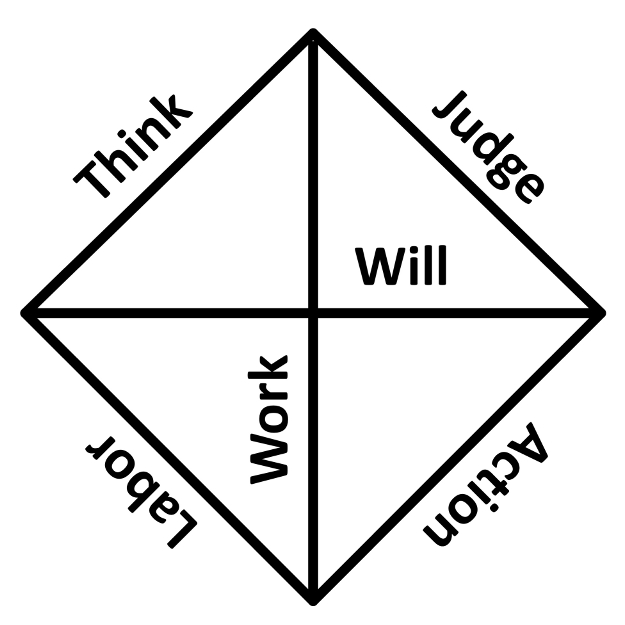
Hannah Arendt: The Human Condition and the Life of the Mind

In her book “The Human Condition”, philosopher Hannah Arendt discussed the vita activa, the active life:

  • Labor
  • Work
  • Action

In “The Life of the Mind”, she wished to present the vita contemplativa, the contemplative life:

  • Thinking
  • Willing
  • Judgment

Unfortunately, she died just as started working on Judgment, so that aspect was just outlined with notes.

The differences between the active and the contemplative can also be thought of as the practical versus the theoretical. This pair of triplets is not easy to turn into a troika of duals.Further Reading:

https://en.wikipedia.org/wiki/The_Human_Condition_(book)

https://www.brainpickings.org/2014/09/16/hannah-arendt-the-life-of-the-mind/

https://www.giffordlectures.org/lectures/life-mind

https://plato.stanford.edu/entries/arendt/

https://en.wikipedia.org/wiki/Hannah_Arendt

[*9.98, *10.102]

<>


Six Types of Philosophers

I have mentioned fourfold classifications of philosophers before, most notably the Philosophical Semantics of philosopher Richard McKeon (which is similar to the Archic Matrix of Walter Watson and David Dilworth). These are actually sixteen-fold classifications, since each of four attributes have four types.

Instead, consider this six-fold classification by Justin E. H. Smith:

  • Curiosa – Particularist
  • Sage – Systematist
  • Gadfly – Social Critic, Commentator
  • Ascetic – Disciplinarian
  • Mandarin – Academic, Professional
  • Courtier – Bureaucrat, Institutionalist

In addition, here is another diagram of this same classification scheme.

tr_six_philosophersFurther Reading:

Justin E.H. Smith / The Philosopher: A History in Six Types, Princeton University Press, 2016.

https://ndpr.nd.edu/news/the-philosopher-a-history-in-six-types/

The Philosopher: A History in Six Types

http://www.jehsmith.com/

[*10.96]

<>