The Alethiometer

The alethiometer, an important fictional artifact in Philip Pullman’s two fantasy trilogies His Dark Materials and The Book of Dust, is a “truth-telling” device that might well have been inspired by the combinatorial art of Ramon Llull. While most users need years of study and reference books to read the alethiometer, the young heroine Lyra can understand it intuitively because of her innocence and her seeming ability to communicate with the mysterious “Dust”.

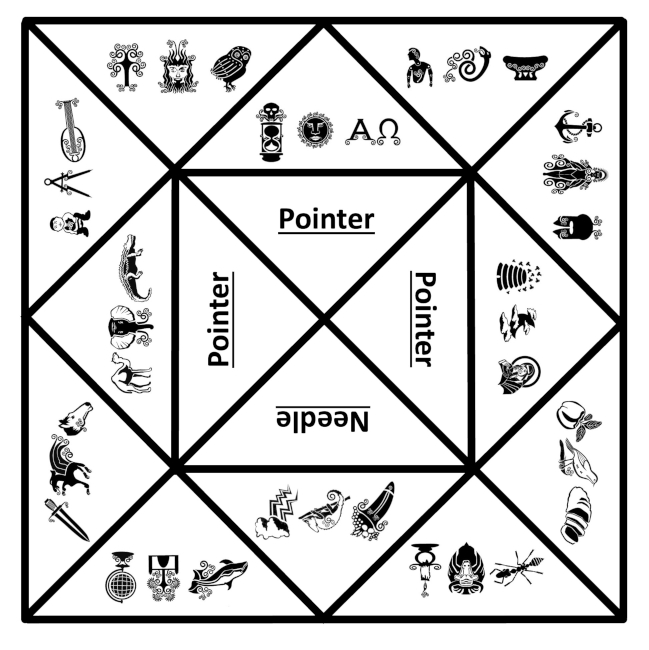
Each alethiometer (of the six made) has 36 symbols on its face, and three pointers that can be set to one symbol each. The three symbols pointed to are intended to frame a question or problem that the user has in mind. A fourth pointer is a needle that freely moves, pointing to one symbol or a sequence of them, and those should represent the answer to the query. The 36 symbols are familiar entities, but their meanings are not straightforward.

In the first trilogy, Lyra could operate an alethiometer readily, and use its power to help her navigate her way through a multi-verse of dangers, enemies, and goals. The first trilogy was more like excellent juvenile literature, in that the heroine was able to overcome hardships and achieve the outcome that she thought was best under the circumstances, even though it wasn’t what she wanted to happen. Nevertheless, it ended in a heartbreaking yet satisfying way.

In contrast, the second trilogy was closer to an adult story, not as tidy in its themes or plot lines, and with the lack of a neat resolution. As she grew out of childhood in the second trilogy, she struggled with reading the alethiometer. This was either because her lost innocence, or because adults don’t usually have as much connection to “Dust” (being enclouded by the Dust that surrounds them), or because of her estrangement to her personal daemon or soul-spirit.

In this age of blatant lies and misinformation, would that we all could have the power to discern truth from falsehoods, to consult our very own Oracle of Truth. Some think that AI driven by Large Language Models can give us access to veridic and factual knowledge, and perhaps it can. But it seems that AI can be manipulated to bias its “thinking” any which way you like. Easy access to the truth and easy determination of lies may just be a pipe dream of childhood.

Further Reading:

https://en.wikipedia.org/wiki/His_Dark_Materials

https://en.wikipedia.org/wiki/The_Book_of_Dust

https://en.wikipedia.org/wiki/Dust_(His_Dark_Materials)

https://academic.oup.com/book/59756

Click to access alethiometerchart-form-glossaryofmeanings.pdf

[*14.136, *14.142-143]

<>
The Yoneda Lemma

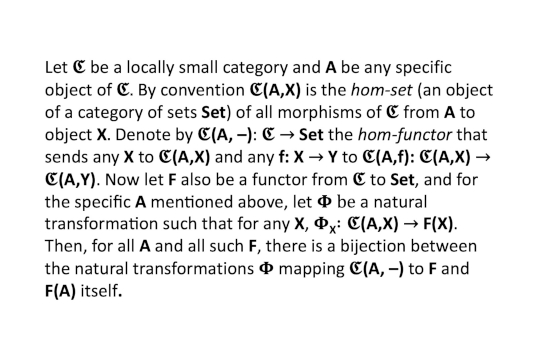
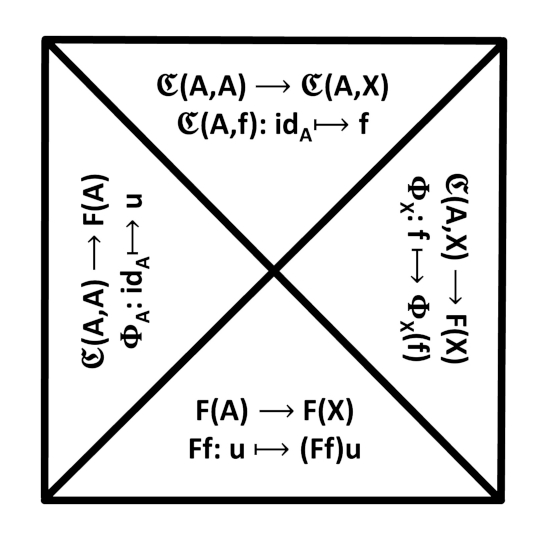
I’ve been wanting to post about the Yoneda Lemma of Category Theory for a while, and finally decided how to draw my little diagram. Next, I will sketch out the fundamentals of the lemma for you (not the proof though) even though there are many better presentations out there.Then, oddly enough, I wondered what if anything the lemma could tell us about metaphysics. I know this is like using Godel’s Theorem to say things about epistemology (and so a category mistake, ha ha), but I still think it’s worth a thought or two. Apparently others have explored the same idea.

First, one would have to assume that reality can be modeled by some Category, so the Yoneda Lemma could apply to it. This may be in fact be wrong, but apparently Category Theory has been used to model various physical subsystems. If we just go ahead and assume it can, what could the Yoneda Lemma tell us?

  • The Yoneda Lemma suggests an object’s essence (nature, being, identity) is entirely defined by its relationships (called morphisms or arrows in Category Theory) with all other objects in its system (i.e., its category), effectively equating an object with its web of connections. Metaphysically, this supports a structuralist or relational view where an entity has no intrinsic nature independent of its context.
  • The lemma shows that knowing how an object relates to all other objects is equivalent to knowing the object itself. And so if two objects have identical relationships with all other objects, then they are functionally identical (isomorphic). This supports the idea that the existence of a thing is defined by structural behavior rather than intrinsic substance.
  • The lemma works by embedding objects into relational mappings via their “view from elsewhere”—how they appear from the perspective of every other object. This could support a metaphysics where reality is fundamentally perspectival: objects are constituted by the totality of possible perspectives on them. There’s no “view from nowhere” that captures what something is independent of its potential relations.

The lemma was named after Nobuo Yoneda (1930-1996), a Japanese mathematician and computer scientist.

Further Reading:

https://en.wikipedia.org/wiki/Yoneda_lemma

https://ncatlab.org/nlab/show/Yoneda+lemma

https://blog.juliosong.com/linguistics/mathematics/category-theory-notes-14/

https://www.math3ma.com/blog/the-yoneda-lemma

The Yoneda Lemma


https://curtjaimungal.substack.com/p/you-are-dual-to-everything-the-yoneda

https://temnoon.com/the-essence-of-relationality-yoneda-lemma-and-the-jeweled-net-of-indra/

https://en.wikipedia.org/wiki/Indra%27s_net

https://equivalentexchange.blog/2014/02/01/relations-all-the-way-down/

[*12.58, *14.160]

<>

The Doomsday Clock

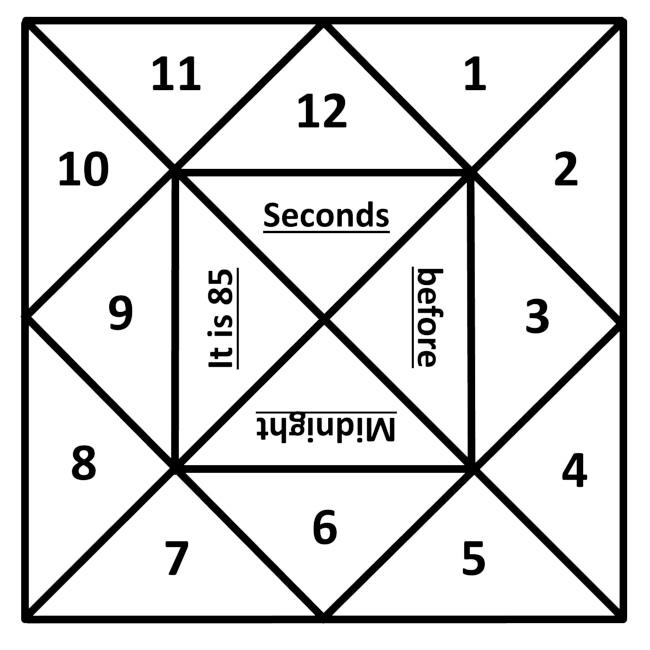
On the Doomsday Clock, it is 85 seconds before midnight!

Tick… tick… tick… tick…

Further reading:

Home page for the Bulletin of the Atomic Scientists:

Home

PRESS RELEASE: It is 85 seconds to midnight

2026 Doomsday Clock Announcement: Complete Livestream

https://docs.google.com/document/d/1g_Yw1vUXE_qYyAMFWReLt3NMSsIVnSkh/edit?usp=drive_link&ouid=112387792748535695420&rtpof=true&sd=true

<>