 The Shewhart Cycle (also known as the PDCA) is an iterative design and management cycle for continuous quality improvement of products and processes. It is named after Walter Shewhart who is known as the father of statistical quality control. The more recent name, PDCA, has several variations in the literature. The PDCA or Shewhart Cycle consists of four parts:
-
- Plan
- Do
- Check
- Act
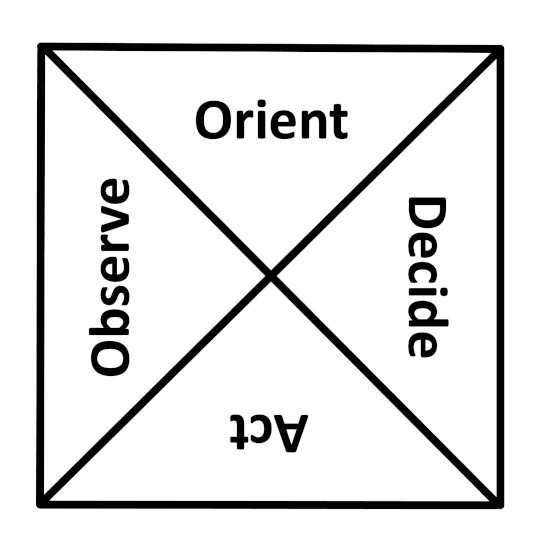 Similarly, the OODA Loop is an iterative framework for the improvement and management of decision processes. It is used in various domains such as business, litigation, and military strategy. The OODA Loop consists of four parts:
-
- Observe
- Orient
- Decide
- Act
Learning Cycles are similar to Design Cycles in that the process to be improved is learning and the product to be improved is knowledge. It would be interesting to compare the two types of cycles to understand their similarities and differences. Some of each type have four stages but others have more or less. I have mentioned several learning cycles with four steps already in this blog, the Kolb learning cycle and the Scientific Method.
Further Reading:
https://en.wikipedia.org/wiki/PDCA
https://en.wikipedia.org/wiki/Walter_A._Shewhart
https://en.wikipedia.org/wiki/Continual_improvement_process
https://www.praxisframework.org/en/library/shewhart-cycle
https://www.google.com/search?q=PDCA+cycle&tbm=isch
https://en.wikipedia.org/wiki/Decision_cycle
https://en.wikipedia.org/wiki/OODA_loop
https://www.techtarget.com/searchcio/definition/OODA-loop
https://en.wikipedia.org/wiki/Learning_cycle
https://www.google.com/search?q=learning+cycles+and+design+cycles+compared&tbm=isch
[*6.54]
<>
 Equivalent Exchange
I’ve long felt that this quaternity is poorly ordered by the author. The PDCA order doesn’t convince me. I’m leaning towards PDAC. I’ve got a way of saying that, and I’m putting a block of clues in front of you.
I propose the following quaternities for your consideration:
– Modes of inference: abduction, deduction, induction, intuition.
– Scope of knowledge: the general, the particular, the singular, the universal.
– Scope of assertion: the certain, the plausible, the possible, the probable.
– Arithmetic operations: addition, division, multiplication, subtraction.
I’ve listed them in alphabetical order so as not to influence you. What would you do with them in relations with the Aristotle’s four causes ?
LikeLike
Thanks for this pop-quiz! I appreciate your interesting comment, and thanks also for your patience while I wrestle with an answer. I agree that some of the steps and some of the step names of PDCA are a bit problematic, and others seem to think so too.
– Some may add a beginning O for Observe giving OPDCA, but then… five.
– Others (Deming) change C for Check to S for Study giving PDSA.
– Some say the A is really for Adjust, which I like better, since Act and Do are too similar.
However, I disagree that Do and Act (or Adjust) should be adjacent. Check (or Study) analyzes the results of the Do phase and must be done before you know how to Adjust the Plan in the next go-round. This is supposed to be a Cycle after all. However, I’m sure I have jumbled the order of other Cycles before based on my usual intuitive alignment with the Four Causes.
Thus you probably could tell I was having difficulty orienting the PDCA and OODA diagrams by this or even some other method. Why should Act in both end up in different places? At first, I did have Plan on the left so that its Act at least matched OODA, which I think is better at least for an initial presentation. So back it goes!
Now, as to the main challenge of your comment, I’m still considering it!
LikeLike
I may have already failed the test with my first comment, but here are some more feeble attempts. And if you are still listening, I would appreciate some feedback or hints for what you have in mind if you have additional time or interest.
While I talk big about fourfold alignments, I usually find them difficult and uncertain. Especially with comparing Loops (or Cycles), the case in point. I find it often easier with Grids (sometimes called double duals in this blog), such as I consider the five quaternities you’ve asked me to play with.
I haven’t considered three of the five before: modes of inference, modes of knowledge, and scope of assertion. Some of these fourfolds don’t seem to be precise and existing sets, but I like them anyway and thanks for sharing.
I’ve played with a few arrangements, and see some connections, but fail to see a great synthesis. (I’ve gone back and changed the diagram for My Dear Aunt Sally, after some contemplation, but then changed it back.) I’m also guided by my intuition about Linear Logic, which guides me as much as the Four Causes.
So here’s my best present guess, which has been stable for a bit. As far as my reasons go, I’ll have work on that some more. I have no clue how the couple of loops relate to these.
LikeLike
I did not see your answer until yesterday, I waited for an automated alert on my mail. I may have mischecked the alerts, I am sorry about that.
I am very passionate about this debate and it is more than rare to be able to talk about it. I’m very interested in your thoughts on all that.
Here is my comment on the table of tables of your second answer.
The three new quaternities which I propose to you are basics in philosophy. They are never studied as quaternary, but their unity and completeness are not exactly in question.
First of all, you take the Aristotelian order of causes, which is not obvious to everyone. It took me a very long time to understand them. So, the middle table is fixed.
All of your pair associations of the tables on the left and right are correct, but they are a little bit misplaced.
Your first line is right for all five terms. Your third line is right for all four terms, but it’s not the right cause. Two corrections are to be made, in this order:
– Interchange rows 2 and 4 of right table.
– Interchange rows 2 and 3 of left and right tables.
This will put in order the scope of knowledge and the scope of the assertion. Yes, it was that easy. I did this very same discover about the four causes.
Your first mistake seems a bit strange to me, given all you have placed so well. The second is more a classic confusion coming from the tradition.
You should start to see the synthesis.
LikeLike
That’s fine, I’m glad you checked back. I thought I was just so wrong that you had given up on the conversation. I went around and around with several tables before posting the one I did, but here’s another that I saved. It seems to be almost your version, except you want Formal and Efficient to be swapped. Is that correct?
So this one is about the same as my previous table except row 2 and 4 of the right hand side is swapped. That aligns the left and right sides like you want, and I like that better now too. Yay! But we disagree on the middle.
So I’m pretty entrenched with thinking that the Formal and Final causes are both “multiplicative”. This comes from my thinking on Linear Logic, where Par and Tensor are multiplicative disjunction and conjunction, respectively. I might even have reasons to think that Formal and Final should be swapped in the table above, but not Formal and Efficient.
That would mean Formal was particular rather general. If anything, Formal should be universal and certain.
Could you please explain your reasons for wanting Formal and Efficient swapped in the table above?
LikeLike
I’ve identified in theory the difference between what you call cycles and the double duel. The first is the cyclic quaternary properly speaking, and the second is the structure of the quaternary, which I call “the traits” and which is present here and there in the tradition, especially since Husserl’s “types”.
The two coexist in a single representation. Sometimes you know one, sometimes you know the other, and sometimes you know both. Knowing both allows you to be sure of the quaternary set, it is a double check. I’ll give you my best example to help you find your way around.
For inferences, I retain the ordered traits:
– to feel-to calculate
– to experiment-to think
The first trait is analog to Hume’s describe-prescribe. The second is analog to body-mind or matter-thought, but before Cartesianism and even somehow before Platonism.
The quaternary gives:
– intuition = feel + experiment
– abduction = feel + think
– induction = calculate + experiment
– deduction = calculate + think
It can be said that all quaternaries are iterations of an idealistic universal quaternary impossible to put into words. It’s the same for traits. The ones I’ve chosen above are the most general I’ve been able to isolate during my research. Each quaternity has its two contextual traits that always lead back more or less to these two.
This will give you another potential reading of the 5 quaternities mentioned. With this “proof of concept” you should be able to reconsider your Linear Logic essay where you clearly design the 2 traits.
LikeLike
I searched for Husserl’s “types”, but only found his four types of phenomenology: descriptive, interpretive, hermeneutic, and narrative. These aren’t the origin of these two traits, it seems.
To name the cross-pairs of a fourfold “traits,” may be as good a name as any, but I’m not sure. At any rate I like your map between these two traits and the four modes of inference. They remind me of the relationship between the four elements and the four qualities of hot, cold, wet, and dry.
Does this relationship between two fourfolds have a common name, or one you use? It is not a relationship that I often see, or even can see.
Besides the cycle and the double dual, which I often call the “grid,” I have the fourfold forms of the block and the chain. It is not a naming that I use routinely, however. But usually the drawn elements of a diagram have no relation to one of these four forms. There are often just chosen aesthetically, but not always.
One thing I’ve discovered in my studies is that everyone who contemplates fourfolds seems to arrive at their own unique and different place. Is it because we think about this so much it etches grooves upon our minds? I appreciate your suggestions of how I should reconsider this and redo that, and I will do my best to understand why.
LikeLike
The Husserlian types seem to have settled down after him.
I was not familiar with this phenomenological set, but it may be useful for me to establish a link with a magnificent quaternary of phenomenology. It’s motivating, there’s a bit of research and not necessarily success.
I chose the term “traits” because the word “types” is too generic. They are interchangeable. I couldn’t find anything else to designate the types or traits.
I have another good reason for making use of “traits”: to pay homage to the psychological field that really allowed me to understand them, which I situate within a shocking psychological quaternary, since its categories are all scandalous.
The qualities are problematic, there is only one clue: using water as an element and as a (wet) line is not ontologically acceptable. Their order is distorted. They are confusing.
Your last points raise the problem of the representation of analogical equations: the square and the cross are simply catastrophic for the readability, and for the unification of interpretations. At the very least: they know no beginning or end; each one puts his “obvious” order; they have historically led to the fifth element (the whole has become a part). Otherwise, they look pretty and allow you to encode both the quaternary (square) and the strokes (cross) in a unique pattern.
I have different modes of representation; the square is not one of them because it would have to be explicitly standardized for each use.
LikeLike
I suggest you redo your ranking of the playing card suits: clubs, diamonds, hearts, spades (♧, ♢, ♡, ♤). This creation is inspired by a long tradition and stems from the need for simplification intended for the mass reproduction of playing cards by the Lyon cartiers of the late fifteenth century. It’s very rich in archetypes that are still to discover after they’ve been put in order.
Your essay seems to mistake them for traits, without success: you mix the two notions. This is quite logical, since our only reference in this regard are the 4 elements, the world’s first quaternity (Egypt), which then hesitated between the two forms without ever resolving them. Hippocrates and Aristotle were the first in history to introduce the idea of traits. They are not clearly established, the 4 elements are ordered, but they are not properly structured. We’re confused because that’s all we have really. This is probably the very source of the second difficulty of your previous essay.
The symbols of the playing cards form a cyclical quaternary, compatible with the others. The traits are visible in the 4 symbols, try to name them from their community of meaning contained in their graphic characteristics, and from there you should be able to order the quaternary unequivocally. The colors are effectively redundant.
LikeLike
Again, I show a cross or plus for my diagram for the suits just to put something in the middle or give it that mandala feel. I don’t suggest they pair in that particular way; I’m more interested in where I locate them at the Cardinal Directions than anything else. Also, such comments might be better served at their particular post for other readers, but would you still see my reply?
I felt that the suits should be arranged by the Four Treasures as well as the Four Elements. I could go through some arguments to justify my placement, or just hand-wave for now: spear-club-wand-fire, sword-spade-sword-air, basin-heart-cup-water, stone-diamond-pentagram-earth.
The suits could be a cycle rather than a grid, that’s fine. But you say their cycle is implicit in their shapes. I can count their lobes, stems, and points, maybe. They all have different triples, but I’m not sure what that means. Another clue, please.
Suit Lobes Stems Points
Club 3 1 0
Spade 2 1 1
Heart 2 0 1
Diamond 0 0 4
LikeLike
About PDCA, your comment confirms my sensation, it is problematic. The solution I had proposed didn’t hold up, the next day I didn’t find it that coherent anymore.
In fact, there are several quaternary iterations very close to the PDCA cycle in different areas, which seem to have exactly the same problematic. I think it’s a family, with a common origin that I don’t know yet. I conducted this study without success a long time ago, it should be done again calmly.
LikeLike
“Could you please explain your reasons for wanting Formal and Efficient swapped in the table above?”
Let us make one thing clear right away: I don’t “want” anything about the order of things, I try to describe it as I have seen it. We are the same in this respect, we do not discuss exactly each quaternary instance, we look for an underlying order common to all of them. We are looking for an agreement.
I am glad that you are satisfied with my first proposal for a correction. You had already considered it and your choice was still in the balance. On the other hand, you do not readily accept the second and you ask me to argue about it. I like this posture.
I have two forms of argument to answer your question: one constructive and the other deconstructive. The second is not good news for you: it undermines your entire work. But it doesn’t manage to destroy everything he has that is valuable. It offers a reconstruction that you don’t have an idea of yet. Sorry to be so pretentious, I have no choice.
I don’t like the position of knowing and lecturing, but I consciously adopt it, taking great care to banish from my mind any value judgments about anyone. The issue of judgment and intentions is at the nerve center of this research.
Without explaining it to you, as a child gives à toy to another child, I give you a quaternity, more less of my composition, and of course ordered, to which I refer in this field: respect-love-admiration-trust. It resonates with the causes, but not yet with the rest.
Constructive:
We agree on the cyclicity of the Quaternary. We have not mentioned the internal growth of the Quaternary, but we agree on the internal growth of the causes, this treasure. My first thought concerns the four quaternary instances, which can spontaneously find an internal growth, like that of the elements. It is a question of comparing the definitions and imagining an increase.
First argument, stick to definitions: if we do it for Scope of Knowledge and Scope of Assertion, the spontaneous order is indeed the one I suggest: singular-particular-general-universal and possible-plausible-probable-certain. I start from this non-problematic semantic order. Since we agree on all line-by-line pairings, this gesture also orders inferences and operations: intuition-abduction-induction-deduction and addition-subtraction-multiplication-division.
Second argument, stick to the causes: the particular notices a hypothetical resemblance in the singular events and tries to formalize it. The general experimentally verifies the particular model and takes it as a rule, provided that the model is reproducible and therefore efficient. The general marks the transition from the hypothetical to the statistical. The particular’s hypothesis tends to be plausible. The general rule is probable, it works effectively. Abduction is also the discursivity of philosophers; in other words, it is dialectics. It is an activity of pure formalization of concepts. Induction is a decision that makes it effective. The order of the 4 operations can be discerned so well from the previous quaternities that it seems to become their emblem. This story can be conducted differently for the same result.
Those are my two arguments for this part of the discussion. My other posts yesterday regarding the structure of the Quaternary lead to these assignments. See, what is at stake for me: without this order, my whole theory falls by the wayside. Here’s what’s at stake for you: with this order, your whole perception of harmony is turned upside down.
Deconstructive:
My proposal for a system is unique in the sense that it is not opposed to any other. It is opposed to a nothingness: as we both know, this study does not exist anywhere in an academic version, even though it seems perfectly legitimate, and even vital, to us.
You have to start somewhere, for you that was the linear logic, and I think it was a very relevant bad choice. Let me put it very simply: it’s better to do things awkwardly than not to do them. This is the explorer’s state of mind. I still blush with shame when I reread some of my ancient texts, but I calm down, I have grown from these countless trials and errors.
Linear logic: the first unavoidable point is that linear logic does not claim to be based on an ontological system. She can’t do it because she respects the academy and wants to be respected by it. It’s complex, but it’s also complicated. I have studied it on the surface, solely from the presupposition of my system. I didn’t try to understand its usefulness in detail, which speaks for itself through its successes. I have sought to confront its declared essence, with the quaternary system as I conceive it. I’m used to this kind of exercise; I have a lot of reflexes that have been checked a thousand times.
Linear logic proposes from the outset a quaternary with two features that are entirely in line with my idea of the system. I’ve only studied this set from your sources, Wikipedia, and arguing at length with AI. I have come to the conclusion that the resemblance to the system is enormous, but that there is a major drift. I am far from having dried up this subject, which you know infinitely better than I do, we can talk about it in more detail another time. I summarize for your use:
– The disjunction of “plus” is not the same as that of “par”. That of “par” is ultimately both disjunctive and conjunctive, which is contradictory for the system. The “par” is also the place of non-choice (neither A nor B), which further complicates it.
The “par” sometimes resembles the sum of the other three, which radically changes the well-ordered Quaternary aspect. The discussion is insanely complex, in contrast to my usual attempts that fluently resolves at self-explanation level. I still want to dig into linear logic, but I would never take it as a quaternary reference as it stands. Other secondary problems reinforce me, forming a non-prohibitive web of indicators of non-compliance with the system:
– The 4 terms chosen are not very intuitive. They bear little relation to their usual grammatical meaning, which is inconsistent between the forms preposition, adverb and noun;
– The 4 chosen symbols do not follow the rule of one of the two traits.
In a quaternary system, harmony is expected. Each element should have a clear and symmetrical function in relation to the others. That’s not really the case here.
Of these counter-arguments, I retain only the breaking of the trait. It suffices to deduce unequivocally that linear logic is not fully compatible with the system. I’m not questioning the function and interest of linear logic; I’m just saying that associating it with quaternary ontology is confusing.
LikeLike
So, for your constructive arguments, you seem to have caught me in a bit of a Socratic bind. Well done! I would like to see a diagram of your causal argumentation before I’m fully convinced. But I always say, if you arrive at the wrong conclusion, some of your premises may be wrong. So, let me temporize a bit.
I’m not so sure that I accept the “Aristotelian” order of the four causes: they were just what occurred in my first table I offered you. That’s why I’m prone to using these diagrams. After all, both efficient and material are “potential”, and formal and final are “actual”. And potency always precedes actuality, right? Not that I’m big on the potential/actual divide in regards to the four causes, more past/future.
As an aside, I wasn’t aware that Thomas Aquinas introduced a priority (not Aristotle himself?): “matter is made perfect by the form, form is made perfect by the agent, and agent is made perfect by the finality.” (Wikipedia). But I’m no thomist or even perfectionist. I defer to your expertise here as to who was prior.
P.S. what perfects the finality? Matter might to give it a cyclic schema, but Thomas likely would say God.
So the order of my four causes diagram as I usually think of it is (material, efficient)-(formal, final), which is a general rising SW to NE direction. So even as I accept the order (or chain) of your other fourfolds, I just don’t “feel” that the causes that elevate the particular to the general are the sum and total of the “formal.”
Hmmmm… or perhaps you meant all along that the four causes are in some “trait” or in-between relationship to these other four “quaternaries.” A half-step could make a difference. You don’t think the four elements have a strict order, much less the four qualities, do you?
Perhaps you reveal the four causes in your casual constructive argument. I do see formalize. But you insert many terms that I know, but not in terms of the four causes and scope of knowledge, etc. Such as experimentation, verification, observation, statistical, hypothetical. Your causal list makes me want to pick it apart to see its construction better. I guess I should do that, so I’m still thinking.
Also, I’m not prepared to address your deconstructive arguments at the present moment. I do admit that I’m no expert on Linear Logic, and I was hoping that someone would be inspired to take up the cause and challenge of showing my vague claims in a better way. To throw them away would be disappointing.
BTW, are you ok with using comments for this dialog? Would you rather use email? You could provide yours in a comment and then I could delete it and not publish it. But I’m ok with the comment style if you are, for now.
LikeLike
The causal diagram is not within my reach, I don’t know how to do it.
You show potential-actual as a β trait candidate for causes. You start off very strong with a puzzle of Platonic idealism. For Plato, the idea is more real than the real. In terms of ontology, I always prefer Aristotle as a last resort.
Here is your sequence, I complete it with two lines at the end:
– potential-current
– material-formal
– effective-final
– before-after
– potential-real
– ideal-real
– thought-matter
Therefore, the material cause is thought, and the formal cause is matter. To me it sounds like Orwell (e.g., war is peace). This is our fundamental point of disagreement.
Platonic idealism is very far from being a consensus in philosophy, and some authors denounce it as a severe retardation. I agree with them, that is the false premise to me. My ontological explanation begins where others leave off in this trap.
I would also like to point out that we need to compare “potential-actual” with “power-act”, which brings me to a point that I cannot talk about so early in our discussion, that of traits γ and δ.
I also began by doubting Aristotle’s order as to causes, now I am certain of it. I suddenly grew up understanding that years ago. Aristotle also studied the 4 elements extensively, and he respected their order. Your interpretation contradicts this fact, according to it he should have written: earth, air, water, fire.
The 4 qualities are a problem of a different kind: they were first perceived as a quaternary, and since Hippocrates and Aristotle they have become unfortunately wobbly traits for moods or temperaments.
Ontological research is not directly concerned with monotheisms. Christians are right to look for God in ontology, but they don’t change anything in ontology.
My deconstruction of linear logic focused on its compatibility with the metaontological quaternary. It is strictly factual: a given trait serves identically wherever it is used in categorical formalization.
LikeLike