 Through the darkness of future’s past,
The magician longs to see.
One chants out between two worlds…
“Fire… walk with me.”
— Mike from Twin Peaks
<>
Through the darkness of future’s past,
The magician longs to see.
One chants out between two worlds…
“Fire… walk with me.”
— Mike from Twin Peaks
<>
 Thinking some more on Popper’s Three Worlds, here is a set of philosophical disciplines that seem to resonate with the themes of this blog.
I believe that one could also 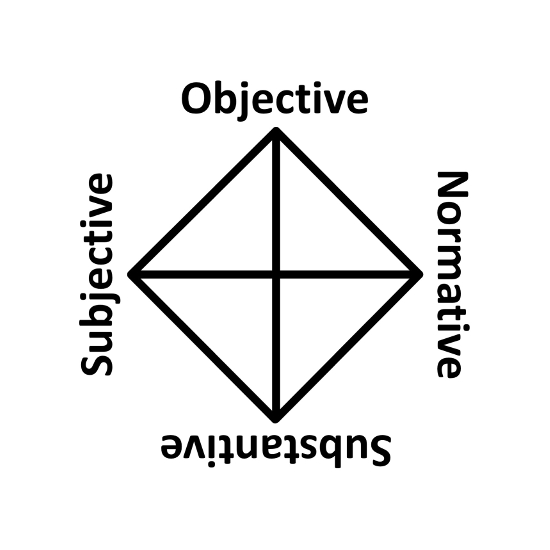 make a case for associations with phenomenology to the subjective, epistemology to the objective, ontology to the substantive, and axiology to the normative.
Further reading:
https://www.quora.com/What-does-ontology-epistemology-and-axiology-mean
http://cognitive-edge.com/blog/phenomenology-epistemology-ontology/
(Note that the author of the article above, David Snowden, is the creator of the Cynefin Framework.)
https://en.wikipedia.org/wiki/Phenomenology_(philosophy)
https://plato.stanford.edu/entries/phenomenology/
https://en.wikipedia.org/wiki/Epistemology
https://plato.stanford.edu/entries/epistemology/
https://en.wikipedia.org/wiki/Ontology
https://plato.stanford.edu/entries/logic-ontology/
https://en.wikipedia.org/wiki/Axiology
https://plato.stanford.edu/entries/value-theory/
https://equivalentexchange.wordpress.com/2015/05/14/four-philosophies/
[*10.20]
<=>
 A digital universe – whether 5 kilobytes or the entire Internet – consists of two species of bits: differences in space, and differences in time. Digital computers translate between these two forms of information – structure and sequence – according to definite rules. Bits that are embodied as structure (varying in space, invariant across time) we perceive as memory, and bits that are embodied as sequence (varying in time, invariant across space) we perceive as code. Gates are the intersections where bits span both worlds at the moments of transition from one instant to the next.
— George Dyson, from Turing’s Cathedral
Further Reading:
George Dyson / Turing’s Cathedral: the origins of the digital universe
Notes:
Embodied as Structure, Perceived as Memory
Invariant across Time: ¬ΔT
Varying in Space: ΔS
Embodied as Sequence, Perceived as Code
Varying in Time: ΔT
Invariant across Space: ¬ΔS
https://equivalentexchange.wordpress.com/2012/04/12/a-digital-universe/
[*7.82, *7.83, *7.153, *10.14]
<>
 A simple example from game theory shows how two rational individuals might not chose to cooperate if the result for not doing so might be in their favor.
Two prisoners are asked for more information about their common crime. They can each remain silent and thus collude with each other. Or they can confess their participation and thereby incriminate the other prisoner.
Unfortunately there is already enough evidence against them for a sentence, so if they both remain silent they will still serve some time (say 1 year each). However if they both confess they will both serve more time (say 2 years each). And if one confesses but the other remains silent the confessor will serve no time but the betrayed one will serve an even longer sentence (say 3 years)!
The thing to notice is that each prisoner will serve less time if they defect and betray the other prisoner than if they cooperate with them. You might even think the sentences are calculated to promote betrayal!
Further Reading:
https://en.wikipedia.org/wiki/Prisoner%27s_dilemma
https://plato.stanford.edu/entries/prisoner-dilemma/
William Poundstone / Prisoner’s Dilemma: John Von Neumann, game theory, and the Puzzle of the bomb
Note passage from SEP:
The new story suggests that the Prisoner’s Dilemma also occupies a place at the heart of our economic system. It would seem that any market designed to facilitate mutually beneficial exchanges will need to overcome the dilemma or avoid it.
[*10.23]
<>
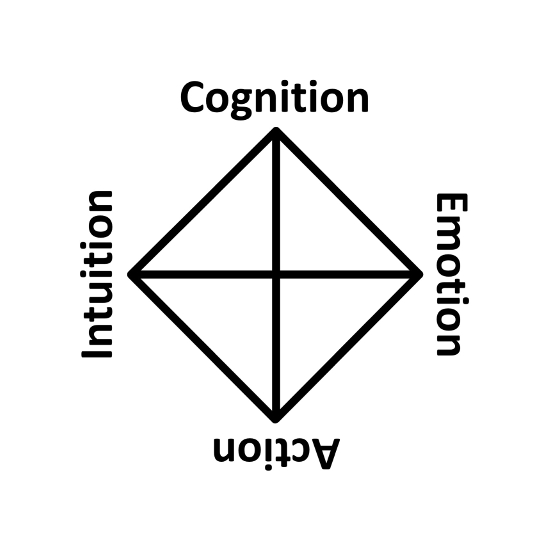 An early work (1934) in the study of fourfolds is James H. Cousins’ “A Study in Synthesis”, which is available for downloading at the link below.
Cousins’ key fourfold is
which is similar to Jung’s psychological types except Action replaces Sensation.
Each fourth also has two movements (passive and active), and two sub-movements (subjective and objective) (see Fig. 20):
Cousins was an influence to Patrick Geddes, renowned as a town planner, who had several fourfolds of his own.
Further Reading:
James H. Cousins / A Study in Synthesis
https://archive.org/details/in.ernet.dli.2015.501469
James Cousins (22 Jul 1873 – 20 Feb 1956): An Effort of Synthesis
http://hodgers.com/mike/patrickgeddes/feature.html
https://en.wikipedia.org/wiki/James_Cousins
[*9.12]
<>
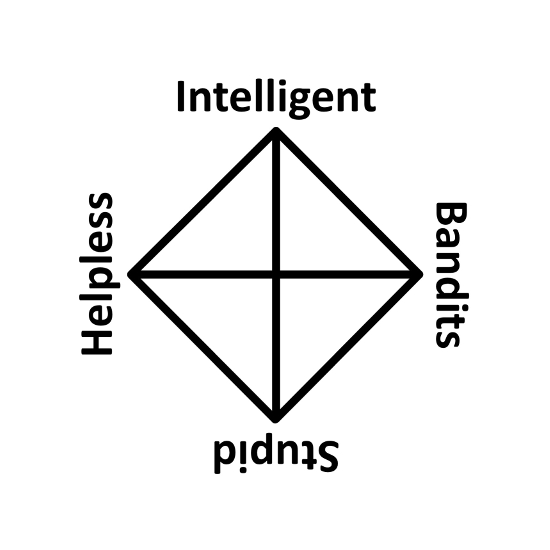 I’ve crossed enough paths to know that one in four people are rock stupid.
— Shadow Moon, from television’s American Gods
Here’s a rather pessimistic take on humankind.
An economist at UC Berkeley sorted people into four groups based upon their proclivities for gain or loss, for themselves and for others. This leads to four groups:
In fact, Professor Cipolla thought the greatest threat to humanity was stupidity, and developed five laws for the foolish.
At first, I considered gain and loss in purely economic terms, but then realized gain and loss should also include the creation and improvement of information and knowledge.
Further Reading:
https://qz.com/967554/the-five-universal-laws-of-human-stupidity/
http://harmful.cat-v.org/people/basic-laws-of-human-stupidity/
[*10.2]
<+>
 Philosopher Sir Karl Popper divided the ontology of all that is into three parts:
World 1: The physical world, the world of physical objects and events, including biological entities.
World 2: Subjective reality, the world of mental objects and events, that occur in (individual) minds.
World 3: Objective knowledge, the world of all products of thought, that may be physical or not.
Instead of physical or mental monism, or the dualism of mind and matter, Popper suggested a pluralism (triplism?) consisting of three worlds. All the elements of each of these worlds, Popper argued, can be said to exist.
One could say that each higher world requires the world below it in order to exist: World 1 < World 2 < World 3. That is, World 2 is emergent or supervenient on World 1, and World 3 is emergent or supervenient on World 2. In addition, these worlds interact with each other.
There is no necessary evaluation of the “truth” of the elements of World 3. There are many products of thought that exist in World 3 that are indeed false. But Popper spends much time talking about the quality of World 3 objects that give credence to their existence. That is, the “objective” goodness or quality of a product makes that product more real.
I suggest that the introduction of another world is necessary for a proper division and understanding of Popper’s Three Worlds. Let’s call it
World 4: Normative values, the world of all intersubjective evaluations.
Indeed, Popper argues that the objective value of certain objects in World 3 gives credibility to the notion that there are such World 3 objects, and not just World 2 instances within minds.
World 4 could serve as a mediator between World 2 and World 3. Popper states that people can evaluate the World 3 products of the mind within their own subjectivities, but it seems to me that they must be trained or lead to appreciate the “objective” greatness of these products. They do not happen in a vacuum, so perhaps a better description would be that they have an “intersubjective” value.
Why would a person discount the well accepted scientific theories of evolution or climate change just because they don’t fit with his other beliefs?
Why would a person destroy ancient sculptures of timeless beauty just because it offends his religious beliefs?
Such cognitive biases could easily block a person from accepting some objective knowledge that conflicts with their values. Certainly the biases exist in the subjective mind, but are learned and maintained in the intersubjective cultural milieu.
A takeaway fourfold for you is presented on the right.
Further Reading:
Karl Popper / Three Worlds. The Tanner Lecture on Human Values, delivered at the University of Michigan, 1978
https://en.wikipedia.org/wiki/Popper%27s_three_worlds
https://en.wikipedia.org/wiki/Supervenience
Sean Carrol / The Big Picture: On the Origins of Life, Meaning, and the Universe Itself
Manfred Eigen, Ruthild Winkler / Laws of the Game: how the principles of nature govern chance
[*8.134, *10.6]
<>
 Quite by accident, I ran across anthropologist Edward T. Hall’s Map of Time in his book “The Dance of Life: the other dimension of time”. In it, he shows a mandala of different notions of time which tries to answer the question, “what is time”? The mandala consists of eight (or nine) different notions of time, organized as a fourfold of duals:
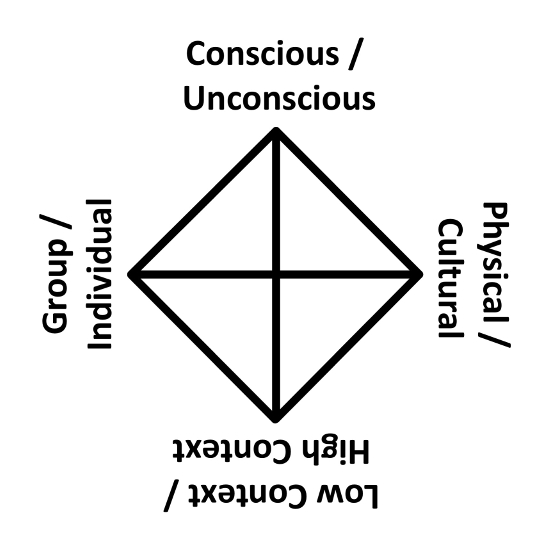
In addition, there are four duals of attributes:
So that the different times have these attributes:
And the different attributes belong to these notions of time:
The ninth notion of time is a synthesis of all eight which he calls meta-time.
Further Reading:
https://en.wikipedia.org/wiki/Edward_T._Hall
http://people.brunel.ac.uk/bst/vol0202/robdoyle.html
[*10.4]
<>
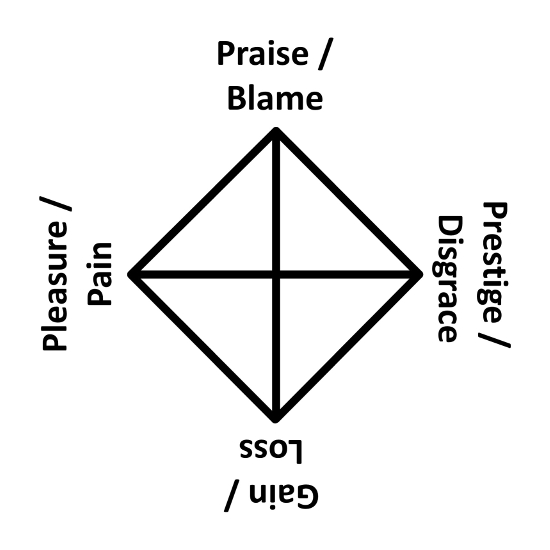 This fourfold of duals from Buddhism lists the hopes and fears that bind us to the world and our culture. They are known as the eight worldly winds, concerns, or dharmas. Both hopes and fears, wanting and not wanting, can be seen as negative.
Further Reading:
http://stefnoble.blogspot.com/2011/11/buddhas-eight-worldly-winds.html
http://www.rigpawiki.org/index.php?title=Eight_worldly_preoccupations
https://www.lionsroar.com/buddhism-by-the-numbers-the-eight-worldly-concerns/
[*9.227]
<+>
Because there are way more than seven wonders in the world.
Always Forward Between Heaven and Earth
Psychological Musings
Critiquing anime and everything else
"For man has closed himself up, till he sees all things thro' narrow chinks of his cavern" -- William Blake
Category Theory, Haskell, Concurrency, C++
Reviewing fascinating science books since 2017
Every Fourth Thing
Derek Wise's blog: Mathematics, Physics, Computing and other fun stuff.
integrating 4 binary opposites in life, learning, art, science and architecture
integrating 4 binary opposites in life, learning, art, science and architecture
Chasing the Paper Rabbit
experiments in a reaction from the left
A blog about computers, evolution, complexity, cells, intelligence, brains, and minds.
mind maps, infographics, and expositions
neat ideas from unusual places
Introduction to a Quadralectic Epistomology
Astronomy, space and space travel for the non scientist
Every Fourth Thing
A Serious Look at Trivial Things
A Survey of Tetradic Testimonials in Architecture
Musings from a Naturalist
Why Evolution is True is a blog written by Jerry Coyne, centered on evolution and biology but also dealing with diverse topics like politics, culture, and cats.
Four-fold thinking4you
Craig Weinberg's Cosmology of Sense
Purveyors of Fine Anime Reviews and Ratings Since 2010
Between Subject and Object
Every Fourth Thing
Every Fourth Thing
Every Fourth Thing
Every Fourth Thing
Every Fourth Thing
Sometimes those Sticking their Heads in the Sand are Looking for Something Deep
Online Home of Christopher Vitale, Associate Professor of Media Studies, The Graduate Program in Media Studies, Pratt Institute, Brooklyn, NY.
Linking Ideas
RESEARCHING THE DEMANDS OF THOUGHT
Explorations in the Paradoxes of Meaning
"The centaur of classical metaphysics shall be mated with the cheetah of actor-network theory."
objects & things, design, art & technology
 Equivalent Exchange