Category Archives: technology

Four Dimensional Space-time

sq_4d_spacetime

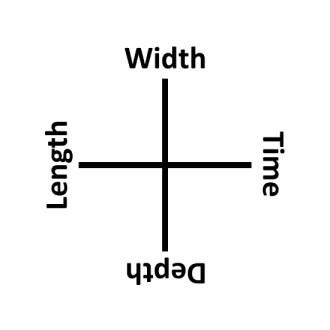
Here’s a simple fourfold I’ve been ignoring just because it’s so trivial, but that triviality can be deceiving. Space-time as formulated in special relativity has four dimensions: three of space and one of time. Our everyday experience shows us the three dimensions of space: length, width (or breadth), and depth (or height), but time is a different kind of thing because we cannot see or move forward and backward through time with our eyes or body, like we can along the axes of space.

Personally, only our memory and imagination can let us range through time. Of course, after the invention of language and more recent technologies, the spoken word, writings, photographs, audio recordings, and videos can also be used. But it’s not the same as shifting one’s gaze along the length of something or moving one’s body across a width.

So, we can move semi-freely through the three spatial dimensions but our movement in time seems to be fixed into a relentless forward motion that we have no control over. And because gravity pulls us down onto the surface of the world, one of the spatial dimensions (depth or height) is more limiting than the other two.

sq_ll2Thus another interesting comparison to this fourfold is to that of linear logic. One observation is that length and width can be considered reversible but depth and time can be considered somewhat irreversible. That’s not true of course, but because of gravity it is easier to descend than to ascend, and it’s far easier to move into the future than into the past. But we can see into the distant past, just not our own, as we turn our telescopes to the heavens.

Space without time could have four or even higher dimensions, but we have no empirical evidence that it is so. Mathematically, however, we can easily construct multidimensional spaces. One representation of four dimensional space is by using quaternions, which have four dimensions to the complex numbers’ two. Tuples of real numbers or even vector spaces can also be used. However, the geometry of space-time is not Euclidean; it is described by the Minkowski metric.

Novels about characters living in different numbers of spatial dimensions are an interesting way to learn and think about them. The very first was Flatland by Edwin Abbott Abbott, about a being limited to two dimensions that learns about a third outside his experience when a three dimensional being comes to visit. Just recently I’ve finished reading Spaceland by Rudy Rucker, about an ordinary human person limited to the three dimensions of space that learns about the fourth dimension by similar reasons.

Links:

http://en.wikipedia.org/wiki/Special_relativity

http://en.wikipedia.org/wiki/Minkowski_space

http://en.wikipedia.org/wiki/Four-dimensional_space

http://en.wikipedia.org/wiki/Flatland

http://en.wikipedia.org/wiki/Flatland_%282007_film%29

http://en.wikipedia.org/wiki/Spaceland_%28novel%29

[*8.72]

<>

Metropolis

sq_metropolis_agents“The Mediator between the head and hands must be the heart!”

— Fritz Lang’s Metropolis

A couple of years ago I watched The Complete Metropolis, the recently restored version of the 1927 silent film. The message that flashes before the viewer at the beginning and at the end of the film is “The Mediator between the head and hands must be the heart!”

I can’t remember if I’ve seen some previous version of Metropolis or not. I’m sure I’ve seen many of the scenes but I hadn’t seen all of them. I cannot speak for previous versions of the film, but this one was enjoyable and I’m glad I watched it.

Somewhat like the film Agora mentioned previously that showed the gulf between science and religion, this film details a fictional conflict between a technocratic ruling class and a subjugated working class. There is some religious imagery throughout and the epic battle between Freder and Rotwang even takes place on the rooftops of a cathedral.

Interestingly, the three elements of the epigram above correspond to three of the elements of Carl Jung’s Psychological Types: sq_jungHead with Cognition, Heart with Emotion, Hands with Sensation. What about the missing aspect, Intuition? I’ve placed Maria at that point because her meeting with Freder really initiates the plot of the film.

Actually I should have placed Grot, a worker foreman, at the Hands position instead of Rotwang. However, I think Rotwang is a more interesting character. Comparing these characters to those in The Tempest and Forbidden Planet, Rotwang is more like Prospero’s Caliban, or Morbius’s Id monster.

As evidence of his evil nature, Rotwang creates a robotic version of Maria and uses her to incite the workers to confusion and violence. Note that the spirit Ariel and Robby the Robot are also placed at Jung’s Intuition position.

Several of the images from the banner on this blog are from the movie, and are of the central tower and office of Fredersen. It is called “The New Tower of Babel” since it was inspired by Bruegel’s painting of the Tower of Babel.

Notes:

For the “4 H Club”, the four H’s are Health, Head, Hands, and Heart. Probably deserves its own post!

Links:

http://en.wikipedia.org/wiki/Metropolis_%281927_film%29

http://en.wikipedia.org/wiki/Tower_of_Babel

http://en.wikipedia.org/wiki/4-H

[*7.152]

<>

Ohm’s Law

Charts for the equations of Ohm’s Law usually consist of the fourfold relation between Voltage (Volts), Current (Amps), Resistance (Ohms), and Power (Watts). For each electrical quantity, there are three equations that represent it in terms of two others, making twelve equations total.

Ohm’s Law is really only between voltage, current, and resistance. Apparently, power is more correctly introduced by the formula for “Joule heating”.

Both voltage and current have been in two fourfolds previously (Four Basic Electrical Components and System Dynamics) but not power and resistance. Well, resistance did make an appearance as a relation between current and voltage.

The twelve equations can be generated by the following identities (where E = voltage, I = current, R = resistance, and P = power):

I*R/E = P/(I*E) = P*R/E^2 = R*I^2/P = 1

http://en.wikipedia.org/wiki/Ohm%27s_law

http://en.wikipedia.org/wiki/Joule%27s_first_law

Google search for images for Ohm’s Law.

[*8.4, *8.5, *8.8, *8.9, *8.10]

<>


The Four Bases of DNA

DNA neither cares nor knows. DNA just is. And we dance to its music.

Richard Dawkins

DNA, the genetic code and biological machinery all life on earth shares, has been in the news lately. It was once thought that much of our DNA was useless junk, but recent research reveals that this portion of our DNA is very important to the operation of epigenesis. This portion of DNA could be called dark bio-matter, or better dark bio-information or even dark bio-code, since it contains switches and instructions that guide each individual organism’s developmental growth through time.

Previously, the parts of DNA thought to be important were those regions that define the proteins that assemble to form our tissues. Mutations in the DNA that specify proteins can lead to disease because the mutated proteins cannot perform the functions that they need to. Of course, mutated proteins can also be improved and increase health. Comparing protein sequences across species shows that we have many commonalities as well as important differences with our animal cousins. What was once considered a “great chain of being” is now thought to be a great tree of life, all shown by DNA.

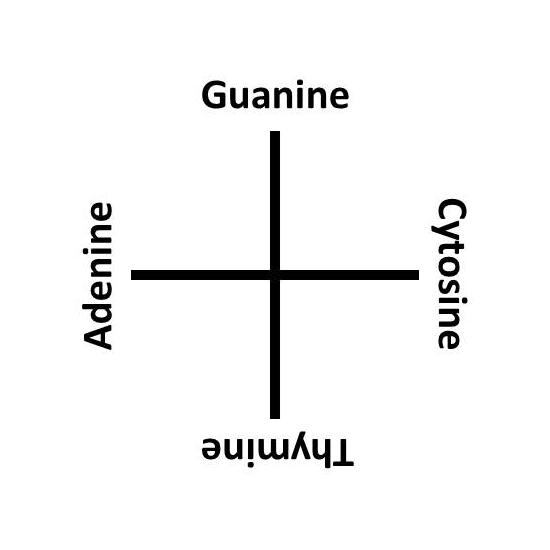
DNA is also a fourfold, and a double dual as well, since for the four bases Adenine (A), Thymine (T), Guanine (G), and Cytosine (C): A pairs with T, and G with C. I am not saying that DNA is analogous to the other fourfolds presented here, but it makes a nice diagram.

Questions:

Why does DNA have four bases and not two, like binary computer code?

Even more of DNA determines our health and variation, the things that make us who we are. Does that constrain us even more, or will this knowledge make us more free?

Further Reading:

http://en.wikipedia.org/wiki/DNA

[*7.112]

<>


The Four Basic Electronic Components

A fourfold has recently been in the news. The physical realization of the memristor completes the four basic electronic components, along with the resistor, capacitor, and inductor. Theorized to exist since 1971, the memristor may revolutionize computational devices.

References:

http://en.wikipedia.org/wiki/Memristor

[*6.126-*6.128]

<>

Kevin Kelly’s Philosophy of Technology

Kevin Kelly’s new book “What Technology Wants” is an exploration of what technology is and what it does. Technology has many of the same attributes as biological evolution, and as such, its effects cannot be fully predicted. At best, we can try to evaluate a particular technology’s advantages and dangers before it is let loose into the world; at worst, we will have no control over it at all.

Kelly describes evolution as shaped by structural, historical, and functional factors; and goes on the describe technology as dependent on structural, historical, and intentional factors. However, he also maintains that technology is an evolutionary process, and evolution in turn is a technological process. Kelly seems to say both processes have all four of the factors shown in the double dual above.

Kelly says that human language is the first big human technology (or was it fire? or stone tools?). But I also agree with him that the mechanisms of biological evolution can be considered technology. What is technique except a method that can shared and perpetuated by others? Molecular genetics grants us the ability to pass (most of) our attributes on to our progeny, including the ability to pass (most of) their attributes on to theirs. Once techniques can be shown or told to others, biology becomes the basis for the showing or telling, but not the mechanism of it.

Kelly calls the entire system of evolution/technology the technium. Because we have been continually shaped by our human technologies, they are not foreign to us. On the whole, we are better with them, than without them. One could argue that without them we wouldn’t even be human!

References:

Kevin Kelly / What Technology Wants

NYT Review of What Technology Wants

[*5.92, *6.60]

<>