Category Archives: sixteenfolds

The Archic Matrix

Now that I am presenting sixteen-folds, let me briefly return to a subject I’ve mentioned previously. The Archic Matrix of Walter Watson and David Dilworth is a four-by-four matrix representing different aspects of the “personalities” of philosophers, determined by their writings. It is adapted from the Philosophical Semantics of philosopher Richard McKeon.

The four aspects of the Archic Matrix (also called Archic Variables) in this diagram are Perspective (upper left), Reality (lower left), Method (upper right), and Principle (lower right). The archic variable Perspective can have values Personal, Agonistic, Existential, and Creative, and similarly for the other three variables.

Each of the values of each of the variables is conditioned by one of the variables. For example, Personal is only conditioned by the Archic Variable Perspective, even though it is already a value of that variable. The value Agonistic is conditioned by the Archic Variable Method, Existential by Reality, and Creative by Principle.

Whereas the Myers-Briggs Type Indicator is a two-by-four matrix giving sixteen different combinations for its four personality “variables”, each having two values, the four-by-four Archic Matrix has four values for each of four variables and so gives 256 different combinations. It would be interesting if someone mapped the larger scheme into the smaller.

Further Reading:

Walter Watson and David Dilworth’s Archic Matrix

Archic Matrix: Perspectives

Archic Matrix: Realities

Archic Matrix: Methods

Archic Matrix: Principles

Richard McKeon’s Aspects of Knowing

http://www.ottobwiersma.nl/philosophy/archic_matrix.php

http://wwwhistoricalthreads.blogspot.com/2010/07/walter-watson-architectonics-of-meaning.html

http://www.philosophicalprofile.org/test/index.php

Notes:

The only work that seems to mention both the Archic Matrix and Myers-Briggs is as follows:

Mondo Secter / The Architectonics of Culture: A Critique, Modification, and Extension of Hofstede’s Study of Societal Culture with a Chinese-Based Typology, Ph.D. Dissertation, Simon Fraser University, August 2003

Click to access b31853754.pdf

Secter is elsewhere mentioned to be completing an adaption of this dissertation (albeit long ago), called “The Architectonics of Culture and Personality: Six Core Dimensions of Who We Are”. It would useful to know anything else about this work. Updates, anyone?

[* 10.151]

<>


The Myers-Briggs Type Indicator

I am not a number, I am a free man!

— Number Six from the 1960’s television series, The Prisoner

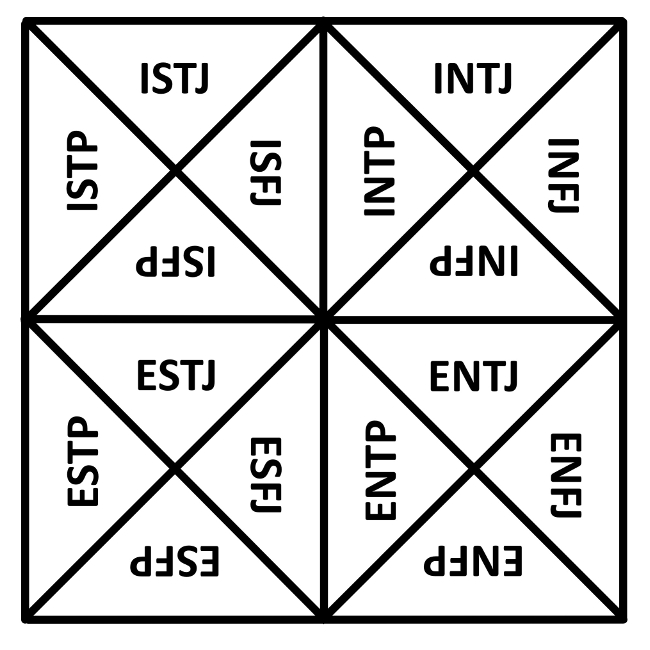
The Myers-Briggs Type Indicator (MBTI) is usually shown as a four-by-four grid of “personality types”. Rebel that I am, here is a triangular version for your personal edification or confusion.

Interestingly, some say that there is an association between the MBTI and Astrology. If they are being positive, they are seeing parallels between the personality pigeonholes of the two schemas. If they are being negative, they are saying that both classification systems are pseudo-science rubbish.

One might think that this is part of the larger discussion of a person being a “blank slate”, and whether we are determined by nature or nurture or a combination of the two, or are free to be who we desire to be.

Further Reading:

https://en.wikipedia.org/wiki/Myers%E2%80%93Briggs_Type_Indicator

The Four Dichotomies of the MBTI

https://en.wikipedia.org/wiki/The_Prisoner

More Images of the MBTI:

https://www.google.com/search?q=mbti&tbm=isch

Comparisons of MBTI and Astrology to chew on:

https://www.porosconsulting.com/news-notes/2018/3/8/your-myers-brigg-personality-type-according-to-your-zodiac-sign

[*10.150]

<>


The Standard Model of Particle Physics

Until a few years ago, the Standard Model of particle physics had sixteen particles verified. Recently, the Higgs Boson was added, so just imagine another triangle hanging off somewhere. Or, alternately, one may combine the Z and W Bosons when adding the Higgs, so a sixteen-fold scheme is maintained.

Also, the Standard Model is much more than a list of these seventeen particles and their attributes. Not shown are a plethora of equations that describe the properties of these entities and their interactions.

I admit that this diagram is not very useful for scientific knowledge, but the reader may contemplate it as they please.

Further Reading:

https://en.wikipedia.org/wiki/Standard_Model

https://home.cern/about/physics/standard-model

https://physics.info/standard/

Also:

Can We Understand the Standard Model?

[*10.148]

<>


The Diurnal Cycle and Chinese Hours

Long ago in a distant land, I, Aku… wait… let me start over.

Long ago in China, the diurnal cycle of day, dusk, night, and dawn was divided into twelve two-hour hours and each hour was named after an animal in the Chinese Zodiac. The Hour of the Rat was from 11 P.M. to 1 A.M., and so on. These animals were also assigned directions: Rat being North, Ox being NNE, etc. Many are familiar with the animals having “years”, so if you were born in a certain animal’s year, you might have certain attributes. These twelve animals are certainly multi-purpose!

Further Reading:

https://en.wikipedia.org/wiki/Diurnal_cycle

https://simple.wikipedia.org/wiki/Chinese_Zodiac

https://www.thoughtco.com/chinese-zodiac-in-mandarin-2278416

The Diurnal Cycle

[*10.144]

<>


The Seasons and the Zodiac

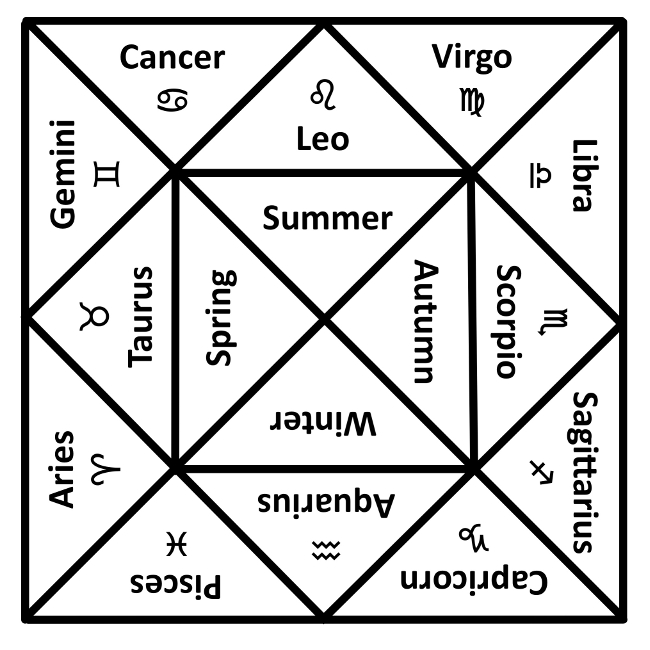
This isn’t a bad little diagram of the four seasons along with the twelve zodiac names and symbols. However, it might be oriented wrong by convention or going clockwise instead of counter-clockwise.  Interestingly, old horoscope charts that show what was in the sky (the positions of the zodiac stars and the eight or nine planets in regards to the twelve “astrological houses”) at the time of a person’s birth were shown using the outside ring of twelve triangles instead of the more familiar circle that is used today. The inner square might be for notes or some nice drawing.

Further Reading:

https://en.wikipedia.org/wiki/Zodiac

https://www.completehoroscope.org/envelope-diagram-horoscope.htm

The Four Seasons

[*10.145]

<>


Ohm’s Law

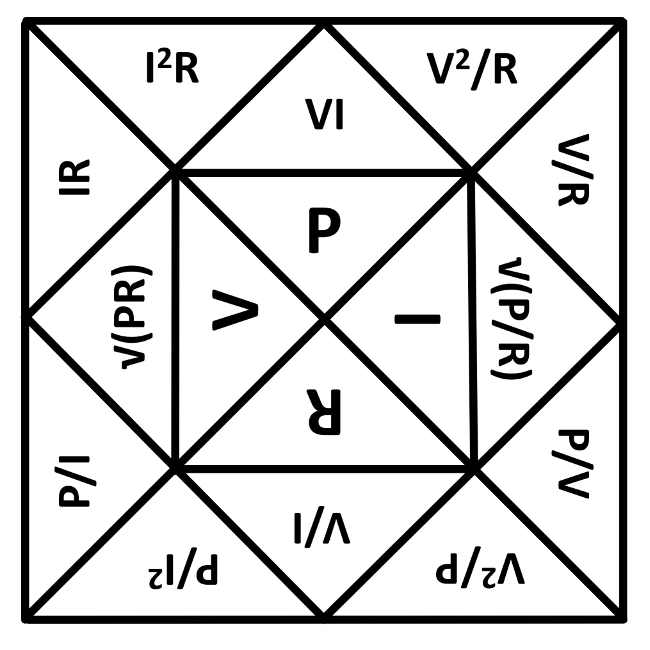
Unfortunately it has finally come to this: enter the sixteenfolds!

  • Voltage = V = P/I = sqrt(P·R) = I·R
  • Resistance = R = V^2/P = V/I = P/I^2
  • Current = I = V/R = sqrt(P/R) = P/V
  • Power = P = I^2·R = V·I = V^2/R

Further Reading:

https://en.wikipedia.org/wiki/Ohm%27s_law

Ohm’s Law

[*8.4, *8.5, *8.8-8.10, *10.62, *10.112]

<>