Category Archives: mythology

The Four Evangelists

Further Reading:

https://en.wikipedia.org/wiki/Four_Evangelists

Brief History of the Analogy of the Four Evangelists to the Four Living Creatures

Behold, the Tetramorph

Exuberant Hungarian: The Art of Matthias Church, Budapest

https://artmuseum.princeton.edu/art/collections/objects/33564

Essay on the Four Evangelists written by Claude.AI:

https://claude.ai/public/artifacts/d727367e-e9be-4087-b0e3-d5d1ee9d4c9d

https://en.wikipedia.org/wiki/Synoptic_Gospels

<>

The Golden Touch

Not everything that is golden is to be desired. Sometimes gold can represent greed or excess in itself, the corruption that wealth and power can bring. Gold has long been coveted by those of status; the legend of King Midas is a case in point. Everything he touched turned to gold, including his food and his daughter.

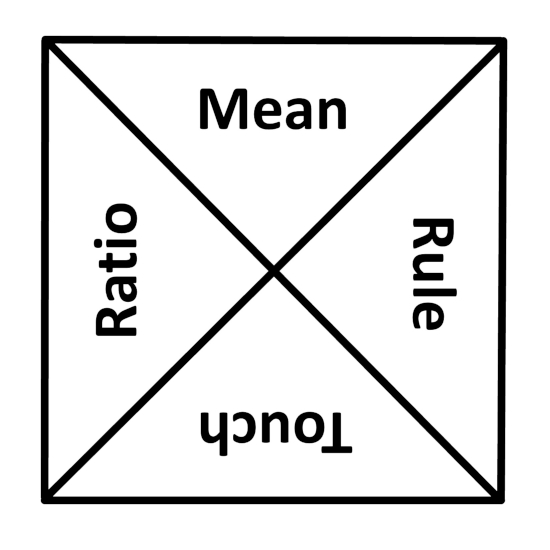
Golden items often figure into myths: the Golden Idol, the Golden Calf, the Golden Apples, the Golden Fleece, the Golden Hind, the Golden Ass. I have already talked about several golden concepts of ethics or morals, the Golden Mean and the Golden Rule. And the Golden Ratio is a valorized concept of geometry, art, and architecture.

So to round out (or square up) my golden theme, the Golden Touch may serve as my culmination. Other golden things can be brought to mind, but I settled on the concept of the title. The Golden Touch can be thought to represent the dark side of Gold!

Further Reading:

https://en.wikipedia.org/wiki/Midas

https://en.wikipedia.org/wiki/Golden_Idol

https://en.wikipedia.org/wiki/Golden_calf

https://en.wikipedia.org/wiki/Golden_Fleece

https://en.wikipedia.org/wiki/Golden_apple

https://en.wikipedia.org/wiki/The_Golden_Ass

https://en.wikipedia.org/wiki/Ceryneian_Hind

Essay written by Claude.AI about the negativities of gold.

https://claude.ai/public/artifacts/2ae11e87-3281-4319-95a3-54d3a87d9c8f

[*14.100]

<>

Hercules at the Crossroads

The story of Heracles (Hercules) at the Crossroads is one of the most profound and enduring moral allegories in ancient Greek mythology. This tale embodies the quintessential struggle between virtue and vice, encapsulating a universal theme that resonates across cultures and generations: the challenge of making life-defining choices. The allegory not only highlights the moral and ethical dimensions of human existence but also offers insight into the complexities of character development and the paths to true fulfillment.

The Story of Heracles at the Crossroads

The story originates from the ancient philosopher Prodicus and has been retold by various classical authors, including Xenophon. It describes a pivotal moment in the life of Heracles, the celebrated hero known for his exceptional strength and his legendary Twelve Labors. As the tale goes, when Heracles was a young man, he reached a crossroads where two goddesses appeared to him, each representing a different path.

One goddess, named Kakia (Vice), promised him a life of ease, luxury, and immediate gratification. She depicted a future filled with indulgence and comfort, free from hardship and struggle. Her voice was alluring, and her promises seemed tempting to a young man eager for enjoyment without toil.

The other goddess, Arete (Virtue), offered a starkly different vision. She spoke of a path defined by toil, sacrifice, and perseverance. Arete promised that while this path would be difficult and fraught with challenges, it would lead to true glory, respect, and lasting fulfillment. The road she offered was steep and treacherous, but it was the path that would bring out the best in Heracles.

Symbolism and Themes

At its core, Heracles at the Crossroads is rich in symbolism, encapsulating the eternal human conflict between short-term pleasures and long-term achievements. The two goddesses embody the dual aspects of human nature: the pull of immediate desires versus the pursuit of higher values and goals. Heracles’ choice is a metaphor for the decisions each person must make at critical junctures in their own lives.

Choosing Kakia’s path represents succumbing to the allure of ease and self-indulgence, which, although pleasant in the short term, ultimately leads to stagnation and dissatisfaction. Arete’s path, on the other hand, illustrates the rewards that come from embracing challenges and persisting in the face of adversity. The story implicitly teaches that true heroism is not found in physical feats alone but in the moral courage to choose the harder right over the easier wrong.

Heracles’ Decision and Its Consequences

Heracles’ choice to follow Arete, the path of Virtue, set the course for his legendary life. The decision signified his commitment to a life defined by effort and purpose. This choice not only elevated him to the status of a hero but also embedded in his narrative the idea that true greatness is achieved through perseverance and moral integrity. Each of Heracles’ subsequent labors—whether slaying the Nemean Lion, capturing the Golden Hind, or cleansing the Augean stables—became both a literal and figurative testament to the virtues he chose to uphold at the crossroads.

The allegory reinforces the notion that real fulfillment and glory are earned, not given. Heracles’ victories were the culmination of hard work, bravery, and self-sacrifice. His choice serves as a reminder that while the path of virtue may be difficult, it is ultimately the most rewarding. This lesson continues to inspire and provide moral guidance, encouraging individuals to strive for excellence even when the path is arduous.

Relevance in Modern Context

The themes of Heracles at the Crossroads are as relevant today as they were in ancient times. Modern society, with its constant barrage of instant gratification through technology and convenience, often mirrors Kakia’s promises. The pressures to seek out shortcuts to success, avoid discomfort, and chase fleeting pleasures are as powerful now as they were in the days of Heracles.

However, Arete’s message remains equally significant: true accomplishment and a meaningful life come from making choices that align with one’s values and principles, even if those choices are demanding. Whether it is pursuing a challenging career path, maintaining integrity in difficult situations, or dedicating oneself to a cause greater than personal gain, the allegory of Heracles’ choice continues to resonate as a symbol of the importance of resilience and moral strength.

Conclusion

The story of Heracles at the Crossroads is an enduring allegory that imparts the timeless lesson of choosing virtue over vice. Heracles’ decision to follow the path of Arete over Kakia not only laid the foundation for his legendary status but also provided a model of moral fortitude that continues to inspire countless generations. In every crossroads that life presents, the essence of this myth invites individuals to choose not just the path of least resistance but the one that leads to true fulfillment and greatness. It reminds us that while the path of virtue may be steep and challenging, it is ultimately the path that shapes heroes.

Thanks again, ChatGPT! I admit that I hesitated to share this little article of yours, but I thought it was worthwhile and thought others might appreciate it as well. However, perhaps I’m choosing the path of ease in asking for your help, instead of the chore of writing this essay myself.

Futher Reading:

https://en.wikipedia.org/wiki/Hercules_at_the_crossroads

https://en.wikipedia.org/wiki/Kakia

https://en.wikipedia.org/wiki/Arete

Hercules at the Crossroads

Images of Hercules at the Crossroads

Also, music!

<>

Four Labyrinths of Antiquity

The concept of the labyrinth is deeply embedded in the cultural and mythological fabric of ancient civilizations, serving as symbols of mystery, complexity, and spirituality. Among the most notable labyrinths from antiquity are those attributed to Egypt, Lemnos, Crete, and Etruria. Each of these labyrinths holds a unique place in history, reflecting the values, beliefs, and ingenuity of the cultures that created them. This essay explores these four legendary labyrinths, delving into their historical significance and the enduring legacy they have left behind.

The Egyptian Labyrinth

The Egyptian labyrinth, known as the Labyrinth of Hawara, is perhaps the most renowned of antiquity, praised by ancient historians such as Herodotus and Strabo. Located near the Faiyum Oasis, this grand architectural feat was constructed during the reign of Pharaoh Amenemhat III (circa 19th century BCE) as part of his funerary complex. According to Herodotus, this structure was more awe-inspiring than the Pyramids themselves, containing a staggering array of interconnected rooms, chambers, and passageways.

The labyrinth’s primary purpose was multifaceted, serving both as a temple dedicated to the gods and a tomb for the pharaoh. It was designed not only to showcase the architectural prowess of the Egyptians but also to protect the sacred relics and treasures buried within. The exact structure and layout of the labyrinth remain elusive, as it has largely been lost to time, but archaeological findings and descriptions suggest an intricate series of corridors and chambers that defied easy navigation. This labyrinth symbolized the journey of the soul through the underworld, embodying themes of life, death, and rebirth that were central to ancient Egyptian belief.

The Labyrinth of Lemnos

The labyrinth on the Greek island of Lemnos is shrouded in mystery, with fewer concrete records compared to its Egyptian counterpart. Lemnos was an important center in the ancient world, linked to myths involving Hephaestus, the god of fire and craftsmanship, who was believed to have been cast down to the island by Zeus. While historical details about a physical labyrinth on Lemnos are scarce, references suggest that it may have had both ritualistic and symbolic purposes.

One of the prevailing theories is that the labyrinth of Lemnos was linked to initiation rites or ceremonial dances performed in honor of deities, particularly those associated with fertility and rebirth. The labyrinth motif in Lemnian culture may also have represented the dualities of life, such as order and chaos, creation and destruction. The idea of a labyrinth as a journey, both physical and spiritual, is consistent with the widespread motif in Mediterranean civilizations of navigating through challenges to attain wisdom or transcendence.

The Cretan Labyrinth

The labyrinth of Crete is arguably the most famous, primarily due to its association with Greek mythology. According to legend, it was constructed by the master craftsman Daedalus at the behest of King Minos of Crete. The purpose of this labyrinth was to contain the Minotaur, a half-man, half-bull creature born from the union of Queen Pasiphaë and a divine bull. The structure was said to be so complex that even its creator, Daedalus, could barely navigate it without assistance.

The myth of Theseus and the Minotaur is central to the legacy of the Cretan labyrinth. According to the story, Athens was required to send young men and women as tribute to be sacrificed to the Minotaur. Theseus, the Athenian hero, volunteered to face the creature and, with the aid of Minos’ daughter Ariadne, who provided him with a thread to retrace his steps, he successfully navigated the labyrinth, killed the Minotaur, and escaped. This myth has resonated through the ages as a tale of bravery, cleverness, and triumph over monstrous challenges.

Archaeological evidence points to the Palace of Knossos as the potential origin of the labyrinth legend. Located near the modern city of Heraklion, Knossos was the largest Bronze Age archaeological site on Crete and is associated with the Minoan civilization. The sprawling layout of the palace, with its maze-like corridors and numerous rooms, likely inspired the myth. The labyrinth of Crete embodies themes of entrapment and liberation, encapsulating the dualities of power and vulnerability.

The Etruscan Labyrinth

The Etruscan civilization, which flourished in what is now modern-day Italy before being absorbed by the Roman Empire, also had its own labyrinth traditions. While not as widely known as the Egyptian or Cretan examples, Etruscan labyrinths have been found depicted in art and inscriptions, suggesting that they held cultural significance. One of the most compelling examples is found in the depictions of labyrinths carved into tomb walls and artifacts. These labyrinths were often associated with funerary practices, symbolizing the journey of the soul through the underworld and the challenges faced before reaching the afterlife.

The labyrinth in Etruscan tradition may have served a protective role, intended to guard the deceased against malevolent spirits and ensure safe passage to the afterlife. The Etruscan belief system, rich with mythology and rituals connected to death and rebirth, incorporated the labyrinth as a powerful symbol of transformation. It represented both a barrier and a path, encapsulating the paradoxes of life and death, hope and despair.

The Enduring Legacy of the Labyrinths

The labyrinths of antiquity were more than just architectural wonders; they were profound symbols imbued with deep cultural, spiritual, and philosophical meanings. Whether serving as metaphors for the soul’s journey, representations of cosmic order, or embodiments of human ingenuity and mystery, each of these labyrinths reflected the values and beliefs of the civilizations that created them. The Egyptian labyrinth was a testament to the grandeur of religious devotion and the pharaoh’s divine protection. The labyrinth of Lemnos, though more enigmatic, suggested themes of ritual and communal celebration. Crete’s labyrinth told a story of heroism and intellect overcoming monstrous obstacles, while the Etruscan labyrinths reflected the culture’s intricate relationship with death and the afterlife.

These ancient labyrinths have influenced countless generations, inspiring literature, art, and modern interpretations of mazes and labyrinthine structures. Today, labyrinths continue to be used as tools for meditation and introspection, echoing their original purposes of guiding individuals on a journey—whether spiritual, physical, or metaphorical. The labyrinths of antiquity remain powerful reminders of humanity’s enduring quest for meaning, order, and transcendence.

Thank you ChatGPT. I was having difficulty getting started again with my blog after taking so much time off. I’m not sure everything is accurate in your essay, but I think it’s generally correct.

Further reading:

https://en.wikipedia.org/wiki/Labyrinth

https://www.perseus.tufts.edu/hopper/text?doc=Perseus%3Atext%3A1999.02.0137%3Abook%3D36%3Achapter%3D19

https://www.labyrinthpark.gr/en/history-of-labyrinth

Penelope Reed Doob / The Idea of the Labyrinth from Classical Antiquity through the Middle Ages
Open access at :
https://www.jstor.org/stable/10.7591/j.ctvn1t9v6

W. H. Matthews / Mazes and Labyrinths: Their History and Development

http://www.ams.org/publicoutreach/feature-column/fc-2015-10

53. An eternal way of confusion


<>
The Wind’s Twelve Quarters

From far, from eve and morning
And yon twelve-winded sky,
The stuff of life to knit me
Blew hither: here am I.

Now — for a breath I tarry
Nor yet disperse apart —
Take my hand quick and tell me
What have you in your heart.

Speak now, and I will answer;
How shall I help you, say;
Ere to the wind’s twelve quarters
I take my endless way.

— “From Far” (A Shropshire Lad), by A. E. Housman

The Rose of the Twelve Greek Winds:

  • Thrascias
  • Aparctias
  • Boreas
  • Caecias
  • Apeliotes
  • Eurus
  • Euronotos
  • Notos
  • Libonotos
  • Lips
  • Zephyrus
  • Argestes

Further Reading:

https://en.wikipedia.org/wiki/Classical_compass_winds

https://en.wikipedia.org/wiki/The_Wind%27s_Twelve_Quarters

https://en.wikipedia.org/wiki/A_Shropshire_Lad

https://en.wikisource.org/wiki/A_Shropshire_Lad/XXXII

https://en.wikipedia.org/wiki/Anemoi

https://www.greekmythology.com/Other_Gods/Anemoi/anemoi.html

https://www.theoi.com/Titan/Anemoi.html

[*12.9]

<>

Ouroboros

Lo! ’t is a gala night
Within the lonesome latter years!
An angel throng, bewinged, bedight
In veils, and drowned in tears,
Sit in a theatre, to see
A play of hopes and fears,
While the orchestra breathes fitfully
The music of the spheres.

— From The Conqueror Worm, by Edgar Allen Poe

The worm, turns.

Further Reading:

https://en.wikipedia.org/wiki/Ouroboros

https://www.poetryfoundation.org/poems/48633/the-conqueror-worm

https://en.wikipedia.org/wiki/The_Conqueror_Worm

https://en.wikipedia.org/wiki/Even_a_worm_will_turn

https://en.wikipedia.org/wiki/The_Worm_Ouroboros

[*12.64]

<>


The Canonical Formula of Myth

Further Reading:

Claude Lévi-Strauss / The Structural Study of Myth, The Journal of American Folklore, 68, 270, Myth: a symposium, American Folklore Society, http://www.jstor.org/stable/536768

https://www.webpages.uidaho.edu/~sflores/KlagesLevi-Strauss.html

https://www.webpages.uidaho.edu/~sflores/KlagesPoststructuralism.html

Lévi-Strauss’s ‘double twist’ and controlled comparison: transformational relations between neighbouring societies

Jack Morava / On the Canonical Formula of C. Lévi-Strauss, arXiv:math/0306174v2 (2003)

James B. Harrod / A post-structuralist revised Weil–Lévi-Strauss transformation formula for conceptual value-fields, November 2018, Sign Systems Studies 46(2/3):255

Jean-Loïc Le Quellec, Marc Thuillard / A phylogenetic interpretation of the canonical formula of myths by Levi-Strauss, December 2016

Mark S. Mosko / The Canonic Formula of Myth and Nonmyth, American Ethnologist, Feb., 1991, Vol. 18, No. 1 (Feb., 1991), pp. 126-151, http://www.jstor.com/stable/645568

[*9.128, *12.64]

<>

Tanabata, V2

Soon it will be Tanabata (七夕) in Japan on July 7th.

Make a wish!

  • Orihime : Vega
  • Hikoboshi : Altair
  • Bridge of Birds : Deneb
  • Silver River : Milky Way

Further Reading:

https://en.wikipedia.org/wiki/Tanabata

http://www.iromegane.com/japan/make-a-wish-for-tanabata/

https://en.wikipedia.org/wiki/Summer_Triangle

[*10.48, *11.114]

<>

The Hero’s Journey

Professor of Literature Joseph Campbell [1] popularized the monomyth of the “hero’s journey” [2], a recurring template for the plot arc or cycle of many heroic characters found in mythologies and even popular modern stories. From his most famous book, “The Hero with a Thousand Faces”:

A hero ventures forth from the world of common day into a region of supernatural wonder: fabulous forces are there encountered and a decisive victory is won: the hero comes back from this mysterious adventure with the power to bestow boons on his fellow man. [3]

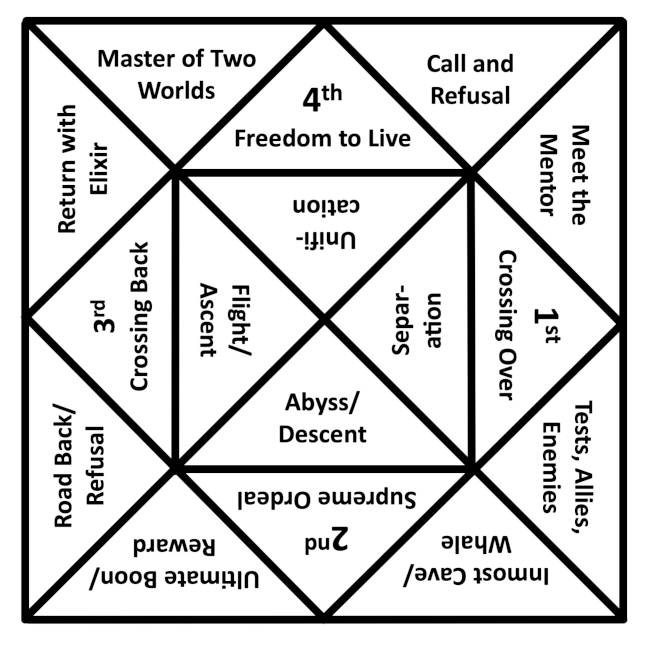
Quite a few diagrams are available showing the generic journey of the hero or heroine; some are more complete than others, and the one I present here is no exception. Campbell’s schema is said to have seventeen basic parts to it, but not all elements need to be present in any specific narrative. I list four basic “acts” (separation, descent, ascent, unification) and twelve basic events, including four thresholds: 1st) crossing into the special world, 2nd) surmounting the supreme ordeal, 3rd) returning to the normal world, and 4th) journey’s end and / or beginning.

  • Call and Refusal
  • ——–< Separation >
  • Meet the Mentor
  • Crossing Over (1st Threshold)
  • Tests, Allies, Enemies
  • ——–< Into the Abyss / Descent >
  • Inmost Cave / Whale Belly
  • Supreme Ordeal (2nd Threshold)
  • Ultimate Boon / Reward
  • ——–< Magic Flight / Ascent >
  • Road Back / Refusal
  • Crossing Back (3rd Threshold)
  • Return with Elixir / Resurrection
  • ——–< Unification >
  • Master of Two Worlds
  • Freedom to Live (or Die) (4th Threshold)

Any hero’s journey must be transformational, and so has associations with alchemical change. It must be of such difficulty that it utterly changes the nature and the mindset of the traveler. Even though many supporting characters may influence, help, and even hinder our hero, it is ultimately about their journey, their sacrifice, and their reward. But what the hero brings back with them is also key to the story, because it is for the benefit of others as well as for themselves.

An interesting dissertation by Richard Warm that I ran across recently proposes that leaders, like heroes, need ordeals and trials in order to bring back the inspiration and wisdom to motivate others. From the abstract:

This dissertation will explore leadership as a mytho-poetic transformational journey toward self-knowledge, authenticity, and ultimately wisdom; the power to make meaning and give something back to the world in which we live; and the necessity of transformation. I view leadership as a transformative process and a transformational responsibility. As leaders we must undergo our own transformation in order to lead change on a larger scale. The dissertation will be both philosophical and theoretical, exploring how the threads of the hero’s journey, transformation, wisdom, and leadership intertwine. …[4]

These ordeals may also be of an intellectual or moral kind, and not just feats of strength or stamina, although those are important too. Warm also has a company [5] for coaching you on your leadership, life, and legacy.

One of my favorite books that I think of when the hero’s journey comes to mind is “Figures of Earth: a comedy of appearances” by James Branch Cabell. It is a bit of a spoof on fantasy tropes, well before its time. However, I’m not quite sure what the “magic elixir” is that the hero returns with except for his story: that life is what you make of it, or what it appears to be to others, or what you can convince yourself that it is, or that it is what it is and must be sufficient to you in the end.

References:

[1] https://en.wikipedia.org/wiki/Joseph_Campbell

[2] https://en.wikipedia.org/wiki/Hero%27s_journey

[3] Joseph Campbell / The Hero with a Thousand Faces

[4] https://aura.antioch.edu/etds/113/

[5] https://mythoscoaching.com/

Further Reading:

https://tvtropes.org/pmwiki/pmwiki.php/Main/TheHerosJourney

http://www.movieoutline.com/articles/the-hero-journey-mythic-structure-of-joseph-campbell-monomyth.html

https://en.wikipedia.org/wiki/Figures_of_Earth

“There are one or two things that I do not fancy the looks of in this torture-chamber.”

[*6.38, *6.133, *6.149, *9.200, *11.70]

<>

Behold, the Tetramorph

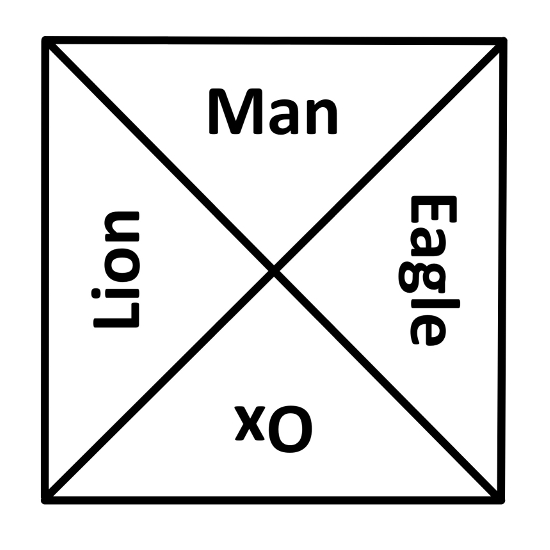
I’ve felt a fondness for the Tetramorph for a long time. Four beings considered simultaneously: a man, an ox, a lion, an eagle.

They are the Babylonian symbols of the four fixed signs of the zodiac: ox or bull for Taurus (and earth), lion for Leo (and fire), eagle for Scorpio (and water), man for Aquarius (and air).

They can be thought of as representing the ancient four elements: earth, fire, water, and air.

They are mentioned in the Judeo-Christian Bible in the books of Ezekiel and Revelation. They have also been paired with the four evangelists and their books: Matthew, Mark, Luke, and John (although the pairing is not fixed).

They are shown on the Tarot card for the “Wheel of Fortune” in the Rider-Waite deck, and the card for the “World” in the Tarot of Marseilles.

Why these four creatures, and not others?

Further Reading:

https://en.wikipedia.org/wiki/Tetramorph

The Tetramorph; The Sumerian Origins of a Christian Symbol

Sacred Symbols: The Four Evangelists (Tetramorph)

Under The Sign Of Tetramorph

https://en.wikipedia.org/wiki/Astrology_and_the_classical_elements#Elements_of_the_zodiac

44. The Tetramorph and more

[*8.38, *8.96]

<>