Category Archives: fourfolds

Richard McKeon’s Aspects of Knowing, Part 2

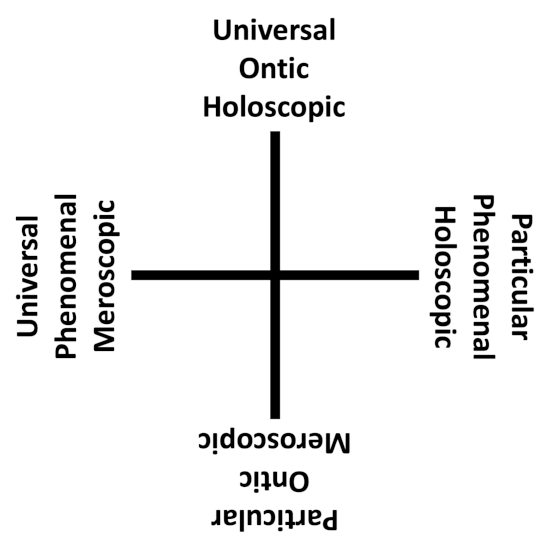
The duals in Richard McKeon’s system of Philosophical Semantics can also be arranged in a three-dimensional tetrahedron, where the dual pairs are on opposing edges. The universal and particular methods, the phenomenal and ontic interpretations, and the meroscopic and holoscopic principles are shown above.

Universal methods, between knower and knowledge, are applicable to all problems and all subject matters. Particular methods, between the knowable and the known, require distinct methodological procedures for different problems or subject matters.

Holoscopic principles, looking at or seeing the whole, provide a coincidence of knowledge and known. Meroscopic principles, looking at or seeing the parts, separate the knower and the knowable from each other and from influence between each other.

Ontic interpretations, between the knowable and knowledge, derive their character from a reality assumed to transcend or to underlie phenomena and statements. Phenomenal interpretations, between knower and the known, may reduce reality and values to aspects or consequences of phenomena.

Alternatively, the four vertices of  knower, knowledge, known, and knowable can be labeled by their method, principle, and interpretation as shown below.

References:

http://www.richardmckeon.org/

http://en.wikipedia.org/wiki/Richard_McKeon

[*6.136]

<>

Graham Harman’s Quadruple Object

Graham Harman’s book The Quadruple Object is now available in English, and hopefully it will clarify some of the questions I have about his metaphysics. I have made an attempt at orienting his fourfold of real object, sensual object, real qualities, and sensual qualities with respect to the other fourfolds presented here. The fourfold object emerges from Harman’s analysis of Heidegger’s das Geviert.

Further Reading:

Graham Harman / Guerrilla Metaphysics: phenomenology and the carpentry of things

Graham Harman / Prince of Networks: Bruno Latour and metaphysics

Graham Harman / The Quadruple Object

<>

E. J. Lowe’s Four Category Ontology

References:

E. J. Lowe / The Four-Category Ontology: a metaphysical foundation for natural science

http://en.wikipedia.org/wiki/E.J._Lowe

https://ndpr.nd.edu/reviews/the-four-category-ontology-a-metaphysical-foundation-for-natural-science/

Lowe, Edward Jonathan

http://www.informationphilosopher.com/solutions/philosophers/lowe/

[*4.94, *6.98]

<>

John R. Searle’s Epistemological and Ontological Senses of Objective and Subjective

References:

John R. Searle / The Construction of Social Reality

http://lafavephilosophy.x10host.com/subjective_objective.html

[*5.198]

<>

Kolb’s Learning Cycle

There seems to be many different so-called learning cycles, but I think Kolb’s matches my other double duals most closely.

David A. Kolb / Experiential Learning : experience as the source of learning and development

References:

http://www.businessballs.com/kolblearningstyles.htm

[*6.38, *6.88, *6.134, *8.93]

<>


The Four Basic Electronic Components

A fourfold has recently been in the news. The physical realization of the memristor completes the four basic electronic components, along with the resistor, capacitor, and inductor. Theorized to exist since 1971, the memristor may revolutionize computational devices.

References:

http://en.wikipedia.org/wiki/Memristor

[*6.126-*6.128]

<>

A Story for Everyone

Wouldn’t it be nice if everyone had a common story we could all learn and share? A story about who we are, what we are, and maybe even a little about the how and the why. Could it be told in such a way that each of us could accept it as our very own? A film and companion book coming out soon will attempt just that, titled Journey of the Universe.

Previous books by Loyal Rue and Brian Swimme have tried to achieve this ideal. Swimme is involved in this new movie, and is the narrator. Rue’s book is a personal favorite. Astrophysicist Eric J. Chaisson has written many books on this topic. Their common theme is evolution, expanded from the biological to encompass the cosmos. Cosmic evolution, if you will.

Evolution merely means change over time, i.e. transformation. Most people agree that things have changed over time, but many disagree on how much, how long, and how come. How can we decide what information to accept, and what to reject? The great unifier of human knowledge is science, yet science is often disparaged even while making the modern world possible. Partially, I’m sure, for that very reason.

Different cultures have had their own creation stories since the very beginning of humanity. Many have said that a large part of being human is the impulse to tell and the need to hear stories. All narratives are built from atomic parts that answer questions: who, what, how, and why. Or, to cast them into modal verbs: may, can, must, and should. Who may? Intention or agency: the characters. What can? Chance or contingency: the setting. How must? Structure or necessity: the plot. Why should? Obligation or responsibility: the theme.

Would a story simplistic enough for everyone to accept be so dilute as to be worthless? All life as we know it requires water, and pure water is ultimately ‘diluted’. But water is certainly not worthless. Daniel Dennett calls the concept of evolution the ‘universal acid’, an alchemical alkahest. Can we replace the corrosive acid in his metaphor with sustaining and nurturing water?

http://www.npr.org/blogs/13.7/2011/03/31/135008214/journey-of-the-universe-the-challenge-of-telling-everybodys-story

http://www.journeyoftheuniverse.org/

Loyal Rue / Everybody’s Story: Wising Up to the Epic of Evolution

Brian Swimme / The Universe Story: From the Primordial Flaring Forth to the Ecozoic Era–A Celebration of the Unfolding of the Cosmos

Daniel Dennett / Darwin’s Dangerous Idea: evolution and the meaning of life

Eric J. Chaisson / Epic of Evolution: seven ages of the cosmos

Marjolein Groefsema / Can, May, Must and Should: A Relevance Theoretic Account, in Journal of Linguistics, Vol. 31, No. 1 (Mar., 1995), pp. 53-79

<>

J.-Y. Girard’s Linear Logic

Linear logic is a substructural logic invented (or discovered, if you’re a Platonist) by logician Jean-Yves Girard. Many other logics can be embedded into it, including classical and intuitionistic logic, so in a sense it is a “logic behind logic”. Linear logic can be partially derived from the rejection of the structural rules of weakening and contraction, the first of which adds arbitrary propositions and the second reduces duplicated propositions to single occurrences. Due to these changes in the logical rules, logic is transformed from being transcendental (truth transcends its use) to pragmatic or materialistic (truth is restricted by use). Therefore linear logic can be given a “resource interpretation” that makes it a logic not of truth but of things: producing and consuming, giving and taking, pushing and pulling, like the desiring machines of Deleuze and Guattari (see Hjelmslev’s Net).

The fragment of linear logic I show here is called MALL, for Multiplicative-Additive Linear Logic. The two exponentials that interconvert additive and multiplicative operations are not shown, which also allow for the weakening and contraction rules to be reintroduced.

Note that the two additive operations allow for propositions to be created and destroyed and the two multiplicative operations contain exactly the same propositions. One could say the additive operations allow for change, and the multiplicative operations allow for bearing. In the resource interpretation, note that additive disjunction () is creative and additive conjunction (&) is destructive. Both additive conjunction (&) and multiplicative disjunction () are reversible, whereas additive disjunction () and multiplicative conjunction () are irreversible.

Linear logic was a major inspiration for naming this blog “Equivalent Exchange” (see Introduction), since it is a logic of production and consumption. Linear implication, written as A –o B (and equivalent to A B), can be thought of as exchanging A for B.

Linear logic has also been adopted as the logic for “radical anti-realism”. How can it have both a physicalistic interpretation, and yet describe an anti-realism more radical than ordinary anti-realism? I will need further study to understand these claims.

References:

http://en.wikipedia.org/wiki/Linear_logic

http://plato.stanford.edu/entries/logic-linear/

[*5.68-*5.70]

<>

The Tetralemma and Semiotic Square

The Tetralemma is a list that is supposed to exhaust all logical possibilities. Something is either X, or not X, or both X and not X, or neither X nor not X. Nagarjuna’s Fourfold Negation expresses a paradox by negating the Tetralemma, and asking what is not X, nor not X, nor both X and not X, nor neither X nor not X.

The Semiotic Square is an analytical tool to explore relationships between two semiotic signs, usually considered opposites of each other. The S1 and S2 in the figure are the signs in opposition, so that S2 is the dual of S1. S1+~S2 (S1 and not S2) would be X, ~S1+S2 would be not X, S1+S2 would be both X and not X, and ~S1+~S2 would be neither X nor not X.

References:

http://en.wikipedia.org/wiki/Tetralemma

http://en.wikipedia.org/wiki/Semiotic_square

[*4.84, *5.182]

<>

Richard McKeon’s Aspects of Knowing

Richard McKeon’s system of Philosophical Semantics arises from the sixteen pairwise and ordered relations between his four aspects of knowing or cognates: knower, knowledge, the known, and the knowable. These sixteen relations can be sorted in four groups of four elements each: methods, interpretations, principles, and selections.

Between knower and knowledge, and between the knowable and the known, arise the four methods of two each: the universal and the particular.

  • From knower to knowledge, the operational method.
  • From knowledge to knower, the dialectical method.
  • From the knowable to the known, the logistic method.
  • From the known to the knowable, the problematic method.

Between knower and the known, and between the knowable and knowledge, arise the four interpretations of two each: the phenomenal and the ontic.

  • From knower to the known, the existential interpretation.
  • From the known to knower, the essential interpretation.
  • From the knowable to knowledge, the entitative interpretation.
  • From knowledge to the knowable, the ontological interpretation.

Between knower and the knowable, and between knowledge and the known, arise the four principles of two each: the meroscopic and the holoscopic.

  • From knower to the knowable, the actional principle.
  • From the knowable to knower, the simple principle.
  • From knowledge to the known, the comprehensive principle.
  • From the known to knowledge, the reflexive principle.

Between each of the aspects of knowing with itself, arise the four selections.

  • From knower to itself, the perspectival selection.
  • From knowledge to itself, the transcendental selection.
  • From the knowable to itself, the reductive selection.
  • From the known to itself, the functional selection.

Each method can be associated with a discursive process: operational with debate, dialectical with dialogue, logistic with proof, and problematic with inquiry. Each method is also associated with a mode of thought which in turn has two moments and one dependency or assumption: the operational method is debate by discrimination and postulation dependent on chosen theses, the dialectical method is dialogue by assimilation and exemplification dependent on changeless models, the logistic method is proof by construction and decomposition dependent on indivisible constituents, and the problematic method is inquiry by resolution and question dependent on discoverable causes.

References:

Richard McKeon / On Knowing–The Natural Sciences

Richard McKeon / Freedom and History and Other Essays: an introduction to the thought of Richard McKeon

Sadly, the following pages are no longer available:

http://net-prophet.net/mckeon/mckeon.htm

http://forums.abrahadabra.com/showthread.php?2331-Unifying-Astrology-and-I-Ching

[*4.47, *5.184-*5.187, *6.20, *6.106]

<>