Category Archives: fourfolds

The Archic Philosophers

In a word, the Sophist begins from man, the Democritean from matter, the Platonist from form, and the Aristotelian from functioning.

— From The Architectonics of Meaning, by Walter Watson

Inspired by philosopher Richard McKeon, I believe that philosophy as a whole is encompassed by four main philosophical stances, exemplified by four ancient philosophers: the Sophists (as a group), Democritus, Plato, and Aristotle. Their four systems of thought lay out principal philosophical directions, much like the compass directions east, south, north, and west lay out a complete set of primary directions.

Of course the compass directions can be subdivided into north-east, or south-south-west, and so on, and similarly each of these philosophical systems can be divided into four parts. This division into a four-by-four matrix is called the Archic Matrix and was written about at length in the separate but complementary works of Walter Watson and David Dilworth.

Watson and Dilworth described the four main philosophical directions to be perspective, reality, method, and principle: perspective for the Sophists, reality for Democritus, method for Plato, and principle for Aristotle. I have written about these philosophical perspectives previously in several ways.

Thus philosophy as a practice goes around and around and revisits the same ideas over and over. Perhaps McKeon thought his philosophical system followed in the footsteps of Aristotle, and probably Watson and Dilworth had a similar view.

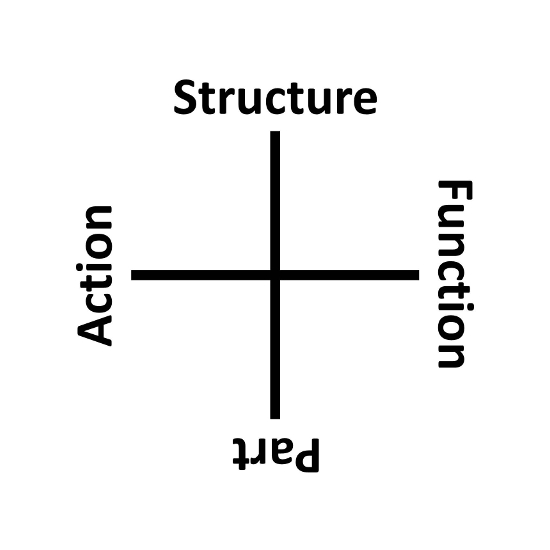
Likewise, I believe that my fourfold of Structure-Function represents these four philosophical directions in the following way: Action(s) for the Sophists, Part(s) for Democritus, Structure for Plato, and Function for Aristotle.

[*6.108]
<>


The Duality of Time and Information, V2

The states of a computing system bear information and change time, while its events bear time and change information.

from The Duality of Time and Information by Vaughan Pratt

The most promising transformational logic seems to us to be Girard’s linear logic.

— from Rational Mechanics and Natural Mathematics by Vaughan Pratt

Here we have three duals: information – time, state – event, and bear – change.

References:

Vaughan Pratt / The Duality of Time and Information http://boole.stanford.edu/pub/dti.pdf

Vaughan Pratt / Time and Information in Sequential and Concurrent Computation http://boole.stanford.edu/pub/tppp.pdf

Vaughan Pratt / Rational Mechanics and Natural Mathematics http://chu.stanford.edu/guide.html#ratmech

[*5.170]

<>

Wheel of Fortuna

O Fortune, like the moon you are changable,
ever waxing and waning, hateful life,
first oppresses and then soothes as fancy takes it;
poverty and power it melts them like ice.

— From Carmina Burana

References:

http://en.wikipedia.org/wiki/Carmina_Burana

http://en.wikipedia.org/wiki/Carmina_Burana_%28Orff%29

http://en.wikipedia.org/wiki/Rota_Fortunae

http://quadriformisratio.wordpress.com/2013/07/01/the-rule-of-four/

[*7.156]

<>

Falls the Shadow

Between the idea
And the reality
Between the motion
And the act
Falls the Shadow

— From “The Hollow Men” by T. S. Eliot

References:

http://en.wikipedia.org/wiki/The_Hollow_Men

https://allpoetry.com/the-hollow-men

[*7.158]

<>


The Space-Time Tetrahedron

In honor of April Fool’s Day, I present the Space-Time Tetrahedron.

The Internet is full of crackpot and nutty websites, and one of the most famous concerns the so-called Time Cube.

Since the ideas expressed on this website are pretty much ignored, it is hoped that it could at least find some recognition as being slightly crackpot or somewhat nutty.

Let’s examine the similarities between Time Cube theory and my theory.

The number four is very important in each. In fact, the Time Cube is a fourfold, although quite a puzzling one.

The notions of space and time are crucial to Time Cube; many of my fourfolds involve some aspect of space and time or spacetime.

How about the differences? I don’t think one can find any common claims between the two theories. At least I hope not!

References:

http://en.wikipedia.org/wiki/Time_Cube

http://knowyourmeme.com/memes/the-time-cube

[*7.150]

<>

The Four Treasures, Part 3

What else has Four Treasures? Interestingly, calligraphy and painting in Chinese and other East Asian traditions calls four important tools the “Four Treasures of the Study”. The ink stone, the ink stick, the paper, and the brush are these four treasures or jewels.

References:

http://en.wikipedia.org/wiki/Four_Treasures_of_the_Study

[*7.158]

<>


The Four Treasures, Part 2

I refute it thus!

— Samuel Johnson

This famous quote from Samuel Johnson was the verbal part to his simple refutation of George Berkeley’s idealism, whose gestural accompaniment was the kicking of a large stone to demonstrate its raw physicality. The ‘thusness’ of the stone is in contrast to the gyrations and perambulations that idealists perform to unmake the stone into mere phenomenal sensation and/or mental or social constructions.

Sure, the stone is mysterious. It is hard to the touch and opaque to vision. Physics demonstrates to us that the atoms that constitute it are almost all empty space. Geology explains to us that stones come in many different varieties, with many different chemical components. What you and I call a stone can completely differ, but usually not. Many tiny stones can make up a seashore, or many large ones a world. One stone usually is as good as another, unless you are trying to build a wall, select a king, or decorate yourself with shiny ones.

A specific legendary stone is one of the Four Treasures of Ireland. The other treasures are a special spear, an esteemed sword, and a distinguished cauldron, all whose unique qualities will not be described. But consider the general features of each item in relation to the Archic Matrix and the four operators of Linear Logic.

The spear is an extention of the pointing finger. The act of pointing is indication, selection, choice, and direction. The spear can be used to pierce, or to combine by piercing multiple items as on a shish-kabob. It is the treasure of perspective. Thus it represents Linear Logic’s with.

The sword is useful for piercing, but its chief purpose is to cleave and divide. It creates space between two parts of something, often at their structural joints where they are weakest. It is the treasure of method. Thus it represents Linear Logic’s par.

The basin or cauldron is for sorting and combining. The sorting is what goes into the cauldron and what remains outside. The combining is of everything in the cauldron in the proportions selected, for the desired functionality of the mixture. It is the treasure of principle. Thus it represents Linear Logic’s tensor.

The stone just is, and its uses have been listed above. Can we access the stone as it is given, the stone in itself? No, but that does not turn it into a ghost. It is the treasure of reality. Thus it represents Linear Logic’s plus.

<>


The Four Treasures of Ireland

In honor of St. Patrick’s Day, I present the Four Treasures of Ireland: the Spear, the Sword, the Cauldron, and the Stone.

The suits of Tarot Cards and Playing Cards are very similar to the Four Treasures. For Tarot, they are Wands, Swords, Cups, and Pentagrams. For Playing Cards, there are many variations, but the most common today are Clubs, Spades, Hearts, and Diamonds.

Treasures and suits are also tied to the four elements.

References:

http://en.wikipedia.org/wiki/Four_Treasures_of_the_Tuatha_D%C3%A9_Danann

http://en.wikipedia.org/wiki/Minor_Arcana

http://en.wikipedia.org/wiki/Suit_%28cards%29

http://en.wikipedia.org/wiki/Elidor

[*7.2, *7.54, *7.55]

<>

Kent Palmer’s Levels of Being

Another fourfold that transitions from simplicity to complexity. Similar to the Cynefin Framework and Bright to Dark.

References:

http://www.goertzel.org/books/wild/chap4fold.html

http://archonic.net/Lx01a14.pdf

[*7.76]

<>


My Dear Aunt Sally

When I took first year algebra in school, I learned the rule “My Dear Aunt Sally” as a mnemonic for the order of applying binary operations in algebraic expressions. “My Dear” meant to perform multiplication and division first. “Aunt Sally” meant to perform addition and subtraction next and last. Most of us have learned some variation of this rule. I see that it has now been enlarged to “Please Excuse My Dear Aunt Sally” to include parentheses and exponentiation, and to perform these two first before the original and now last four.

Why remark about this simplistic and even obsolete rule? Note the similarity between this fourfold of binary arithmetic operators and the four binary linear logic operators. In each there are two operators for increasing: addition and multiplication in arithmetic, and the disjunctive operators plus and par in linear logic. In each there are two operators for decreasing: subtraction and division in arithmetic, versus the conjunctive operators with and tensor in linear logic. In each there are two rules for attraction and two rules for repulsion.

In addition, the double duality of the four arithmetic operators is revealed, as in arithmetic addition and subtraction are duals, and multiplication and division are duals. In linear logic, with and plus are duals, and tensor and par are duals. Can arithmetic be simulated by linear logic, or vice versa? Is linear logic equivalently exchangable with arithmetic? I don’t think so but perhaps some expert can tell us.

References:

http://en.wikipedia.org/wiki/Order_of_operations

[*7.94]

<>