Category Archives: fourfolds

Knowledge and Its Limits

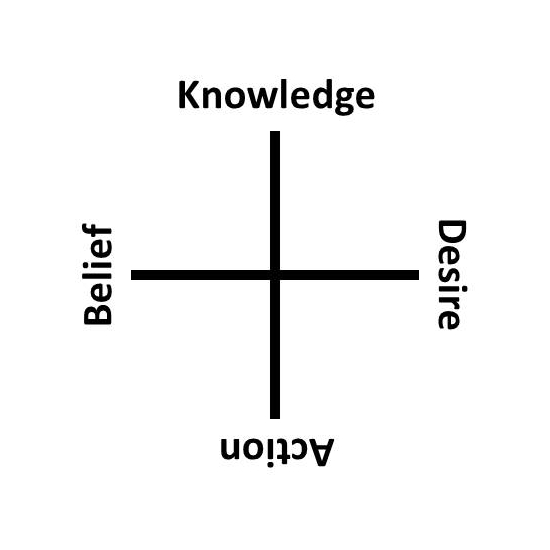
Knowledge and action are the central relations between mind and world. In action, world is adapted to mind. In knowledge, mind is adapted to world. When world is maladapted to mind, there is a residue of desire. When mind is maladapted to world, there is a residue of belief. Desire aspires to action; belief aspires to knowledge. The point of desire is action; the point of belief is knowledge.

— From Knowledge and Its Limits by Timothy Williamson

sq_knowledge_limits

Or with some substitutions:

Theory and practice are the central relations between the mental and the physical. In practice, the physical is shaped to the mental. In theory, the mental is shaped to the physical. When the physical is misshaped to the mental, there is a residue of intention. When the mental is misshaped to the physical, there is a residue of attention. Intention aspires to practice; attention aspires to theory. The point of intention is practice; the point of attention is theory.

sq_knowledge_limits2

Also, note the similarity to The Scientific Method.

Further Reading:

Timothy Williamson / Knowledge and Its Limits

[*6.24, *6.32, *8.22]

<>

The Noble Truths of Suffering

The Four Noble Truths of Suffering are:

  • Dukkha: the truth that suffering exists.
  • Samudaya: the truth that suffering has a beginning.
  • Nirodha: the truth that suffering can end.
  • Magga: the truth that there exists a path for the end of suffering.

Further Reading:

http://en.wikipedia.org/wiki/Four_Noble_Truths

[*8.24]

<>

Ægypt Tetralogy

AEgypt is a literary work by John Crowley consisting of four novels published over a period of twenty years. Each of the four books is divided into three parts, and the twelve parts are named after the astrological houses.

Many occult, alchemical, and esoteric themes run through the novels, and one might describe the work as being “magical realism”. Many of the magical elements are told as “a book within the book” about British occultist Doctor John Dee and Italian heretic Giordano Bruno. Even though some of the magical events occurring in the past and described within the novels seem to be actually magical, by the time the novels end the age of magic is now over, and the last magical event seemed to erase the fact that magic ever was.

The ending of the last book makes several references to Shakespeare’s “The Tempest”.

Further Reading:

http://en.wikipedia.org/wiki/%C3%86gypt

Some very useful reviews of the first three books can be found below.

http://watershade.net/wmcclain/jc-index.html

http://en.wikipedia.org/wiki/House_%28astrology%29

http://www.latimes.com/features/la-bkw-park7oct07,0,4224148.story#axzz2lmoAGKzp

http://www.latimes.com/features/la-bkw-park4nov04,0,6059163.story#axzz2lmoAGKzp

<>

The Medicine Wheel

The Native American Medicine Wheel is a symbol system that associates several fourfolds together, such as the Four Seasons, the Four Cardinal Directions, the Four Elements, etc. Another fourfold that does this is the Four Temperaments.

There should be a good word for this amalgamation of fourfolds into one hyper- or mega- or uber- fourfold. What about quadriphilia? No, that’s just love of fours, but it is in the Urban Dictionary. Quadrasyncretism? I like the neologism tetrasyncretism, from tetra meaning four, and syncretism, meaning combining different (or many) beliefs into one.

The aspect of the Medicine Wheel illustrated above is similar to the Four Temperaments.

The colors Red, White, Black, and Yellow are important for the Medicine Wheel. The colors often occur in a certain order within quadrants of the circle of the wheel. The colors also correspond to the Four Seasons: Black for Autumn, White for Winter, Yellow for Spring, and Red for Summer, although there can be other mappings.

These same four colors are also important in alchemy and represent stages of the Magnus Opus or Great Work, where Red is Rubedo or Iosis, White is Albedo or Leukosis, Black is Nigredo or Melanosis, and Yellow is Citrinitas or Xanthosis. The order is usually Black, White, Yellow, and then Red, through beginning to ending stages of the work.

In addition, the current anime RWBY has characters with these main costume colors. Apparently it is a story with some magic and much fighting with large weapons by four young women.

Further Reading:

http://en.wikipedia.org/wiki/Medicine_wheel

http://en.wikipedia.org/wiki/Magnum_opus_%28alchemy%29

http://en.wikipedia.org/wiki/Cardinal_direction

http://en.wikipedia.org/wiki/RWBY

Angeles Arrien / The Four-Fold Way: Walking the Paths of the Warrior, Teacher, Healer, and Visionary

Google search for images of the Medicine Wheel.

Google search for images of the Four Cardinal Directions.

[*7.194, *8.12]

<>


The Tempest and Forbidden Planet

To work mine end upon their senses that
This airy charm is for, I’ll break my staff,
Bury it certain fathoms in the earth,
And deeper than did ever plummet sound
I’ll drown my book.

Prospero from The Tempest

In times long past, this planet was the home of a mighty, noble race of beings who called themselves the Krell. Ethically and technologically they were a million years ahead of humankind, for in unlocking the mysteries of nature they had conquered even their baser selves, and when in the course of eons they had abolished sickness and insanity, crime and all injustice, they turned, still in high benevolence, upwards towards space. Then, having reached the heights, this all-but-divine race perished in a single night, and nothing was preserved above ground.

Dr. Morbius from Forbidden Planet


Further Reading:

http://en.wikipedia.org/wiki/The_Tempest

http://en.wikipedia.org/wiki/Forbidden_Planet

http://en.wikipedia.org/wiki/Return_to_the_Forbidden_Planet

https://grg.org/charter/Krell2.htm

[*7.154, *8.11]

<>

Complex Numbers and Quaternions

Two conceptualizations of four directions in mathematics are Complex numbers and Quaternions. For complex numbers, two of the directions are the opposite or negative of the other two. Complex numbers are like Cartesian coordinates in that they combine an (x,y) coordinate pair of real numbers into one complex number x + yi. Plus, complex numbers can by manipulated by extensions of arithmetic operations, like addition, subtraction, multiplication, and division.
Quaternions are an extension of the complex numbers where the directions are all different, and each direction is perpendicular to the other three. Like complex numbers are a notion of numbers that cover a plane, quaternions are a notion of number that fill four dimensional space. Thus they combine a 4-tuple (w,x,y,z) into one quaternion number w + xi + yj + zk. Like complex numbers, quaternions can be manipulated by further extensions of arithmetic operations.

http://en.wikipedia.org/wiki/Complex_number

http://en.wikipedia.org/wiki/Quaternion

[*7.189]

<>

Ohm’s Law

Charts for the equations of Ohm’s Law usually consist of the fourfold relation between Voltage (Volts), Current (Amps), Resistance (Ohms), and Power (Watts). For each electrical quantity, there are three equations that represent it in terms of two others, making twelve equations total.

Ohm’s Law is really only between voltage, current, and resistance. Apparently, power is more correctly introduced by the formula for “Joule heating”.

Both voltage and current have been in two fourfolds previously (Four Basic Electrical Components and System Dynamics) but not power and resistance. Well, resistance did make an appearance as a relation between current and voltage.

The twelve equations can be generated by the following identities (where E = voltage, I = current, R = resistance, and P = power):

I*R/E = P/(I*E) = P*R/E^2 = R*I^2/P = 1

http://en.wikipedia.org/wiki/Ohm%27s_law

http://en.wikipedia.org/wiki/Joule%27s_first_law

Google search for images for Ohm’s Law.

[*8.4, *8.5, *8.8, *8.9, *8.10]

<>


The Four Temperaments

What would a list of fourfolds be without mentioning the Four Temperaments: Sanguine, Choleric, Melancholic, and Phlegmatic?

Indeed, these personality types from ancient medicine and philosophy are still a source of classification and inspiration for modern psychology, even though the reasons for the differences (the four humors) has been discredited. The four humors were blood, yellow bile, black bile (they were big on bile), and phlegm, and were also related to the Four Seasons and the Four Elements.

Below is psychologist David Keirsey’s modernization of the four temperaments, consisting of Idealist, Artisan, Guardian, and Rationalist.

References:

http://en.wikipedia.org/wiki/Four_temperaments

http://en.wikipedia.org/wiki/Humorism

http://en.wikipedia.org/wiki/Myers-Briggs_Type_Indicator

http://en.wikipedia.org/wiki/David_Keirsey

http://en.wikipedia.org/wiki/Keirsey_Temperament_Sorter

https://en.wikipedia.org/wiki/The_Four_Temperaments_(ballet)

Images of the Four Temperaments.

[*6.122, *6.123, *7.194, *8.14, *8.94, *8.139]

<>


A Vision by W. B. Yeats: The Four Faculties

A Vision by W. B. Yeats is the focus of a large amount of scholarship for a book on the occult. It looks interesting as a source of metaphor and symbolism, and I hope to return to it at another time. There is an excellent website devoted to Yeat’s Vision, the link of which is below.

Above I show the fourfold of the Faculties: Will, Body of Fate, Mask, and Creative Mind. It is not arranged as recommended by the four elements, but by my whim.

I saw a preview of the recent movie “Kill Your Darlings” which mentioned A Vision and showed the woodcut of the Cosmic Wheel.

Further Reading:

http://en.wikipedia.org/wiki/A_Vision

http://www.yeatsvision.com/

Neil Mann, Matthew Gibson, and Claire Nally, eds. / Yeats’s “A Vision”: Explications and Contexts

https://academic.oup.com/liverpool-scholarship-online/book/43466#login-purchase

[*7.200]

<>


Modal Things

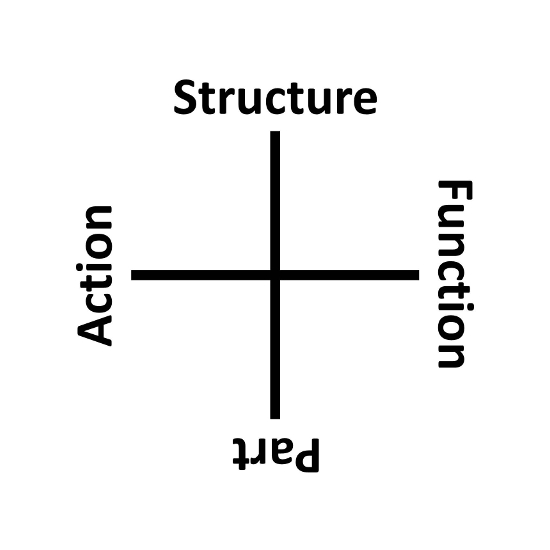
As a complementary fourfold to Things Happen, here is a combination of Structure-Function and Modal Verbs.

Actions may. Parts can. Structures must. Functions should.

Actions may occur. Parts can vary. Structures must maintain. Functions should perform.

[*7.192, *8.40]

<>