Category Archives: Esoteric

Geomancy

I’m not sure why I haven’t noticed the esoteric study of Medieval Geomancy before. There are 16 figures, each having four vertical binary digits of one or two dots, and there are several relationships between the figures, as well as arcane meanings. And there are quite a few introductions to the subject on the web, like many other occult topics have.

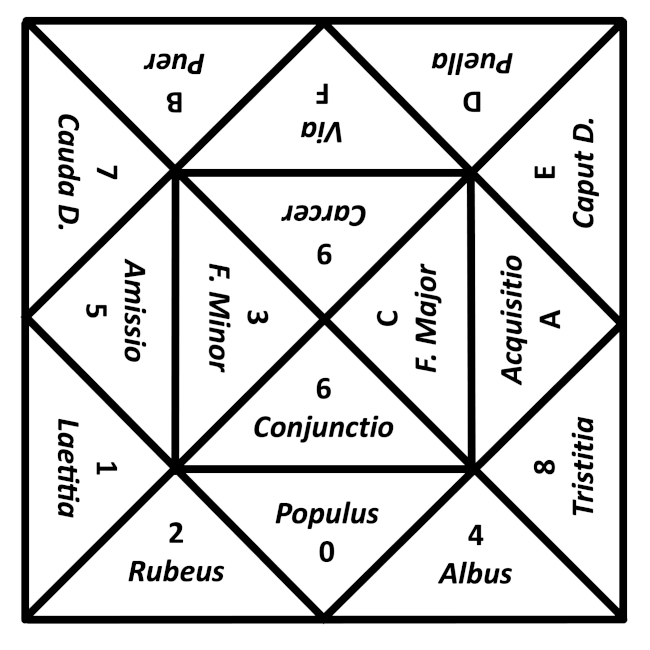
The figures are as follows (with the number explained below):

0 Populus (People)
1 Laetitia (Joy)
2 Rubeus (Red)
3 Fortuna Minor (Lesser)
4 Albus (White)
5 Amissio (Loss)
6 Conjunctio (Union)
7 Cauda Draconis (Head)
8 Tristitia (Sorrow)
9 Carcer (Prison)
A Acquisitio (Gain)
B Puer (Boy)
C Fortuna Major (Greater)
D Puella (Girl)
E Caput Draconis (Tail)
F Via (Path)

I think I have numbered them in reverse of what is usual, because to me it seemed that the top line Fire to be the most mobile, then Air, then Water, and then Earth to be the least. Thus Fire should change most frequently, and so on. A line with two dots is usually thought of as passive (0), and one dot is active (1).

And so I have numbered the 16 figures as a hexadecimal digit where Fire is in the one’s place, Air is in the two’s place, Water is in the four’s place, and Earth is in the eight’s place. For example, Puella is 1101 or D (decimal 13).

The arrangement of the figures on the diagram above has the so called Reversion of each being the one reflected through a vertical mirror, and the Inversion of each being the one reflected about the center point of the diagram. For example, the Reversion of Puella is Puer, and the Inversion of Puella is Rebeus.

There is also the operation of Conversion, or a combination of both Inversion and Reversion. Those associated figures are found via a horizontal mirror through the center point. Note also what are called the entering figures are on the right side, the exiting figures are on the left side, and the ones along the center are both entering and exiting.

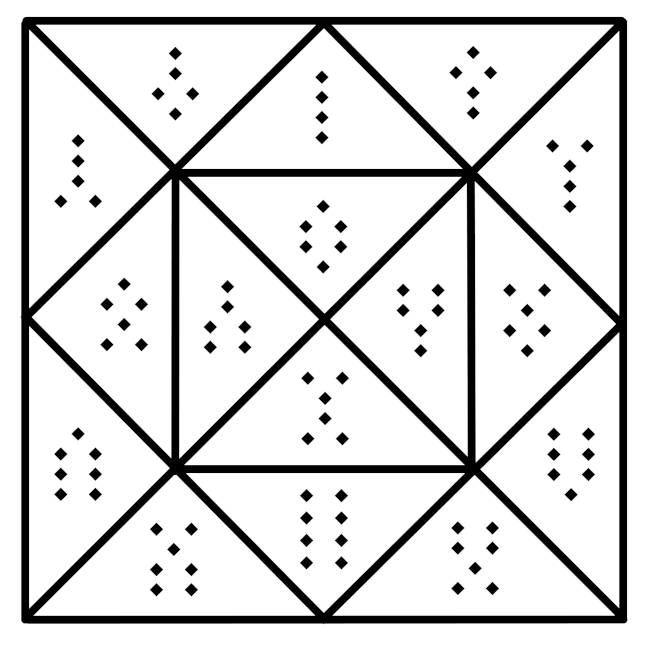
Finally, I couldn’t resist showing the figures as their dotted glyphs, but with them all oriented correctly (i.e. vertically). The diagram is more or less the same as the arrangement found in Four Forms Make a Universe, Part 2.

Further Reading:

https://en.m.wikipedia.org/wiki/Geomantic_figures

https://en.m.wikipedia.org/wiki/Geomancy

Fun With Geomancy, Part 1

Fun With Geomancy, Part 2

Fun With Geomancy, Part 3

https://www.princeton.edu/~ezb/geomancy/figures.html

https://www.princeton.edu/~ezb/geomancy/geostep.html

https://www.princeton.edu/~ezb/geomancy/agrippa.html

Magic: Learning Geomancy

http://www.quadibloc.com/other/geoint.htm

On the Structure and Operations of the Geomantic Figures

https://digitalambler.com/category/geomancy/

<>


Walter Bowman Russell (1871-1963)

Walter Bowman Russell was an American polymath, artist, author, and philosopher who made copious contributions and claims to various fields, including spirituality, art, and metaphysics. While his work encompasses a broad range of ideas, here are four major themes that capture the essence of his philosophy:

  • Universal Law and Natural Order: One of Russell’s central ideas is the existence of an underlying universal law and natural order that governs all aspects of the universe. He believed that this law operates in perfect harmony, and by understanding and aligning ourselves with it, we can achieve balance and fulfillment in our lives.
  • Unity and Interconnectedness: Russell emphasized the interconnectedness of all things in the universe. He saw everything as part of a grand, unified whole, where all elements are interdependent and interconnected. According to his philosophy, recognizing this interconnectedness enables us to grasp the fundamental unity of all existence.
  • Harmonic Vibrations and Rhythmic Balance: Russell believed that the universe is fundamentally vibrational in nature, with everything composed of waves and rhythms. He emphasized the importance of achieving harmony and balance within ourselves and in our interactions with the world around us. By attuning ourselves to the harmonies and rhythms of the universe, we can lead more fulfilling and purposeful lives.
  • The Power of Mind and Consciousness: Russell regarded the power of the human mind and consciousness as fundamental forces in shaping our reality. He believed that our thoughts and beliefs have the ability to create and influence the world we experience. According to his philosophy, by harnessing the power of our minds and cultivating a positive and constructive consciousness, we can achieve personal and collective transformation.

These four themes offer a glimpse into the multifaceted philosophy of Russell, often presented with his signature illustrations. However, it’s worth noting that Russell’s ideas encompass a vast array of subjects, including a non-standard physics and a spiritual cosmology, all interconnected through his unique perspective and understanding of the universe. Indeed, he was perhaps the first to endorse “new age” thought.

(Thanks, ChatGPT! I didn’t have the strength to read enough to write a quick summary. You were far less skeptical than I would have been, so I made a few small edits.)

Further Reading:

https://en.wikipedia.org/wiki/Walter_Russell

https://www.philosophy.org/#/

https://projectavalon.net/forum4/showthread.php?41699-The-Enigmatic-Walter-Russell

Startseite

RUSSELL, WALTER BOWMAN — MIAMI

WALTER RUSSELL

Only for NYT subscribers:

https://timesmachine.nytimes.com/timesmachine/1963/05/20/90548414.html?pageNumber=31

Also, see:

The Decemberists – Cavalry Captain

[*13.175]

<>

The Gnostic Ogdoad

ChatGPT said:

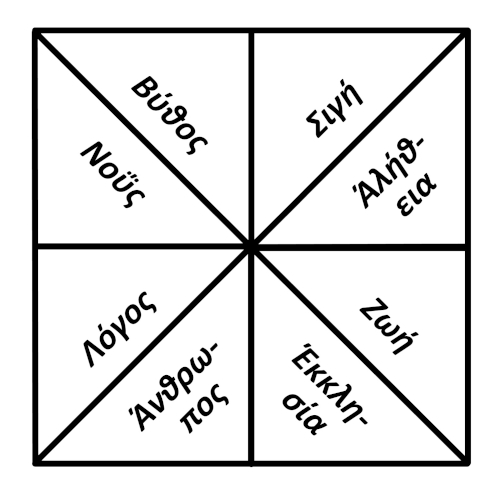
The Gnostic Ogdoad is a group of eight divine beings or emanations that were central to certain Gnostic cosmologies. The divisions of the Gnostic Ogdoad vary depending on the specific Gnostic system, but generally, they consist of four pairs of male and female aeons, or divine beings.

Here is one example of the divisions of the Gnostic Ogdoad [note: some of my Greek names at right are different. See refs. below.]:

  1. Barbelo and Bythos: Barbelo represents the divine feminine aspect of the highest deity, while Bythos represents the divine masculine aspect. Together, they represent the ultimate unity and transcendence of the divine.
  2. Nous and Aletheia: Nous represents divine mind or wisdom, while Aletheia represents truth. Together, they represent the intellectual and rational aspects of the divine.
  3. Logos and Zoe: Logos represents divine word or speech, while Zoe represents life. Together, they represent the creative and life-giving aspects of the divine.
  4. Anthropos and Ecclesia: Anthropos represents the divine human or perfect man, while Ecclesia represents the divine assembly or church. Together, they represent the human and social aspects of the divine.

It’s important to note that different Gnostic systems may have different variations or interpretations of the Ogdoad, and some may not include all eight divine beings.

Further Reading (not by ChatGPT):

https://en.wikipedia.org/wiki/Aeon_(Gnosticism)

https://en.wikipedia.org/wiki/Ogdoad_(Gnosticism)

https://en.wikipedia.org/wiki/Valentinianism

Previously I wrote about a different, earlier Ogdoad:

The Ogdoad: Unity of Eight Gods

[*9.223]


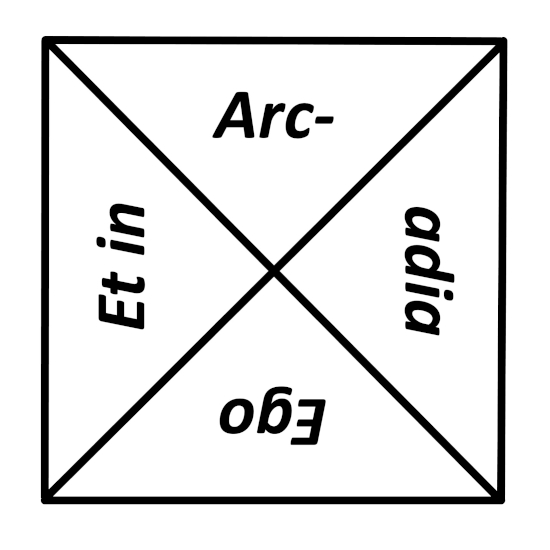
Et in Arcadia Ego

Further Reading:

https://en.wikipedia.org/wiki/Et_in_Arcadia_ego

https://en.wikipedia.org/wiki/Et_in_Arcadia_ego_(Guercino)

https://en.wikipedia.org/wiki/Memento_mori

https://en.wikipedia.org/wiki/Mono_no_aware

https://en.wikipedia.org/wiki/Sic_transit_gloria_mundi

https://en.wikipedia.org/wiki/Vanitas

[*10.70]

<>


Georgia Guidestones, RIP

Georgia Guidestones
Born: March 22, 1980
Died: July 6, 2022

Let These Be
Guidestones
to an Age
of Reason (*)

Capstone with (*) written in Four Ancient Languages

    • Cuneiform
    • Hieroglyphics
    • Greek
    • Sanskrit

Ten Recommendations (**) about

    • Population
    • Environment
    • Governance
    • Spirituality

Four Upright Stones with (**) written in Eight Modern Languages

    • English and Spanish
    • Swahili and Hindi
    • Hebrew and Arabic
    • Chinese and Russian

One Center Stone supporting Capstone for Three Astronometries

    • Finding the Celestial Pole
    • The Sun’s Annual Travel
    • Sun’s Position at Noon over the Year

Fear no more the heat o’ the sun,
Nor the furious winter’s rages;
Thou thy worldly task hast done,
Home art gone, and ta’en thy wages:
Golden lads and girls all must,
As chimney-sweepers, come to dust.

– William Shakespeare (from Cymbeline)

Further Reading:

https://en.wikipedia.org/wiki/Georgia_Guidestones

https://www.coastalbreezenews.com/news/a-new-world-order-for-the-few-left-behind/article_c811714a-69c5-5889-8cc6-8ce58f7c991a.html

https://www.onlineathens.com/story/news/local/2022/07/11/georgia-guidestones-elbert-county-talk-rebuilding-after-monument-destroyed/10014859002/

https://www.wired.com/2009/04/ff-guidestones/

https://www.poetryfoundation.org/poems/50428/song-fear-no-more-the-heat-o-the-sun-

<>


The Diamond Approach Design Method

Again, I have taken a diagram and bent it into my preferred vision. At least the original figures have isosceles right triangles to begin with. However, they were in a left-to-right sequence (ordered by time) instead of a cycle as I have done. On many diagrams of the diamond approach there are indeed loops that return the user to positions earlier in the sequence so I don’t feel too bad.

The steps that are part of the diamond approach are reminiscent of other learning cycles, such as that of Kolb. The original left-to-right sequence emphasizes the order, as well as showing that steps may be divergent or convergent (analytic or synthetic) in their methods. Instead I have denoted divergence by arrows facing away from each other and convergence by arrows facing towards each other.

    • Discover (divergent)
    • Define (convergent)
    • Develop (divergent)
    • Deliver (convergent)

The main creator of the Diamond Approach is A. H. Almaas, who has written many books on spirituality or esoteric subjects such as the Enneagram. Being a skeptical sort, I have no idea if the notions and methods in these books are worth your time, but the goals indeed sound laudable. How do they differ from psychoanalysis, psychotherapy, or other techniques to improve mental health? Further reading may be required before you pay for classes and retreats.

Further Reading:

https://www.diamondapproach.org/home

https://www.diamondapproach.org/almaas

https://en.wikipedia.org/wiki/A._H._Almaas

https://www.google.com/search?q=the+diamond+approach+design+method&tbm=isch

[*13.74, *13.75]

<>

Four-Dimensional Vistas

The Fourth Dimension has been an interest of mine since I was a child. I’m not sure when I first heard about it, but I still have my coverless copy of “Geometry of 4 Dimensions” by Henry Parker Manning that I bought in a used book store. (I wonder why it hasn’t ever been reissued by Dover?) Maybe I heard about the fourth dimension in some science fiction TV movie, or in some mathematical survey book like “Mathematical Snapshots” or “Mathematics and the Imagination”.

Once I tried to explain to my best friend about my newly discovered insight how a hypercube could be folded up in four-dimensional space from its so-called three-dimensional net consisting of eight cubes, just as a regular three-dimensional cube could be folded up from its two-dimensional net of six squares. This 3D net somewhat resembling a cross is famously seen in Dali’s “Crucifixion (Corpus Hypercubus),” although I probably didn’t refer to this painting in my explanation.

I’m not sure who came up with the take-away message from my exposition, but it remains clear in my memory that the “junk in the middle” of the hypercube was a piece of the fourth dimension, just as the faces of a cube enclose a piece of our normal third dimension.

I recently came across Claude Fayette Bragdon, architect, author, draughtsman, stage designer, and mystic. At first I was interested in his drawings found on-line. His book “Four-Dimensional Vistas” started off with a good if overly wordy introduction to the concept of the fourth dimension. But then he suggests that many esoteric concepts such as the meaning of dreams, reincarnation, past-life regression, prognostication, ESP, etc. could possibly be explained by higher dimensional space or even higher dimensional time.

Even though I initially found many of these hypotheses too far-fetched for my tastes, I still found some interesting ideas to mull over in this little book.

Further Reading:

https://en.wikipedia.org/wiki/Claude_Fayette_Bragdon

https://www.gutenberg.org/ebooks/author/4128

https://theosophy.wiki/en/Claude_Fayette_Bragdon

Claude Fayette Bragdon

https://rbscp.lib.rochester.edu/bragdon-family-papers-claude-bragdon-architectural-drawings

The art of Claude Fayette Bragdon, 1866–1946

https://rbscp.lib.rochester.edu/3514

https://bauarchitecture.com/research.loshuworldofwonderous.shtml

Claude Fayette Bragdon / Four-Dimensional Vistas (1930)

Claude Fayette Bragdon / The Beautiful Necessity (1910)

Claude Fayette Bragdon / Architecture and Democracy (1918)

For my gratuitous anime tie-in, Bragdon’s world-view suddenly reminds me of the anime character  Haruhi Suzumiya, who wished for her aliens, time-travelers, and ESPers so much that she willed them into being. If only she had known about the fourth dimension!

https://reelrundown.com/animation/Anime-Philosophy-1-Melancholy-of-Haruhi-Suzumiya

[*3.139, *12.121, *13.50]

<>


The Four Worlds of the Kabbalah

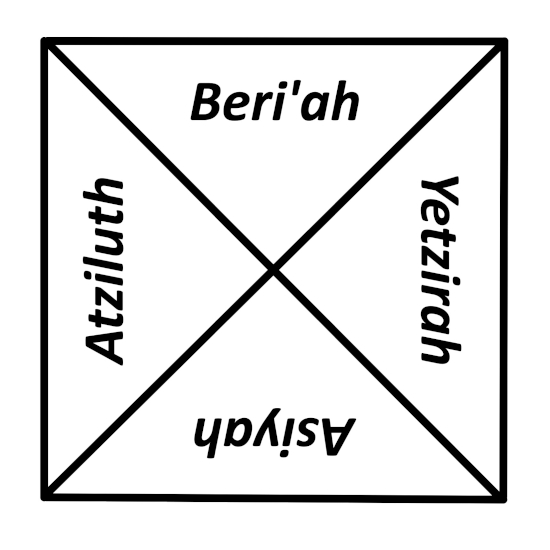
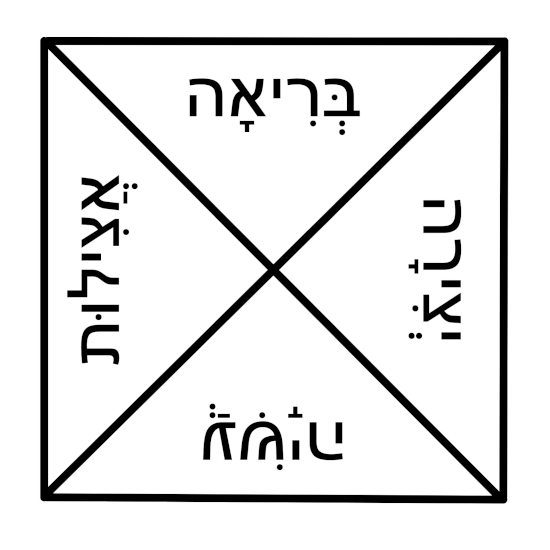
The Kabbalah (correspondence) is a traditional and esoteric school of thought in Jewish mysticism. The ten Sephirot (emanations) of the Kabbalah in the Tree of Life diagram can be divided into Four Worlds as follows, and correspond with the Four Suits of the Tarot and the Four Elements:

  • Atziluth (אֲצִילוּת): World of Emanation (Wands, Fire, Spirit)
  • Beri’ah (בְּרִיאָה): World of Creation (Swords, Air, Intellect)
  • Yetzirah (יְצִירָה): World of Formation (Cups, Water, Emotion)
  • Asiyah (עֲשִׂיָה): World of Manifestion (Disks, Earth, Action)


Further Reading:

https://en.wikipedia.org/wiki/Four_Worlds

https://en.wikipedia.org/wiki/Kabbalah

https://en.wikipedia.org/wiki/Tree_of_life_(Kabbalah)

And:

The Four Worlds

Four Worlds Judaism

http://www.yashanet.com/studies/revstudy/rev6.htm

Alan Bain’s Thirty Two Paths of Wisdom

Also:

https://en.wikipedia.org/wiki/Promethea

<>

The Tao of Thoth

Ethan Indigo Smith’s recent book, “The Tao of Thoth,” is a companion to a previous book of his I reviewed, “The Matrix of Four“. But instead of dwelling on fourfolds from ancient and esoteric sources, this book’s appeal to me is mainly for eightfolds. The sources are again traditional and occult, and indeed the title’s constituents come from ancient Asian and Egyptian cultures. Smith encourages us to contemplate these venerable concepts to reclaim simplicity in our lives and move away from any unnecessary complexity of modern life.

Certainly Smith is legitimate in critiquing present-day institutions and mentalities that valorize profit and consumption over ecological and humanitarian well-being. Can we learn from ancient cultural precepts and use them to heal the earth as a whole as well as enhance the health of our own lives, our descendants lives, and that of our follows? We seem to be avoiding the simple fact that current lifestyles are unsustainable for the earth and even harmful to our own psyche.

The first chapter introduces us to the Taiji, or Yin Yang, as well as the Tao of Asian study. The “Tao of Thoth” is also introduced and seems to be the relationship between the Taiji and the Tenets of Thoth (also referred to as Thoth Energy). Several claims are then made as to their separate and related simplicity and applicability. The next two chapters deal with this so-called Thoth Energy and the Taiji in more detail.

In Chapter 1 the Egyptian god Thoth is described in some detail, and his connection to gods in other mythologies, both Eastern and Western. The term Thoth Energy seems to describe the principles conceptualized by his attributes. That these principles are found in separate traditions is indicative our common humanity, rather than cultural approbation (maybe except for continuity between the Egyptian (Thoth), Greek (Hermes), and Roman (Mercury) gods). Next the Eight Trigrams of the Bagua and the eight deities of the Ogdoad are discussed.

A list of the Seven Tenets of Thoth close the chapter: Mentalism, Correspondence, Vibration, Polarity, Rhythm, Cause and Effect, Gender, and their relationship to the Tao. Hermetic and occult principles are often associated with individual self-development and not social coherence common to institutions. These tenets are the Seven Hermetic Principles mentioned in Chapter II of the Kybalion. Hermeticism is also deeply connected with Alchemic principles.

Chapter 2 discusses the Tao, Taiji (Yin Yang), and Taiji practice (Tai Chi). The Eight Layered Body is mentioned (the physical body, the chi body, the emotional body, mental body, psychic body, causal body, body of individuality, and the body of Tao). The next seven chapters deal with the seven hermetic principles which are hinted to align with Taoist principles as well, but do they do so in clear ways? Perhaps I need to study both the Kybalion and the Taiji in depth before I understand their connection.

And so briefly:

  • Chapter 3 (Mentalism) mentions The Eightfold Path.
  • Chapter 4 (Correspondence) mentions the Seven Minor Physical Planes (Chapter VIII of the Kybalion).
  • Chapter 5 (Vibration, Chapter IX of the Kybalion) mentions the Eight Limbs of Yoga.
  • Chapter 6 (Polarity, Chapter X of the Kybalion) mentions the Eight Energies or Gates of Taiji and the fourfold Known Knowns.
  • Chapter 7 (Rhythm, Chapter XI of the Kybalion) mentions the Bagua and Eight Taiji Principles.
  • Chapter 8 (Cause and Effect, Chapter XII of the Kybalion) mentions the Eight Auspicious Symbols of Buddhism.
  • Chapter 9 (Gender, Chapter XIII of the Kybalion, and Mental Gender, Chapter XIV) mentions the Eight Auspicious Offering Bowls and the Eight Secrets of the Tao Te Ching.
  • In Chapter 10, I am certainly glad that Smith rounded out the Seven Tenets to Eight with Patience. Mentioned are Chakras and the Spectrum of Light and the fourfold Wu Wei. In contrast, the last Chapter XV of the Kybalion deals with “Hermetic Axioms,” discussing several of the principles together.

After each chapter discussing a tenet, Smith suggests a Taiji or Taiji-inspired meditative practice that embraces a core concept: standing meditation, champion posture, shaking, arm swinging (Renunciation/Reintegration, Evaporation/Condensation), spiraling balance, pressurization, integrating Yin and Yang, walking.

It would be nice to have a bibliography and index included in this book, as many sources are mentioned and it would be convenient to have it as a quick reference. I must say that I didn’t find this short book as rewarding as “The Matrix of Four,” nevertheless, I found it worth reading and it piqued my interest for trying Tai Chi.

Further Reading:

Ethen Indigo Smith / The Tao of Thoth

https://en.wikipedia.org/wiki/Tao

https://en.wikipedia.org/wiki/Tai_chi

https://en.wikipedia.org/wiki/Thoth

https://en.wikipedia.org/wiki/Book_of_Thoth

https://en.wikipedia.org/wiki/Hermeticism

The Three Initiates / The Kybalion

https://en.wikipedia.org/wiki/The_Kybalion

https://www.sacred-texts.com/eso/kyb/index.htm

http://www.gutenberg.org/ebooks/14209

https://en.wikipedia.org/wiki/Absolute_(philosophy)

[*12.50, *12.51]

<>


The Twelve Houses of the Zodiac

How does one circumscribe the totality of human experience, both for the individual as well as for culture? One of the oldest ways is the twelvefold division of the Houses of the Zodiac, which may have its origins in Babylon. Other similar systems were used in India, China, Europe, etc. In my diagram above I’m using Latin numerals along with the Latin names of the houses.

For Western Astrology, four groups of three houses are divided by the four classical elements and then into triplicities (from Wikipedia):

  • Fire : Identity (I, V, IX)
  • Earth : Material (II, VI, X)
  • Air : Social and intellectual (III, VII, XI)
  • Water : Soul and Emotional (IV, VIII, XII)

And somewhat similarly for India, the divisions of Vedic Astrology are broken into four Bhavas or “needs” (from Wikipedia):

  • Dharma : (Duty) The need to find our path and purpose
  • Artha : (Resources) The need to acquire the necessary resources and abilities to provide for ourselves to fulfill our path and purpose
  • Kama : (Pleasure) The need for pleasure and enjoyment
  • Moksha : (Liberation) The need to find liberation and enlightenment from the world

There are more recent and scientific divisions of human universals, such as those by George Murdock, Robin Fox, and Donald Brown, as mentioned by Jungian analyst Anthony Stevens in his book “Archetype Revisited”. These are also grouped into four categories (from Wikipedia):

  • Language and cognition
  • Technology
  • Society
  • Beliefs

Further Reading:

https://en.wikipedia.org/wiki/House_(astrology)

https://en.wikipedia.org/wiki/Hindu_astrology

https://www.dimension1111.com/astrology-the-houses.html

https://en.wikipedia.org/wiki/Cultural_universal

https://en.wikipedia.org/wiki/Anthony_Stevens_(Jungian_analyst)

Anthony Stevens / Ariadne’s Clue: a guide to the symbols of mankind

Note that John Crowley’s “AEypgt Quartet” uses the Latin names of the Houses as “books”, three to a volume.

Ægypt Tetralogy

[*11.156]

<>