All posts by Martin K. Jones

The Scientific Method

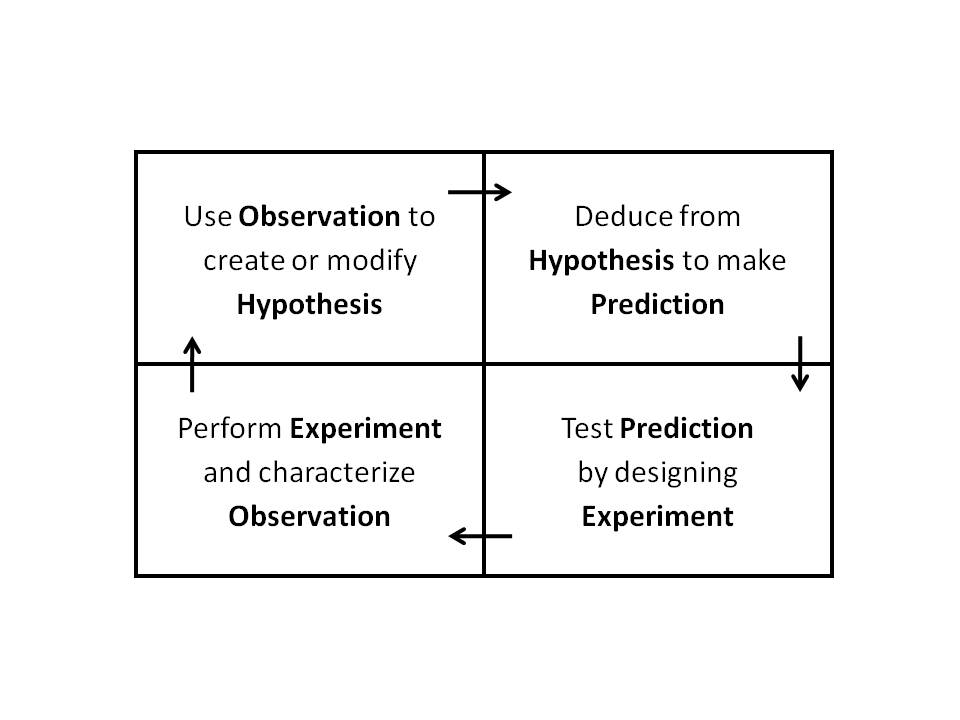
The Scientific Method (SM) is often shown as a cycle of four steps: Observation, Hypothesis, Prediction, and Experiment. This cycle is somewhat similar to Kolb’s Learning Cycle, but there are important differences. Experiment is in both, but in Kolb Experience is the result of Experiment, and in the SM, Experiment follows Prediction. I think that Prediction would ideally be a part of both, and in the SM, Experience could be included in Observation.  Perhaps Kolb’s Active Experimentation is really SM’s Prediction and Kolb’s Experience is SM’s Experiment.

References:

http://en.wikipedia.org/wiki/Scientific_method

[*6.24, *7.26]

<>

Linear Logic: the dualities

The meaning of the logical rules is to be found in the rules themselves.

J. Y. Girard in “On the Meaning of Logical Rules I: syntax vs. semantics”

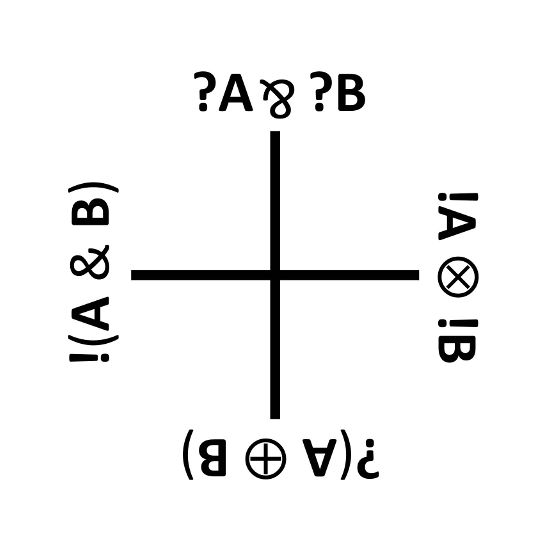
There are two types of dualities in linear logic. Linear negation () carries the conjunctions to the disjunctions and back again, as equivalences (≡), like De Morgan’s laws in classical logic.Additionally, the exponentials ? and ! link the additives and the multiplicatives, as linear biconditionals (o—o).

[*5.146, *7.8]

<>


Lucretius: On the Nature of Things

But, now again to weave the tale begun,
All nature, then, as self-sustained, consists
Of twain of things: of bodies and of void
In which they’re set, and where they’re moved around.
For common instinct of our race declares
That body of itself exists: unless
This primal faith, deep-founded, fail us not,
Naught will there be whereunto to appeal
On things occult when seeking aught to prove
By reasonings of mind. Again, without
That place and room, which we do call the inane,
Nowhere could bodies then be set, nor go
Hither or thither at all- as shown before.

—  From On the Nature of Things by Lucretius

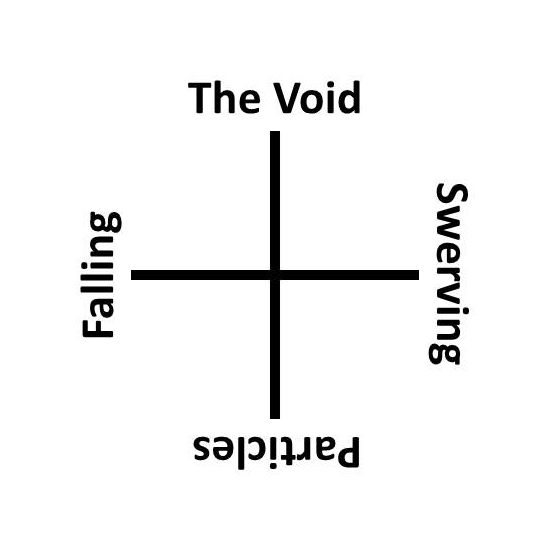
A book on the  rediscovery of  the ancient Epicurean poem “On the Nature of Things” by Lucretius has recently been published. “The Swerve: how the world became modern” by Stephen Greenblatt looks quite interesting. The fourfold above was inspired by the previous fourfold Spacetime. A very nice NPR review can be found below.

Further Reading:

http://www.npr.org/books/titles/140464239/the-swerve-how-the-world-became-modern

http://classics.mit.edu/Carus/nature_things.1.i.html

To Do:

Change swerving to veering.

[*7.18]

<>

Spacetime

What is space? Is space merely extension? What makes up extension, but a set of locations?

What is time? Is time merely duration? What makes up duration, but a series of successions?

Is space a void for things to be located in, or do things create the space between them?

Is time a continuance for events to happen in, or do events create the time that joins them?

Does space and time exist objectively, or only subjectively? Are they absolute or are they relative?

Does space and time enframe all that exists? Does anything exist outside of space or time? How could we know if it did?

What is spacetime? Is it space plus time, disjoint, or is it a reciprocal enfolding of space and time, so that neither can exist without the other?

[*7.4]

<>

Carl Jung’s Psychological Types

Carl Jung’s Psychological Types can be thought of as different mental states: Intuition, Sensation, Cognition, or Emotion, or as different events in the mind: Intuiting, Sensing, Thinking, and Feeling. I’m not sure why intuition and sensation is often paired with thinking and feeling, as it seems to mix tenses.

In Jung’s theory, intuition and sensation are considered perceiving or irrational functions, and thinking (cognition) and feeling (emotion) are considered judging or rational functions. In opposition to great quantities of scholarship, I believe that intuition is more rational than feeling, as well as intuition being a subjective choice as opposed to feeling being ordered choosing, or choice integrated over time. Similarly, thinking is sensing integrated. Thus perception is the substance of the form of judgment, and rationality and irrationality both bridge perception and judgment.

These distinctions are also the basis for the Myers-Briggs Type Indicator, a psychological test and classification based on four dichotomies: extraversion-introversion, sensing-intuition, thinking-feeling, and judgment-perception, each choice of which determines a person’s attitude, perception, judgment, and lifestyle. There are thus sixteen different personalities measured by this assessment.

This is sixteenfold less than the 256 different philosophical personalities represented by the Archic Matrix. It would be interesting if someone would create a Myers-Briggs type test for philosophers that would serve the same function for the Archic Matrix. Initial question: can the 16 personalities encoded by the MBTI, the 256 philosophical personalities encoded by the Archic Matrix, and the 64 Hexagrams of the I Ching be linked?

Further Reading:

http://thezodiac.com/soul/elements/cornerstones.htm

http://malankazlev.com/kheper/topics/Jung/typology.html

http://www.personalitypage.com/four-prefs.html

http://www.mindstructures.com/2010/08/intuition-sensing-thinking-and-feeling/

http://psychclassics.yorku.ca/Jung/types.htm

https://en.wikipedia.org/wiki/Psychological_Types

[*5.189, *7.2]

<>


William Blake’s Four Zoas

Now I a fourfold vision see
And a fourfold vision is given to me
Tis fourfold in my supreme delight
And three fold in soft Beulahs night
And twofold Always. May God us keep
From Single vision & Newtons sleep.

— By William Blake, in a letter to Thomas Butts

The dark Religions are departed & sweet Science reigns.

— From “The Four Zoas” by William Blake

William Blake’s Four Zoas arranged by the Four Elements. Most references associate Urizen to Reason, Luvah to Feeling, Tharmas to Sensation, and Urthona to Intuition. This means Air is Reason, Fire is Feeling, Earth is Intuition, and Water is Sensation. However, I follow others that associate Air to Reason, Fire to Intuition, Earth to Sensation, and Water to Feeling. Another puzzle to consider.

References:

William Blake / The Book of Urizen

http://en.wikipedia.org/wiki/Vala,_or_The_Four_Zoas

http://ramhornd.blogspot.com/search/label/Four%20Zoas

http://ramhornd.blogspot.com/2010/03/fourfold-vision.html

http://www.mindfire.ca/Mind%20on%20Fire%20-%20Blake%20-%20The%20Fourfold%20Vision.htm

http://www.128path.org/pathtimes/article4.html

http://www.psyche.com/psyche/cube/cube_blake.html

http://www.astrostar.com/Four-Elements.htm

[*6.188, *6.190, *6.192, *8.38]

<>

Plato’s Divided Line

How to display Plato’s Divided Line? Instead of a continuous line going from low to high as it is usually shown, I’ve shown it as two continuous crossed lines, a fourfold or double dual. Eikasia (imagining) and Pistis (belief) together are Doxa, the phenomenal. Dianoia (understanding) and Noesis (knowledge) together are Episteme, the intelligible. Doxa should indeed be horizontal, corresponding to the phenomenal of Richard McKeon’s Aspects of Knowing, and the subjective or content of other double duals. I believe Eikasia should come before Pistis, as the substance and form of content in Hjelmslev’s Net. Considering the vertical axis, Episteme as Dianoia and Noesis should surely be there for Plato, corresponding to McKeon’s ontic. But how do Dianoia and Noesis relate?

By the measure of the Aspects of Knowing or the Archic Matrix, Dianoia could be considered the method/knowledge and Noesis the reality/knowable of Plato’s Divided Line. Thus Dianoia should be above Noesis, as method/knowledge is above reality/knowable. Yet by other measures, that of the Here and Now or Hjelmslev’s Net, Noesis should be above and Dianoia below. Noesis is the form to the substance of Dianoia. Dianoia can also be thought of as meroscopic, reducing all to number and quantity, and Noesis can be thought of as holoscopic, combining all thing into the hierarchy of forms that culminate in that ultimate form, “The Good”.

The difficulty may be because the lower position, here Noesis, serves both as the position of the real in some fourfolds, as well as the position of earth and matter in others. This is a bias that I would like to avoid, but a resolution will need to come later.

References:

http://en.wikipedia.org/wiki/Analogy_of_the_Divided_Line

Images of Plato’s Divided Line:

https://www.google.com/search?udm=2&q=plato%27s+divided+line&sa=X

[*6.158-*6.165, *6.186]

<>

Stephen C. Pepper’s World Hypotheses

References:

Stephen C. Pepper / World Hypotheses: a study in evidence

http://en.wikipedia.org/wiki/World_Hypotheses

[*4.124, *5.22, *5.70]

<>

Archic Matrix: Principles

Creative cause functioning by virtue of (indeterminate) potentiality transcend what is given, functioning caused is without limit different for different things, indeterminate in kind of functioning caused
Elemental cause functioning by virtue of (determinate) potentiality immanent in what is given, from which the functioning emerges same for all things, all things are the same in their being
Comprehensive cause functioning by virtue of actuality (of totality) transcend what is given, functioning of all things transcends any given thing same for all things, all things are differentiated parts of same whole
Reflexive cause functioning by virtue of actuality (of functionality) immanent in what is given, as the functioning itself different for different things, determinate in kind of functioning caused

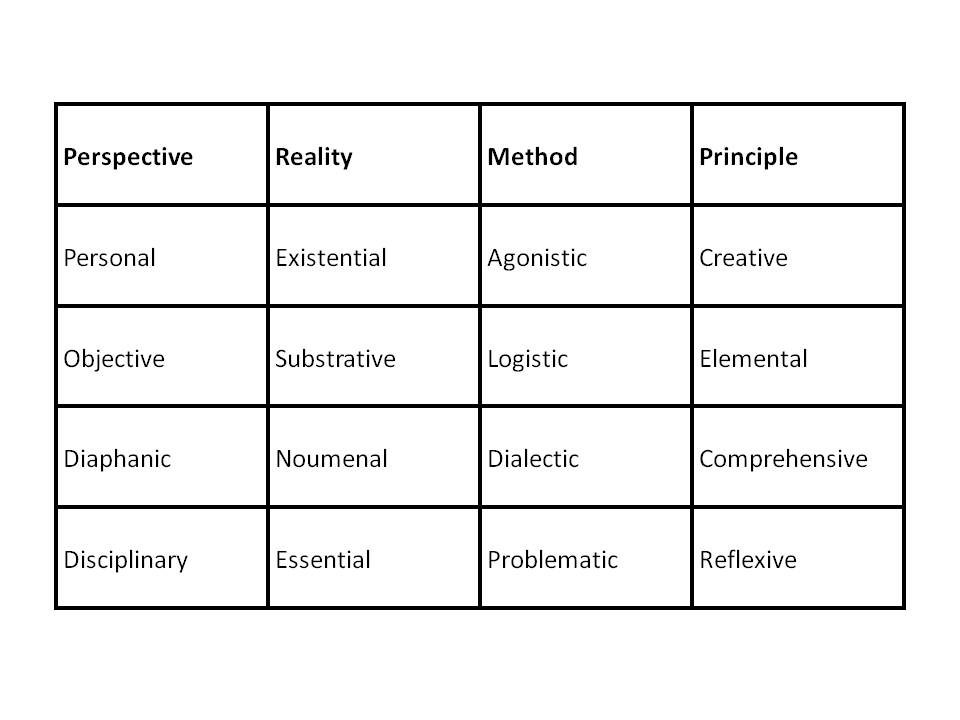
Since the Archic Matrix can be thought of as the union of four separate fourfolds, each of the fourfolds of perspective, reality, method, principle can be considered on its own. Here is the fourfold of principles consisting of creative, elemental, comprehensive, and reflexive principles. The content of the table and the bottom figure is derived from Walter Watson’s Architectonics of Meaning.

[*6.146-*6.148]

<>

Archic Matrix: Methods

Agonistic parts are primary, producing whole through endeavors two voices are tested against each other to organize whole close off intermediate wholes because of external forces
Logistic parts are primary, producing whole while remaining same one voice beginning from determinate towards determinate whole extend towards ultimates (least parts)
Dialectic whole determines parts directly two voices are united with each other to organize whole extend towards ultimates (all-inclusive whole)
Problematic whole determines parts reciprocally one voice beginning from indeterminate towards determinate whole close off intermediate wholes because of own internal unity

Since the Archic Matrix can be thought of as the union of four separate fourfolds, each of the fourfolds of perspective, reality, method, principle can be considered on its own. Here is the fourfold of methods consisting of agonistic, logistic, dialectic, and problematic methods. The content of the table and the bottom figure is derived from Walter Watson’s Architectonics of Meaning.

[*6.146-*6.148]

<>