All posts by Martin K. Jones

A Game of Fourfolds, Part 5

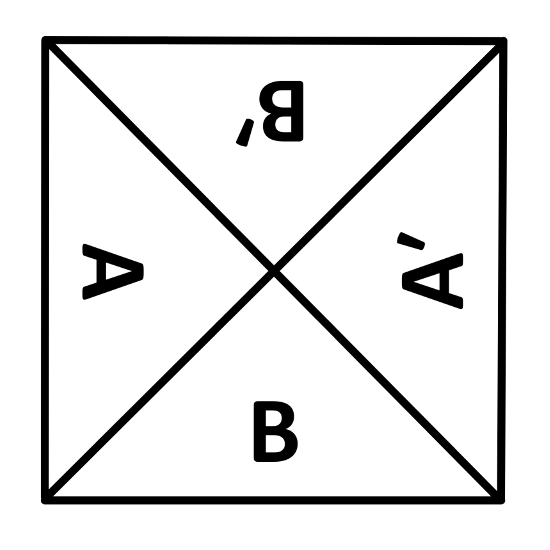
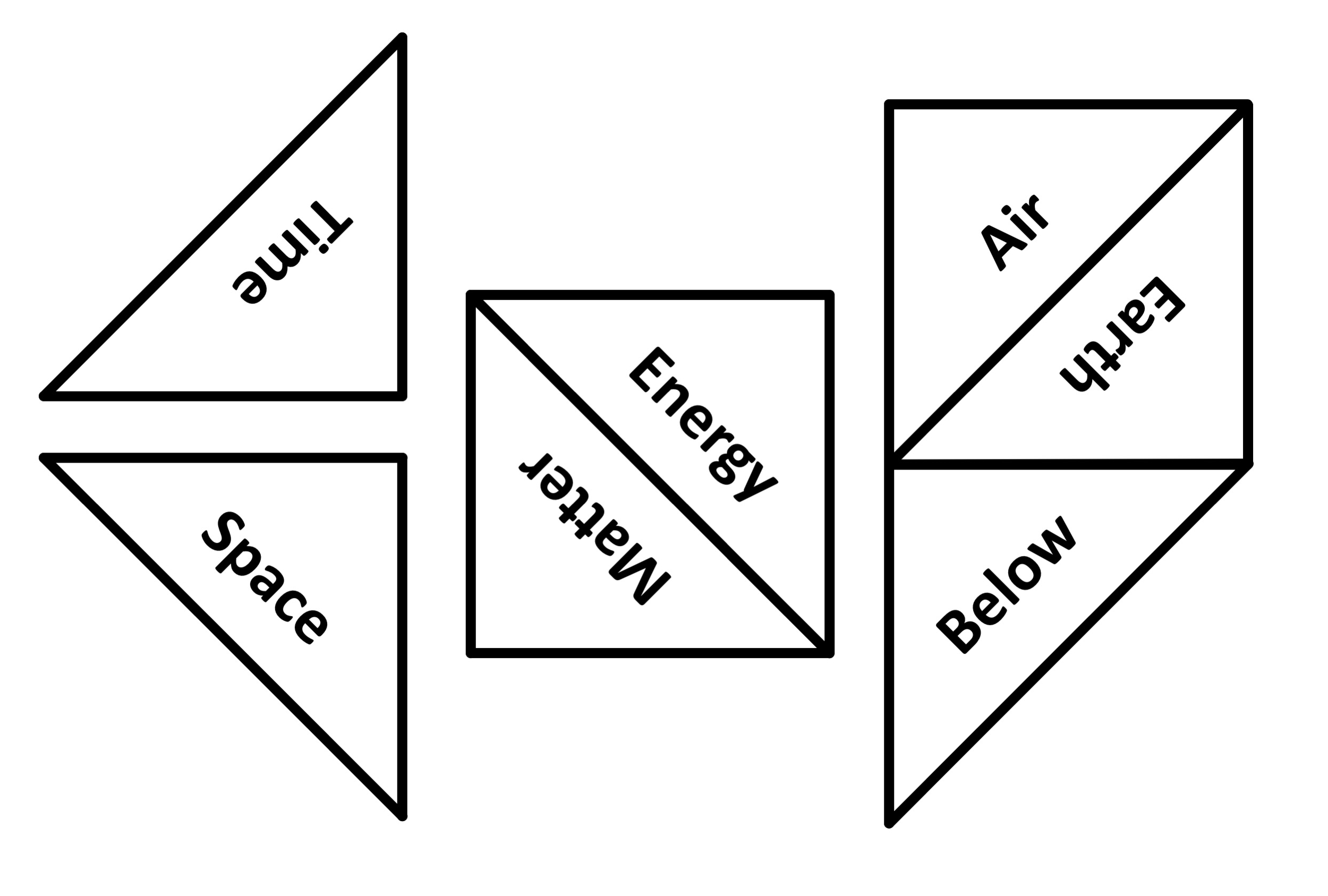
In this fifth installment of our ongoing series, I propose that a game could be played by making a set of equally sized and shaped triangular tiles with simple words or phrases on them. The triangles are all isosceles right triangles, also called monoboloes, so that two of them joined along their long edge would be a square, and four of them joined at their right angles would be a larger square. Figures of two tiles joined along any edge of equal length are called diaboloes, three are called triaboloes, four are called tetraboloes, and in general the figures are called polyboloes (or also polytans, after the Chinese tangram puzzle).

The words or short phrases on the monoboloes would need to be chosen judiciously so that each word has a matching opposite. (A list of such pairs of opposites or duals can be found at my previous fourfold game post.) This is so that a square diabolo could be formed from opposites, and a square tetrabolo could be formed that makes some conceptual sense. In fact, the game play would require that tiles should only be played and joined if there was a rational or explainable reason for their combination.

For example, “Water” and “Fire” could be aligned along their long edge as well as a short edge, whereas “Earth” and “Below”, not being opposites, could only be aligned along a short edge. Opposites could also be aligned “corner” to “corner” (where corner is the 90 degree angle), if there is a supporting tile between them.

During game play, the players alternate playing tiles from their hand onto the table, or pick tiles up from the table and place them back in different positions. Obviously the rules of play would need to be specified in more detail, as well as a method for scoring so that a player could “win”. Or, as a game of solitaire, perhaps winning is just maximizing the number of tiles played onto the table, or the illumination of concepts brought about by the play.

I might also consider that the flip-side of a monobolo is the same word but perhaps having white letters on a black background or colored differently to distinguish it from the “front”. And would the flip-sides all be of the same color? As I have shown various fourfolds on this blog, I have tried to orient them in a common conceptual “direction”, although that is often not clear to me or agreed upon by others of similar temperament. Perhaps they could be the same color if they metaphorically point this same way.

Also, by design and by construction, the monoboloes could be considered “Words”, diaboloes could be considered “Thoughts”, triaboloes could be considered “Actions”, and tetraboloes could be considered “Things”. This would be more in line with the hierarchy given by Richard McKeon’s 1972 lectures on Aristotle’s “Topics”. Words, thoughts, actions, and things are called “commonplaces” by McKeon, or a “place within which inquiry about meanings that are about things that are covered by that meaning can take place”.

The association of these tiles with tangrams is an interesting one. The standard tangram set consists of two small tans (unitans?), three bitans (square, midtan?, and paratan?), and two tetratans that form larger tans (bigtans?). I wonder if there is a standard nomenclature for these pieces, because mine seems rather silly.

I used to have a tangram set when I was a child and even still have an old Dover book by Ronald C. Reed “Tangrams: 330 puzzles”. It’s nice to see that it’s still available on Amazon. Of course the arrangement of the pieces in tangrams is much more flexible than what I’m proposing here for my game so really they are very little alike.

Further Reading:

http://mathworld.wolfram.com/Polyabolo.html

https://en.wikipedia.org/wiki/Tangram

https://en.wikipedia.org/wiki/Two-factor_models_of_personality

Richard McKeon / Disciplines, Arts, and Faculties: Invention and Justification: Topics, Lectures given at University of Chicago 1972. (Taped, Transcribed and Edited by Patrick F. Crosby, by private communication)

Notes:

Possible names for tile combinations:

  • Unit, Solitary, Unitary, Simple, Singular, Singleton
  • Binary, Duplex, Dual, Twofold, Bipartite
  • Triple, Threefold, Ternary, Trinity, Tripartite
  • Quaternary, Quadruple, Tetrad, Fourfold, Quadripartite

[*10.72]

<>

Fourfold Physicalism

It is not enough for a wise man to study nature and truth, he should dare state truth for the benefit of the few who are willing and able to think. As for the rest, who are voluntarily slaves of prejudice, they can no more attain truth, than frogs can fly.

— From Man a Machine, by Julien Offray de La Mettrie

Further Reading:

https://equivalentexchange.wordpress.com/2012/07/03/structure-function/

https://equivalentexchange.wordpress.com/2013/10/09/things-happen/

https://equivalentexchange.wordpress.com/2014/02/01/relations-all-the-way-down/

https://equivalentexchange.wordpress.com/2015/06/09/four-primary-relations/

https://en.wikipedia.org/wiki/Man_a_Machine

Notes:

Structures are built from parts.
Parts are reductions of structures.
Functions are assembled from actions.
Actions are the constituents of functions.

[*8.132, *9.104, *10.10]

<>

Enlightenment Now!

I want a new enlightenment and I want it now! One replete with:

  • Humanism
  • Reason
  • Science
  • Progress

Or, at least I can read the book.

Further Reading:

Steven Pinker / Enlightenment Now: The Case for Reason, Science, Humanism, and Progress

http://www.playboy.com/articles/playboy-profile-steven-pinker

Pinker’s twitter feed:

[*10.70]

<>


Seven Sermons to the Dead, Part 2

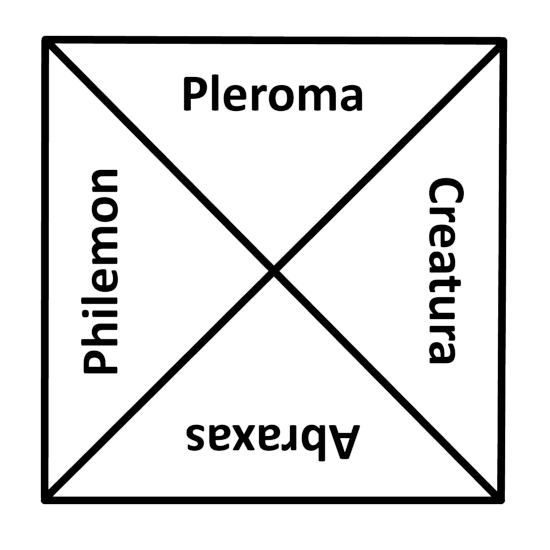
Here with inadequate description is another fourfold of entities from Seven Sermons to the Dead.

  • The Pleroma: The spiritual universe as the abode of gods and of the totality of the divine powers and emanations.
  • The Creatura: The living world, subject to perceptual difference, distinction, and information
  • Abraxas: The supreme power of being transcending all divinities and demons and uniting all opposites into one
  • Philemon: Jung’s spiritual guide, the narrator

Further Reading:

https://en.wikipedia.org/wiki/Seven_Sermons_to_the_Dead

https://en.wikipedia.org/wiki/Pleroma

https://en.wikipedia.org/wiki/Abraxas

Who is Philemon?

[*10.76]

Seven Sermons to the Dead

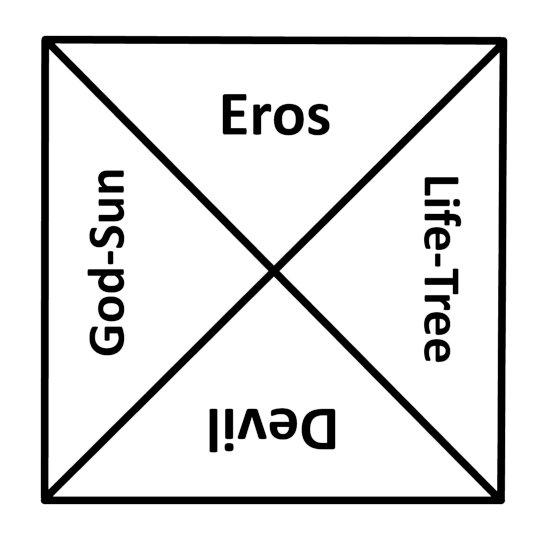
Four is the number of the principal gods, as four is the number of the world’s measurements.

One is the beginning, the god-sun.

Two is Eros; for he bindeth twain together and outspreadeth himself in brightness.

Three is the Tree of Life, for it filleth space with bodily forms.

Four is the devil, for he openeth all that is closed. All that is formed of bodily nature doth he dissolve; he is the destroyer in whom everything is brought to nothing.

— Carl Jung, from Seven Sermons to the Dead

Further Reading:

http://gnosis.org/library/7Sermons.htm

https://jungiangenealogy.weebly.com/seven-sermons.html

https://en.wikipedia.org/wiki/Tree_of_life

[*10.76]

<>

Every Fourth Thing

And thence retire me to my Milan, where
Every third thought shall be my grave.

— Prospero, from The Tempest

Every single action.

Every other word.

Every third thought.

Every fourth thing.

Further Reading:

Things, Thoughts, Words, and Actions

On Things, Thoughts, Words, and Actions

Notes:

I should have ordered this fourfold by 1: words, 2: thoughts, 3: actions, 4: things, as per Richard McKeon. But, I have my reasons.

[*9.164]

<>

The World Values Survey

For a number of years, very interesting research in cultural studies has been produced by the World Values Survey. This survey measures the slippery notion of value as belonging to four types: Survival, Traditional, Self-Expression, and Secular-Rational.

Individual and social values are quantified, resulting in two pairs of value types that are independent, and for each pair, the two types are dependent and inversely proportional:

  • Survival values ⇔ Self-expression values
  • Secular-rational values ⇔ Traditional values

In other words, if survival values are high (say one), self-expression values are low (say zero), and if survival values are low, self-expression values are high. Similarly, secular-rational values are higher if traditional values are lower, etc. So a pair of numbers each between zero and one indicates how an individual or society considers the importance of these values.

These social values are measured and compared in countries around the world, resulting in the Inglehart-Welzel Cultural Map. This map is a scatter plot that clusters similar countries by value pairs, rather than geography. However, countries close in geography are also often fairly close as “value” neighbors on this cultural chart.

One might try to claim that self-expression values and secular-rational values are more “advanced” than survival and traditional values. As a culture obtains more material wealth they are less dependent on using resources for survival, and so can foster more self-expression. Then perhaps as self-expression grows and so independent thought, less dependence on or even tolerance of traditional values encourages increased secular-rational values. But that would be too easy!

Further Reading:

https://en.wikipedia.org/wiki/World_Values_Survey

https://en.wikipedia.org/wiki/Inglehart–Welzel_cultural_map_of_the_world

World Values Survey on Twitter:

[*9.170]

<>

Atom and Archetype

A few weeks ago I ran across this nice review of the book Atom and Archetype: the Pauli-Jung letters 1932-1958. This is a collection of letters exchanged between psychiatrist Carl Jung and physicist Wolfgang Pauli over a course of years. Evidently, Pauli was quite the metaphysician and Jung was intrigued by Einstein’s physics of relative space and time. Together in dialectic they argued and struggled to join together the disparate notions of mind and matter.

What mainly caught my eye was a diagram that I’ve slightly altered and shown above. I’ve mainly just replaced energy with matter-energy for two reasons: first because matter and energy are inter-convertible and second because matter conditions space. This results in similarity to the fourfold diagram for Lucretius that I’ve shown before, consisting of Particles, the Void, Falling, and Swerving.

Further Reading:

https://www.brainpickings.org/2017/03/09/atom-and-archetype-pauli-jung/

Carl Jung and Wolfgang Pauli / Atom and Archetype: the Pauli-Jung letters 1932-1958, Princeton University Press; Updated edition (July 21, 2014)

https://equivalentexchange.wordpress.com/2011/10/10/lucretius-on-the-nature-of-things/

https://equivalentexchange.wordpress.com/2014/02/17/matter-energy-space-and-time/

https://equivalentexchange.wordpress.com/2015/01/16/wave-particle-duality/

https://equivalentexchange.wordpress.com/2012/05/04/noethers-theorem/

[*10.60]

<>

The Four Mythological Beasts

Another item for my fourfold menagerie is the four symbolic mythological beasts of China. They are associated with the Four Cardinal Directions and the Four Seasons.

  • The Vermilion Bird (South, Summer, named Zhūquè or Ling Guang)
  • The Azure Dragon (East, Spring, named Qīnglóng or Meng Zhang)
  • The Black Turtle (North, Winter, named Xuánwǔ or Zhi Ming)
  • The White Tiger (West, Fall, named Báihǔ or Jian Bing)

They are also part of Japanese folklore and I show the Japanese names of these four god beasts to the right, mostly because I am more familiar with them: Suzaku, Seiryu, Genbu, and Byakko.

Further Reading:

https://en.wikipedia.org/wiki/Four_Symbols_(China)

http://tvtropes.org/pmwiki/pmwiki.php/Main/TheFourGods

https://allthetropes.org/wiki/The_Four_Gods

http://readingjapanesehistory.blogspot.com/2010/03/four-gods-protecting-kyoto.html

http://koei.wikia.com/wiki/Four_Gods

https://en.wikipedia.org/wiki/Twenty-Eight_Mansions

Notes:

It was nice to see the Four Beasts in the opening ceremony at the 2018 Winter Olympics in South Korea.

[*8.104, *10.64]

<>


Kant’s Synthetic-Analytic Distinction, V3

One of the oldest and most problematic philosophical questions is the comparison of the a prioria posteriori distinction with that of the analyticsynthetic distinction. Both are used in epistemology to divide knowledge, or true statements, between the innate and the learned, or the immediate and the earned, so they might even be considered the same. A priori and a posteriori statements are before “experience” and after it, respectively. Analytic statements are true only by their “meaning”, whereas synthetic statements are true only when facts about the world are combined consistently with that meaning.

It seems we have complicated the issue because now we must define and understand “experience” and “meaning”. However, these concepts are not independent because we must experience meaning, and meaning in turn conditions experience. In addition, even the a priori or the analytic are not innate or immediately obvious because deductions and the rules of logic require effort just like inductions do. Otherwise we would have Fitch’s Paradox: all truths are in fact known. What a muddle! So both experience and meaning are necessarily locked into a cooperative spiral dance to improve each other.

In addition, if you search for the two pairs a priori-a posterior and analytic-synthetic, you also find that the pair necessary-contingent is associated with them. Are these three pairs independent of one another and so give rise to eight triplets, or are they dependent in some way and reduce into fewer combinations? In addition, from Wikipedia:

Thus, the relationship between aprioricity, necessity, and analyticity is not easy to discern. However, most philosophers at least seem to agree that while the various distinctions may overlap, the notions are clearly not identical: the a priori/a posteriori distinction is epistemological, the analytic/synthetic distinction is linguistic, and the necessary/contingent distinction is metaphysical.

The web site of Stephen R. Palmquist has a great wealth of material on fourfolds in relation to Kant’s as well as his own philosophy. From my own initial reading of his extensive material I have tried to choose a canonical Kantian fourfold which has the most relevance to my project.

The fourfold shown to the right Dr. Palmquist calls Kant’s “reflective perspectives on experience”. Consisting of the logical, the empirical, the transcendental, and the hypothetical, these facets bear a close analogical likeness to many of the fourfolds presented here.

Logical: Analytic a priori
Transcendental: Synthetic a priori
Hypothetical: Analytic a posteriori
Empirical: Synthetic a posteriorikant_table

Dr. Palmquist also has many of his own books available on his web site for the interested reader. I will certainly be returning to his web site in the future for much enjoyable study.

Further Reading:

http://en.wikipedia.org/wiki/Analytic-synthetic_distinction

http://en.wikipedia.org/wiki/A_priori_and_a_posteriori

A Priori-A Posteriori, Analytic-Synthetic, and Necessary-Contingent Distinctions

http://plato.stanford.edu/entries/analytic-synthetic/

A Priori and A Posteriori

http://plato.stanford.edu/entries/fitch-paradox/

http://www.philosophypages.com/hy/5f.htm

http://www.hkbu.edu.hk/~ppp/

http://www.hkbu.edu.hk/~ppp/ksp2/KCR3.htm

[*7.68, *7.84, *8.126, *10.54]

<>