All posts by Martin K. Jones

Crisis-Response and Covid-19

The RSA (Royal Society for the encouragement of Arts, Manufactures and Commerce) has written several articles recently on the ongoing impacts of Covid-19 on society. Their great-sounding motto is that the RSA “believes in a world where everyone is able to participate in creating a better future.” I’ve enjoyed several of their animated videos over time, with signature black and red colors and sped-up hand drawing illustrating a featured talk.

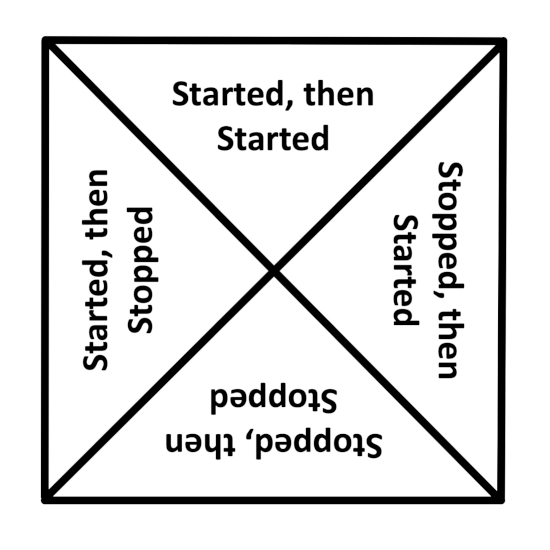
I’ve been meaning to read a few of their recent articles on Covid-19, but hadn’t until I spotted an interesting two-by-two matrix labeled Crisis-Response Measures. Actions or practices that are performed during and after a crisis are divided over four cells as to whether they are stopped or started in those two times. Thus we examine the actions or practices that are:

  • Jettisoned (Let Go): Stopped During Crisis, then Stopped Post-Crisis
  • Transitory (End): Started During Crisis, then Stopped Post-Crisis
  • Restarted: Stopped During Crisis, then Started Post-Crisis
  • Amplified: Started During Crisis, then Started Post-Crisis

When in the middle of a crisis, one often is so busy that there’s no time to think about what one should be or should not be doing, and to be in that situation is certainly poor planning. Plus we should try to determine what we should plan to be doing in the future, thus giving our planning a normative consideration. Just because we’ve been doing something before the crisis or began something because of it doesn’t mean we should continue.

Indeed, there may be few or even no reasons to go back to the old ways of doing things, and a crisis is a grand opportunity to change the bad and maybe find good new practices and institutions for maintaining them. Of course when good and bad are in great dispute you have a lot of difficulty in coming to a consensus of action. And being in the midst of a crisis is perhaps not the best of times to come to a meeting of the political minds.

Also, these charts don’t describe the actions that are transformations of old actions, only distinguishing them as being new or old. Anything started during the crisis is new (transitory and amplified) and anything stopped during the crisis is old (jettisoned and restarted). However, there are many great ideas in these essays and we certainly need to build bridges to a future that we can look forward to living in.

Further Reading:

https://www.thersa.org/

https://www.thersa.org/discover/publications-and-articles/rsa-blogs/2020/04/change-covid19-response

https://www.thersa.org/discover/publications-and-articles/rsa-blogs/2020/05/stabilisation-transition-bridges

<>

Everything is Four

Out of the None comes One,
out of the One comes Two,
and from the twain comes forth
the One as Four.

— Not the Axiom of Maria

How do you solve a problem like Maria?

— From The Sound of Music

Further Reading:

https://en.wikipedia.org/wiki/Axiom_of_Maria

https://www.wussu.com/laotzu/laotzu42.html

Everything is Four

[*12.18, *12.20]

<>


Scenario Thinking and Covid-19

Scenario Planning, Analysis, or Thinking is a technique for probing into possible futures when you are anticipating or overwhelmed by tumultuous challenges. One often starts by examining two factors that have both great Importance and Uncertainty and then considering two extremes of each. For their four different mixtures, you can posit causes, how to recover from bad outcomes, what actions would be favorable for all scenarios, etc. In other words, one can develop related stories about these different futures.

In these slides by authors Steven Weber and Arik Ben-Zvi, the two important and uncertain factors are Public Health and Economics, both affected by the Covid-19 pandemic, and for their initial purposes independent of each other. For public health, the disease could kill far more than estimated (a secondary wave) or kill less (vanish like a miracle). For the economic impact, the toll could be sustained (a long term depression) or the recovery could be relatively quick (v-shaped). So the two factors and their extremes are

    • Economic recovery is slow (depression, recession), or fast (v-shaped)
    • Health and death toll is worse (than estimates), or better (yay)

The four scenarios that are named are basically

    • Economy good, Health good: Americans Win
    • Economy bad, Health good: Fractured USA
    • Economy good, Health bad: Resilient USA
    • Economy bad, Health bad: Coronavirus Wins

and the scenario stories are told with respect to January of 2021 at the next state of the union address. Each of these scenarios are quite detailed and then followed by Insights and Implications for all. Often Scenario Thinking is used for more distant future analysis, but this shows it can be used for a mere nine months as well.

Further Reading:

https://www.linkedin.com/feed/update/urn:li:activity:6663482861041012737/

https://en.wikipedia.org/wiki/Scenario_planning

Continue reading Scenario Thinking and Covid-19

The Pi Calculus

My previous post on Wolfram’s physics mentioned the Pi calculus, but I liked this little diagram so much I decided to let it have its own mention. The rules aren’t really four in number, but oh well.

  • (νx)P: create a channel named x, then do P
  • x(y).P: receive y over channel x, then do P
  • x‾<y>.P: send y over channel x, then do P
  • P|Q: do P and Q at the same time
  • !P: do P over and over until stopped
  • 0: stop

Further Reading:

https://en.wikipedia.org/wiki/%CE%A0-calculus

https://en.wikipedia.org/wiki/Process_calculus

https://en.wikipedia.org/wiki/Game_semantics

https://golem.ph.utexas.edu/category/2009/08/the_pi_calculus.html

[*12.34]

<>


The Wolfram Physics Project

When I first started looking at Stephen Wolfram’s latest proposal to solve physics, I was somewhat disappointed. I was rather fond of his previous “New Kind of Science” based on the structural rigidity of cellular automata. However, I am now intrigued by his latest ideas, based on the looser but more flexible basis of networks.

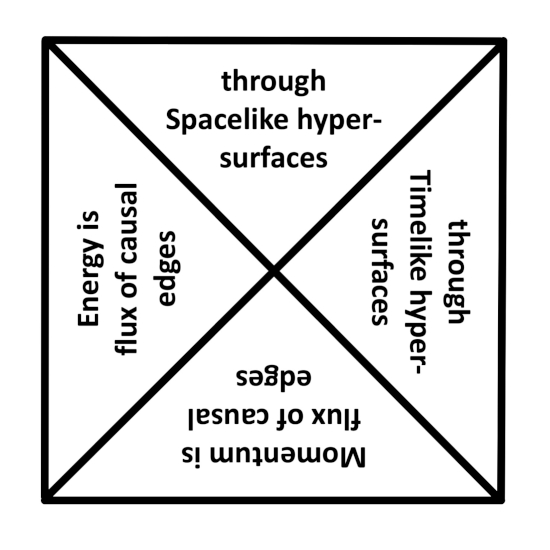
And once you have pithy statements with space, time, energy, and matter (as momenta), you catch my attention:

  • Energy is flux of causal edges
  • through Spacelike hypersurfaces
  • Momentum is flux of causal edges
  • through Timelike hypersurfaces

I confess I haven’t read much about the project yet, but it seems to be using rewriting rules, perhaps similar to the notion of rewriting in Wolfram’s previous framework, cellular automata. Of course, cellular automata and also rewriting rule systems can be computationally universal or Turing complete.

Another idea might be to try some sort of computational metaphysics between nodes like the pi-calculus (or some other process calculus). After all, you have to support quantum entanglement! However if you can encode everything with simpler structures then do it!

Further Reading:

https://www.wolframphysics.org/

https://www.wired.com/story/stephen-wolfram-invites-you-to-solve-physics/

How We Got Here: The Backstory of the Wolfram Physics Project

https://en.wikipedia.org/wiki/Digital_physics

https://www.scientificamerican.com/article/physicists-criticize-stephen-wolframs-theory-of-everything/

https://turingchurch.net/computational-irreducibility-in-wolframs-digital-physics-and-free-will-e413e496eb0a

View at Medium.com

Cellular automata:

https://en.wikipedia.org/wiki/Cellular_automaton

Note this quote for future reference:

The primary classifications of cellular automata, as outlined by Wolfram, are numbered one to four. They are, in order, automata in which patterns generally stabilize into homogeneity, automata in which patterns evolve into mostly stable or oscillating structures, automata in which patterns evolve in a seemingly chaotic fashion, and automata in which patterns become extremely complex and may last for a long time, with stable local structures. This last class are thought to be computationally universal, or capable of simulating a Turing machine.

Rewriting:

https://en.wikipedia.org/wiki/Rewriting

https://en.wikipedia.org/wiki/Semi-Thue_system

[*12.32]

<>

Who Do You Love?

Who do you love?
Who do you love?
Who do you love?
Who do you love?

— From Who Do You Love by Bo Diddley

The constituents of this list had pretty much congealed in my mind when I ran across information on the eight kinds of love. I thought that in this difficult time it might be useful to consider what is most important by examining all the people and all the things one can love as well as their myriad ramifications. Indeed, love may be the most considered and talked about emotion. Might one even say it is at the root of all of human action?

I know that in order to substantiate my claims I should justify these particular selections by comparing and contrasting them with each other, or to show their association to the eight kinds of love, and to do both would be a worthwhile effort. If I just show my diagram and my little list no one will think much of it. I could say I would return later but we all know how I tend to be distracted by the next bright shiny thing.

At the very least I could do some research, or do some hard thinking about why I’ve chosen these particular eight. I’m not sure if such diligence will reap any benefits but all one can do is try their best. So therefore I invite you to continue reading and perhaps you will be enlightened or perhaps you will be disappointed by what I say in the following analysis, if it even manages to appear at all.

I see that there are some modern analyses of love like Robert Sternberg’s Triangular Theory of Love, based on concepts of passion, intimacy, and commitment. This theory seems to be devoted to interpersonal relationships but maybe so is the Greek Eight types. But I’m thinking of love in a broader sense than just interpersonal, although maybe that doesn’t agree with certain definitions of love.

Love doesn’t have to reciprocated, of course, or directed towards another loving entity. For example, Agape is love of humanity in general, but humanity in general cannot return one’s love. One can also love negative things, like hate, or strife, or friction, and some even make a career out of it. But I’m going to leave that out for now. Alas, my interest has waned on this post and so I will have to try again at a later time.

  • Love of Self
  • Love of Leader
  • Love of Group
  • Love of Other
  • Love of Nature
  • Love of Ideas
  • Love of Gods
  • Love of Things

Further Reading:

https://en.wikipedia.org/wiki/Who_Do_You_Love%3F_(Bo_Diddley_song)

https://en.wikipedia.org/wiki/Triangular_theory_of_love

https://en.wikipedia.org/wiki/Category:Love

https://en.wikipedia.org/wiki/Category:Philosophy_of_love

[*11.76]

<>


The Adaptive Cycle

As we all wonder how the current world order will be transformed by the Covid-19 pandemic, perhaps now would be a good time to read up on the Adaptive Cycle. Worried about societal and economic collapse, I was originally thinking about the notion of social cycles, but came across this more general notion of cycles within ecological systems. It is also applicable to insightful investigation of social institutions and organizations.

The Adaptive Cycle is usually shown as a figure-eight loop, with four main segments (Growth, Maturity, Release, and Renewal), inhabiting a space of two or three variables (Potential, Complexity, and Resilience):

  • Growth or Exploitation: (r)
  • Maturity or Conservation: (K)
  • Release or Collapse: (Ω)
  • Renewal or Reorganization: (α)

Thus these charts indicate a closed trajectory of a system’s state within a state space over time. This concept was originally applied to cycles within ecological systems, measuring certain attributes of systems in order to predict their ability to handle, recover, and adapt from significant disruptive changes in environment, species populations, genetic landscape, etc.

These cycles can form steps on chains of greater systems where an individual cycle is a quasi-stable element but the overall state can jump and grow to higher forms of complexity and potential, or indeed collapse and fall to lower forms if the resilience is weak. As well, the multiplicities of cycles can represent a range of spacial scales for systems that have smaller cycles nested within them, operating concurrently.

This greater notion of change within systems has been called Panarchy. In contrast to hierarchy or even anarchy, Panarchy is neither the top-down or bottom-up of the other two. Panarchy tries to describe how actual ecological and social systems can change and transform yet endure and return to similar states, across scales of space and time.

Further Reading:

https://en.wikipedia.org/wiki/C._S._Holling

https://en.wikipedia.org/wiki/Adaptive_capacity

https://en.wikipedia.org/wiki/Panarchy

https://www.resalliance.org/

https://www.resalliance.org/panarchy

https://www.sciencedirect.com/science/article/pii/S1476945X1830165X

View at Medium.com

Images of the Adaptive Cycle:

https://www.google.com/search?q=adaptive+cycle&tbm=isch

Images of Panarchy:

https://www.google.com/search?q=panarchy&tbm=isch

Social Cycle Theory

https://en.wikipedia.org/wiki/Societal_collapse

https://en.wikipedia.org/wiki/Social_cycle_theory

[*12.24]

<>

The Eight Kinds of Love

There are several mentions of eight types of love purportedly discussed by the ancient Greeks, but I’m short on the actual references.

In no particular order:

  • Agape: unconditional love
  • Eros: romantic love
  • Philia: affectionate love
  • Philautia: self love
  • Storge: familiar love
  • Pragma: enduring love
  • Ludus: playful love
  • Mania: obsessive love

I had an earlier post on The Four Loves by C. S. Lewis, but now I see that he just left out half of them for some reason. Missing are Philautia, Pragma, Ludus, and Mania, which seem important, but since I haven’t read the book, I don’t know his reasons.

Further Reading:

8 Different Types of Love According to the Ancient Greeks

https://www.lifehack.org/816195/types-of-love

https://www.ftd.com/blog/give/types-of-love

https://www.organicauthority.com/energetic-health/learn-the-8-types-of-love-according-to-the-ancient-greeks

https://authorjoannereed.net/lets-talk-about-love-8-flavors-of-love/

<>


The Genetic Code

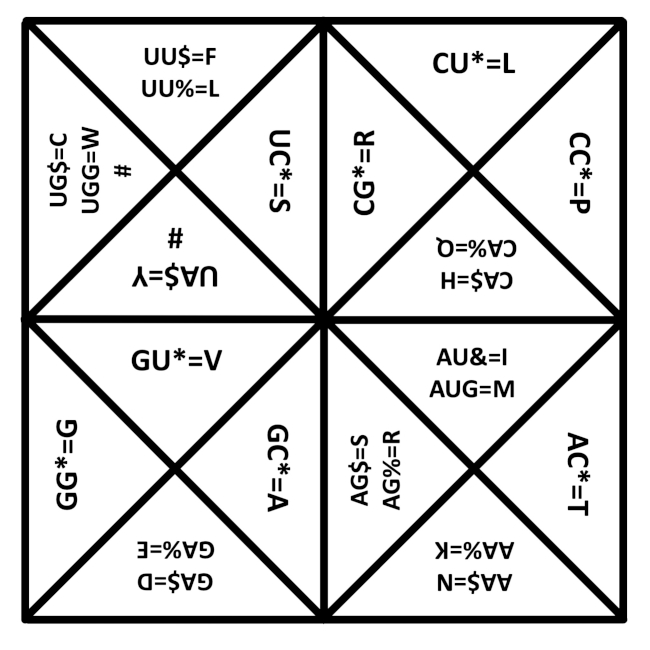
There are many ways to show the genetic code, the map between triplets of nucleotides and the amino acids of proteins. Here is one that may be a bit awkward to understand, but other more standard ones are easily found.

 First, here are the codes for the four nucleotides:

  • U = Uracil
  • C = Cytosine
  • A = Adenine
  • G = Guanine

As well, let

  • $ = U or C
  • % = A or G
  • & = U or C or A
  • * = U or C or A or G

And so, here are the amino acids and their nucleotide codes

A = Ala = Alanine = GC*
C = Cys = Cysteine = UG$
D = Asp = Aspartic Acid = GA$
E = Glu = Glutamic Acid = GA%
F = Phe = Phenylalanine = UU$
G = Gly = Glycine = GG*
H = His = Histidine = CA$
I = Ile = Isoleucine = AU&
K = Lys = Lysine = AA%
L = Leu = Leucine = UU% + CU*
M = Met = Methionine = AUG
N = Asn = Asparagine = AA$
P = Pro = Proline = CC*
Q = Gln = Glutamine = CA%
R = Arg = Arginine = CG* + AG%
S = Ser = Serine = UC* + AG$
T = Thr = Threonine = AC*
V = Val = Valine = GU*
W = Typ = Tryptophan = UGG
Y = Tyr = Tyrosine = UA$
# = Stop = UA% + UGA

Note that some letters encode both nucleotides as well as amino acids, which might be confusing.

Further Reading:

https://en.wikipedia.org/wiki/Genetic_code

[*10.146, *10.147]

<>

The Four Philosophy Ensemble

A woman came up to me and said
“I’d like to poison your mind
With wrong ideas that appeal to you
Though I am not unkind”
She looked at me, I looked at something
Written across her scalp
And these are the words that it faintly said
As I tried to call for help…

— From Whistling in the Dark, by They Might Be Giants

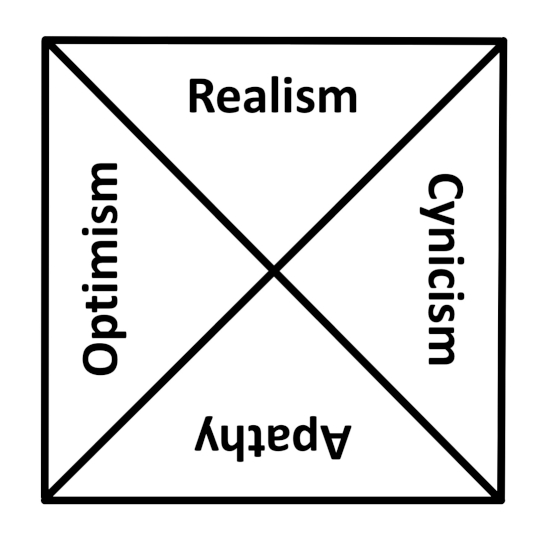
  • The Cynic
  • The Realist
  • The Optimist
  • The Apathetic

Further Reading:

https://tvtropes.org/pmwiki/pmwiki.php/Main/FourPhilosophyEnsemble

The Utopian vs. the Dystopian

https://en.wikipedia.org/wiki/Flood_(They_Might_Be_Giants_album)

https://genius.com/They-might-be-giants-whistling-in-the-dark-lyrics

Notes:

Since these pair up nicely (Realism and Apathy, Optimism and Cynicism), perhaps one could combine them as Optimistic Realism, Optimistic Apathy, Cynical Realism, Cynical Apathy.

<>