The Four Mythological Beasts

Another item for my fourfold menagerie is the four symbolic mythological beasts of China. They are associated with the Four Cardinal Directions and the Four Seasons.

  • The Vermilion Bird (South, Summer, named Zhūquè or Ling Guang)
  • The Azure Dragon (East, Spring, named Qīnglóng or Meng Zhang)
  • The Black Turtle (North, Winter, named Xuánwǔ or Zhi Ming)
  • The White Tiger (West, Fall, named Báihǔ or Jian Bing)

They are also part of Japanese folklore and I show the Japanese names of these four god beasts to the right, mostly because I am more familiar with them: Suzaku, Seiryu, Genbu, and Byakko.

Further Reading:

https://en.wikipedia.org/wiki/Four_Symbols_(China)

http://tvtropes.org/pmwiki/pmwiki.php/Main/TheFourGods

https://allthetropes.org/wiki/The_Four_Gods

http://readingjapanesehistory.blogspot.com/2010/03/four-gods-protecting-kyoto.html

http://koei.wikia.com/wiki/Four_Gods

https://en.wikipedia.org/wiki/Twenty-Eight_Mansions

Notes:

It was nice to see the Four Beasts in the opening ceremony at the 2018 Winter Olympics in South Korea.

[*8.104, *10.64]

<>


Kant’s Synthetic-Analytic Distinction, V3

One of the oldest and most problematic philosophical questions is the comparison of the a prioria posteriori distinction with that of the analyticsynthetic distinction. Both are used in epistemology to divide knowledge, or true statements, between the innate and the learned, or the immediate and the earned, so they might even be considered the same. A priori and a posteriori statements are before “experience” and after it, respectively. Analytic statements are true only by their “meaning”, whereas synthetic statements are true only when facts about the world are combined consistently with that meaning.

It seems we have complicated the issue because now we must define and understand “experience” and “meaning”. However, these concepts are not independent because we must experience meaning, and meaning in turn conditions experience. In addition, even the a priori or the analytic are not innate or immediately obvious because deductions and the rules of logic require effort just like inductions do. Otherwise we would have Fitch’s Paradox: all truths are in fact known. What a muddle! So both experience and meaning are necessarily locked into a cooperative spiral dance to improve each other.

In addition, if you search for the two pairs a priori-a posterior and analytic-synthetic, you also find that the pair necessary-contingent is associated with them. Are these three pairs independent of one another and so give rise to eight triplets, or are they dependent in some way and reduce into fewer combinations? In addition, from Wikipedia:

Thus, the relationship between aprioricity, necessity, and analyticity is not easy to discern. However, most philosophers at least seem to agree that while the various distinctions may overlap, the notions are clearly not identical: the a priori/a posteriori distinction is epistemological, the analytic/synthetic distinction is linguistic, and the necessary/contingent distinction is metaphysical.

The web site of Stephen R. Palmquist has a great wealth of material on fourfolds in relation to Kant’s as well as his own philosophy. From my own initial reading of his extensive material I have tried to choose a canonical Kantian fourfold which has the most relevance to my project.

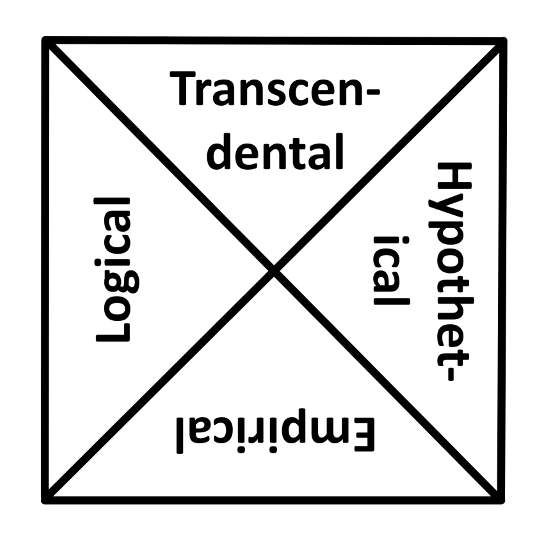
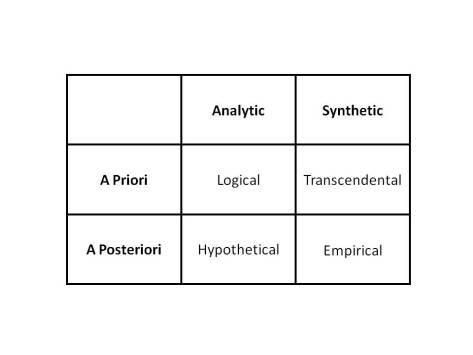
The fourfold shown to the right Dr. Palmquist calls Kant’s “reflective perspectives on experience”. Consisting of the logical, the empirical, the transcendental, and the hypothetical, these facets bear a close analogical likeness to many of the fourfolds presented here.

Logical: Analytic a priori
Transcendental: Synthetic a priori
Hypothetical: Analytic a posteriori
Empirical: Synthetic a posteriorikant_table
Dr. Palmquist also has many of his own books available on his web site for the interested reader. I will certainly be returning to his web site in the future for much enjoyable study.

Further Reading:

http://en.wikipedia.org/wiki/Analytic-synthetic_distinction

http://en.wikipedia.org/wiki/A_priori_and_a_posteriori

A Priori-A Posteriori, Analytic-Synthetic, and Necessary-Contingent Distinctions

http://plato.stanford.edu/entries/analytic-synthetic/

A Priori and A Posteriori

http://plato.stanford.edu/entries/fitch-paradox/

http://www.philosophypages.com/hy/5f.htm

http://www.hkbu.edu.hk/~ppp/

http://www.hkbu.edu.hk/~ppp/ksp2/KCR3.htm

[*7.68, *7.84, *8.126, *10.54]

<>
 

Fourier Analysis, V2

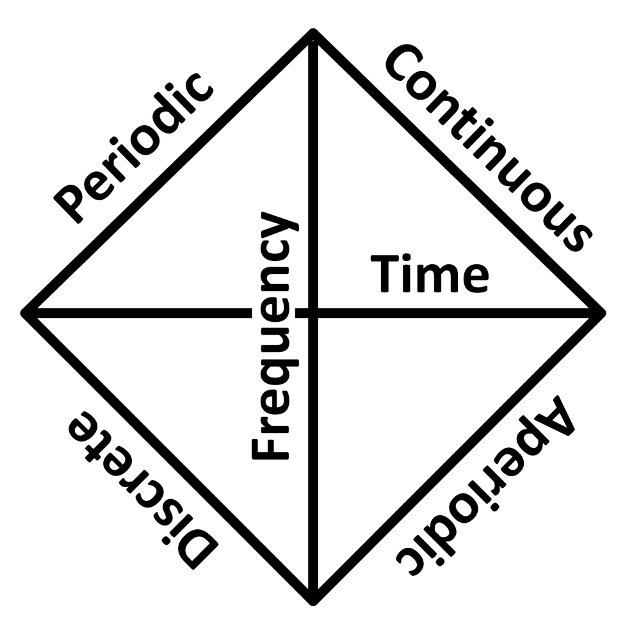
Here is another example of a fourfold, in the mathematics of Fourier Analysis. Here the four elements of our investigation resolve into Discrete Time, Continuous Time, the Fourier Series, and the Fourier Transform.

From the three dualities of Time – Frequency, Periodic – Aperiodic, and Discrete – Continuous, we obtain the four combinations Discrete Time/Periodic Frequency, Continuous Time/Aperiodic Frequency, the Fourier Series (Periodic Time/Discrete Frequency), and the Fourier Transform (Aperiodic Time/Continuous Frequency).

In the table below, T stands for Time and f for Frequency. The subscripts denote the attributes of each: D for Discrete, C for Continuous, P for Periodic, and A for Aperiodic. So T subscript C, f subscript A means that when Time is Continuous, Frequency is Aperiodic, etc. Please see Steve Tjoa’s web site for the equations for the Fourier Series and the Fourier Transform in Continuous and Discrete Time.References:

http://stevetjoa.com/633

http://en.wikipedia.org/wiki/Fourier_analysis

http://en.wikipedia.org/wiki/Fourier_series

http://en.wikipedia.org/wiki/Fourier_transform

[*7.74, *7.108]

<>

A Rosetta Stone

Abstract of Physics, Topology, Logic and Computation: A Rosetta Stone by John Baez and Michael Stay:

In physics, Feynman diagrams are used to reason about quantum processes. In the 1980s, it became clear that underlying these diagrams is a powerful analogy between quantum physics and topology: namely, a linear operator behaves very much like a “cobordism”. Similar diagrams can be used to reason about logic, where they represent proofs, and computation, where they represent programs. With the rise of interest in quantum cryptography and quantum computation, it became clear that there is extensive network of analogies between physics, topology, logic and computation. In this expository paper, we make some of these analogies precise using the concept of “closed symmetric monoidal category”. We assume no prior knowledge of category theory, proof theory or computer science.

  • Physics
  • Logic
  • Topology
  • Computation

Perhaps Category Theory is a “Fifth Essence”?

Further Reading:

Click to access rose3.pdf

https://arxiv.org/abs/0903.0340

[*9.168, *10.50]

<>

Speak, Listen, Write, and Read

Here’s another simple fourfold and maybe sixfold.

Speaking, Listening, Writing, and Reading are commonly presented together in elementary education as interrelated language skills. One is speaking for a listener and one is writing for a reader. One is listening to a speaker and one is reading a writer.

In the computer age another pair needs to be mentioned, that of programming for computers and the execution or running of that code by the computer. In a way, this new pair doesn’t fit, since one is writing code for computers, not people. And the execution of the program is not performed by a person, but by a computer.

(That’s not entirely true. Programs are also written for other human programmers in mind so that they can debug or maintain or modify the code if the original programmer isn’t available. Structured programming is one method to simplify the logical organization of the program so that others can comprehend it more readily. Object oriented programming is another method to allow multiple programmers to work independently without conflict.)

  • Speak – Listen
  • Write – Read
  • Program – Execute

But perhaps there is a different way to understand these duals. A speaker understands that a listener is following their speech by their response. A writer understands that a reader is comprehending their writing by their response. A programmer understands that a computer is ‘understanding’ the code by its response or output when the program is run.

Also, one can consider speech and writing to be encodings of thoughts into physical representations, and listening and reading to be decoding of the representations back into thoughts. Running or executing a program is not really decoding, or is it? But it is something like processing the speech or writing, like a computer is processing the program.

One might say that listening and reading are like processing the speech and text as programs on the computer of our brains. They are normally thought to be processed as data, as in Natural Language Processing, but it is an interesting twist if one considers them as programs. (Actually, I just recalled that the 1992 science-fiction novel “Snow Crash” by Neal Stephenson used this notion.)

To program effectively the programmer must execute their code in their mind, at least piecemeal and partially, just as a speaker or a writer must listen as they speak and read over what they have written. They can’t understand the full effect of the program’s execution, especially once the program becomes larger than a few statements, just as the full effect of speech or writing that is being processed by another person cannot be completely understood.

Not considered are computers themselves writing programs for other computers to “read” or execute. As the science of artificial intelligence becomes mature, computers writing and reading among themselves may become a common thing. Wasn’t there a news article about that recently? They pulled the plug on that pretty fast.

As digital assistants become more ubiquitous, they are fully participating in our language games of speaking, listening, writing, and reading. Will these so-called virtual assistants program for us next, as in Automatic Programming? That day may already be here.

Further Reading:

https://www.englishclub.com/learn-english/language-skills.htm

https://en.wikipedia.org/wiki/Natural_language_processing

https://www.theatlantic.com/technology/archive/2017/06/artificial-intelligence-develops-its-own-non-human-language/530436/

https://en.wikipedia.org/wiki/Automatic_programming

N. Katherine Hayles / My Mother was a Computer: digital subjects and literary texts

Neal Stephenson / Snow Crash

https://en.wikipedia.org/wiki/Virtual_assistant_(artificial_intelligence)

Images:

https://www.google.com/search?q=speak+listen+write+read&tbm=isch&tbo=u&source=univ&sa=X&ved=0ahUKEwi14LrrsarXAhUG6CYKHaugBH4QsAQIVQ

[*9.50, *10.36, *10.46]

<>

The Who, What, Where, When, Why, and How of Everything

I’ve mentioned several times the fourfold of Who, What, Why, and How, mostly because I perceive an association between it and Aristotle’s Four Causes: Who for Efficient Cause, What for Material Cause, Why for Final Cause, and How for Formal Cause.

Two other “W”’s, Where and When, weren’t mentioned because they add two more to the four, and don’t fit into the Four Causes anyway.

But evidently they are mentioned often with the first four, as the several links below indicate. These six questions are used in elementary education and even beginning journalism to elicit six answers. They also form three pairs as follows:

  • Who – What
  • Where – When
  • How – Why

Further Reading:

https://en.wikipedia.org/wiki/Five_Ws

Every Proposal Needs Six Elements: Who, What, Where, When, Why, and How. The Rest is Mere Commentary.

https://www.webhostingsecretrevealed.net/blog/web-copy-writing/the-who-what-where-when-and-why-of-excellent-blog-writing/

Other Images:

https://www.google.com/search?q=who+what+how+why+where+when&tbm=isch

[*10.46]

<>

Richard McKeon’s Aspects of Knowing, Part 2, V3

The duals in Richard McKeon’s system of Philosophical Semantics can also be arranged in a three-dimensional tetrahedron, where the dual pairs are on opposing edges. The universal and particular methods, the phenomenal and ontic interpretations, and the meroscopic and holoscopic principles are shown above.

Universal methods, between knower and knowledge, are applicable to all problems and all subject matters. Particular methods, between the knowable and the known, require distinct methodological procedures for different problems or subject matters.

Holoscopic principles, looking at the parts from the perspective of the whole, provide a coincidence of knowledge and known. Meroscopic principles, looking at the whole from the perspective of the parts, separate the knower and the knowable from each other and from influence between each other.

Ontic interpretations, between the knowable and knowledge, derive their character from a reality assumed to transcend or to underlie phenomena and statements. Phenomenal interpretations, between knower and the known, may reduce reality and values to aspects or consequences of phenomena.

Alternatively, the four vertices of  knower, knowledge, known, and knowable can be labeled by their method, principle, and interpretation as shown at right.

Further Reading:

http://www.richardmckeon.org/

http://en.wikipedia.org/wiki/Richard_McKeon

Notes:

As McKeon said in his lecture of  October 23, 1972 (the “Topics course”, unpublished): “You can either look at things from the point of view of the whole — then the principles are holoscopic (holos means whole, skopein means to look). Or, you can take the same set of facts, and view them from the part: then you have meroscopic principles. (Meros means part, skopein still means to look at).”

[*6.136]

The Duality of Time and Information, V3

The states of a computing system bear information and change time, while its events bear time and change information.

from The Duality of Time and Information by Vaughan Pratt

The most promising transformational logic seems to us to be Girard’s linear logic.

— from Rational Mechanics and Natural Mathematics by Vaughan Pratt

Here we have three duals:

  • Information – Time
  • States – Events
  • Bear – Change

Further Reading:

Vaughan Pratt / The Duality of Time and Information http://boole.stanford.edu/pub/dti.pdf

Vaughan Pratt / Time and Information in Sequential and Concurrent Computation http://boole.stanford.edu/pub/tppp.pdf

Vaughan Pratt / Rational Mechanics and Natural Mathematics http://chu.stanford.edu/guide.html#ratmech

[*5.170]

<>

The Philosopher’s Wheel

Eric A. Meece’s web site philosopherswheel.com has been in existence for a while, and it claims there is a forthcoming book called “The Philosopher’s Wheel”. This seems like an interesting project and it’s a shame that the book is still “in process”.

Meece has certainly been working on these ideas for a few years. Starting with a Master’s thesis in 1979, and a presentation in 2001, he also has a collection of articles available to the reader that are related to his theme.

The philosopher’s wheel is essentially composed of three polarities:

  • Materialism vs. Spiritualism
  • Rationalism vs. Empiricism
  • Essentialism vs. Existentialism

Two polarities are related to Jung’s Psychological Types:

  • Rationalism (Thinking)
  • Empiricism (Sensing)
  • Existentialism (Feeling)
  • Essentialism (Intuiting)

I’ve tried to represent these dualities a little differently than Meece. Note in the above diagram that Materialism mediates Rationalism and Empiricism, and Spiritualism mediates Essentialism and Existentialism, similar to the wheel representation.

At right is an attempt at eliminating the “isms”. Perhaps I should have read some more of his writings before making these efforts.

Further Reading:

http://philosopherswheel.com/

http://philosopherswheel.com/philosophycircle.htm

Notes:

The more I think about it, the more I like to compare this with

https://equivalentexchange.wordpress.com/2017/09/09/simon-magus-and-the-six-roots-of-boundless-power/

Images of the Philosopher’s Wheel:

https://www.google.com/search?q=philosopher%27s+wheel&tbm=isch

<>


Cassini

“Thanks, and farewell, faithful explorer.”

— Cassini program manager Earl Maize

Today, Cassini’s impetus succumbed to Saturn’s gravity.

Further Reading:

https://www.google.com/amp/amp.usatoday.com/story/667937001/

<>

Every Fourth Thing

Daydream Tourist

Because there are way more than seven wonders in the world.

The Digital Ambler

Always Forward Between Heaven and Earth

The Mouse Trap

Psychological Musings

Wrong Every Time

Critiquing anime and everything else

The Chrysalis

"For man has closed himself up, till he sees all things thro' narrow chinks of his cavern" -- William Blake

  Bartosz Milewski's Programming Cafe

Category Theory, Haskell, Concurrency, C++

The Inquisitive Biologist

Reviewing fascinating science books since 2017

Gizmodo

Every Fourth Thing

Simplicity

Derek Wise's blog: Mathematics, Physics, Computing and other fun stuff.

COMPLEMENTARY 4x

integrating 4 binary opposites in life, learning, art, science and architecture

INTEGRATED 4x

integrating 4 binary opposites in life, learning, art, science and architecture

Playful Bookbinding and Paper Works

Chasing the Paper Rabbit

Antinomia Imediata

experiments in a reaction from the left

Digital Minds

A blog about computers, evolution, complexity, cells, intelligence, brains, and minds.

philosophy maps

mind maps, infographics, and expositions

hyde and rugg

neat ideas from unusual places

Visions of Four Notions

Introduction to a Quadralectic Epistomology

Explaining Science

Astronomy, space and space travel for the non scientist

Log24

Every Fourth Thing

Ideas Without End

A Serious Look at Trivial Things

Quadralectic Architecture

A Survey of Tetradic Testimonials in Architecture

Minds and Brains

Musings from a Naturalist

Why Evolution Is True

Why Evolution is True is a blog written by Jerry Coyne, centered on evolution and biology but also dealing with diverse topics like politics, culture, and cats.

Quadriformisratio

Four-fold thinking4you

Multisense Realism

Craig Weinberg's Cosmology of Sense

RABUJOI - An Anime Blog

Purveyors of Fine Anime Reviews and Ratings Since 2010

Intra-Being

Between Subject and Object

The Woodring Monitor

Every Fourth Thing

FORM &amp; FORMALISM

Every Fourth Thing

Log24

Every Fourth Thing

The n-Category Café

Every Fourth Thing

THIS IS NOT A BLOG

Every Fourth Thing

PHILOSOPHY IN A TIME OF ERROR

Sometimes those Sticking their Heads in the Sand are Looking for Something Deep

Networkologies

Online Home of Christopher Vitale, Associate Professor of Media Studies, The Graduate Program in Media Studies, Pratt Institute, Brooklyn, NY.

Hyper tiling

Linking Ideas

DEONTOLOGISTICS

RESEARCHING THE DEMANDS OF THOUGHT

Incognitions

Explorations in the Paradoxes of Meaning

Object-Oriented Philosophy

"The centaur of classical metaphysics shall be mated with the cheetah of actor-network theory."

Objects & Things

objects & things, design, art & technology